Direct answer
Most cigarette filters are not harmless paper or cotton. They are commonly made from cellulose acetate, a plastic-like polymer that can fragment into smaller fibers after littering. Cigarette butts are repeatedly identified by NOAA and EPA as common aquatic and marine trash, and UNEP has treated plastic tobacco filters as a current plastic pollution issue. The practical answer is prevention first: do not flick butts onto streets, provide and maintain proper receptacles, keep outdoor smoking areas away from drains and waterways, record butt litter in cleanup data, question biodegradable or green-looking filter claims, and treat cleanup as a last layer rather than a substitute for source control.
Key points
- Cigarette filters belong in the plastic pollution conversation because many are made from cellulose acetate and can shed microplastic fibers.
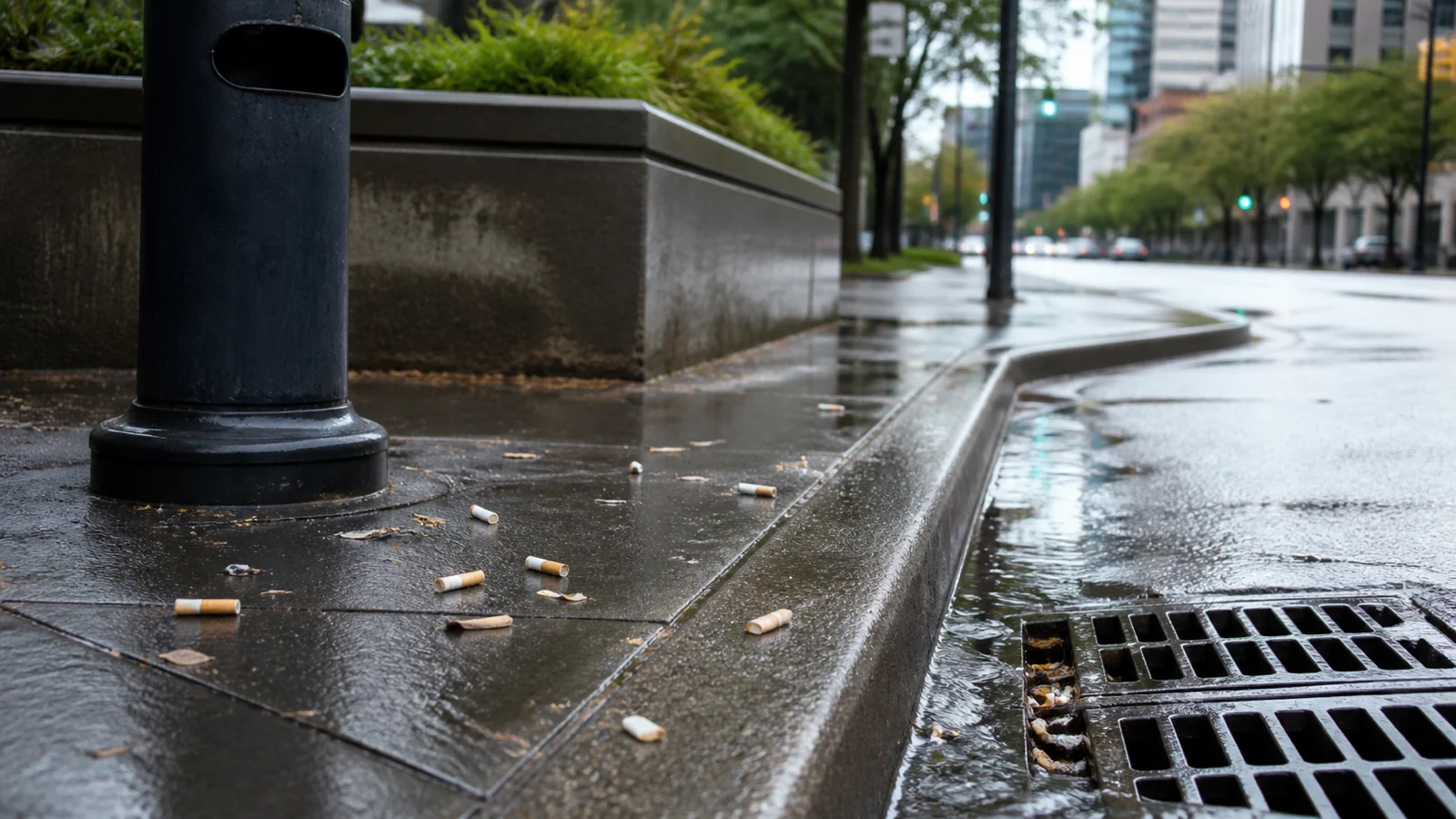
- Stormwater is a major pathway: a butt dropped on a sidewalk can move through drains, streams and rivers before reaching marine environments.
- Cleanup helps remove visible litter, but repeated deposition means prevention, receptacles, smoke-free zones, enforcement and producer responsibility matter more.
- Biodegradable, recyclable or filtered claims should be checked carefully because the practical issue is whether the butt is prevented, captured and managed.
- This article intentionally skips partner links because the topic is public environmental education, not a local service-industry reference.
Related Plastika Problema reading
- How plastic reaches the ocean - background on storm drains, streets, rivers and ocean leakage
- Wet wipes and hidden plastic - another example of a small item that can move through water systems when disposal claims are misunderstood
- Beach cleanups and source reduction - why cleanup evidence should lead to prevention instead of one-off volunteer events
- Plastic packaging greenwashing claims - a practical method for checking broad environmental words against evidence
- Plastic pellet pollution and stormwater - a related industrial example of tiny plastics moving through drains
- Action checklist - the core site checklist for practical plastic reduction habits
Why cigarette filters count as plastic pollution
Cigarette butts often look too small to deserve a plastic pollution article. That is part of the problem. A filter on a curb, in a planter, beside a beach path or near a storm drain can seem like ordinary street dirt rather than a manufactured plastic product. But many cigarette filters are made from cellulose acetate, a synthetic polymer formed into fine fibers. After use, the filter is also contaminated with residues from tobacco smoke. When it is littered, it is both a plastic item and a toxic waste concern.
NOAA's public ocean-service page describes cigarette butts as the most common form of marine litter and explains that many filters are made from cellulose acetate. NOAA also notes that sunlight can break the fibers into smaller pieces without making them disappear. EPA's Trash Free Waters guidance makes the stormwater pathway explicit: a cigarette butt dropped on the ground can wash into a storm drain and travel through a system that may lead directly to waterways. Those two ideas make the topic clear enough for a restored public-information site: this is not only an anti-litter message; it is a plastic leakage issue.
The point is not to shame individual smokers while ignoring systems. The point is to name the material and the route. If a single-use plastic cup, wipe, pellet or bottle cap deserves source-control attention, a plastic filter does too. It is small, frequently discarded, easy to move with rain, hard to recover after fragmentation, and widely misunderstood by people who assume it is biodegradable paper or cotton.
The direct answer for readers
If you want the shortest practical answer, it is this: cigarette filters should go into a proper waste receptacle after they are fully extinguished, not onto streets, beaches, drains, plant beds, gutters, riversides, parks or construction sites. Outdoor bins and ash receptacles should be placed where smoking actually happens, maintained before they overflow, and kept away from storm drains where possible. Cleanups should count butts separately because the item category can reveal hotspots that need design changes.
For venues, offices, hotels, cafes, bars, campuses, transit areas and public plazas, the operational question is not whether cigarette butts are ugly. It is whether the site has a capture system. Where do smokers stand? Where does rainwater flow? Are ash receptacles visible, smell-controlled and emptied often enough? Are staff expected to sweep butts into drains, which moves the problem rather than solving it? Is there a smoke-free perimeter near water? Is the cleanup team recording the item so management can see the scale of repeated litter?
For households and individuals, the action is simpler. Do not flick. Carry a pocket ashtray if no receptacle is available. Never treat a beach, street tree pit, curb or drain as disposal. If you organize a cleanup, record butts as a separate category instead of mixing them into general small trash. That small record can support better receptacle placement, city maintenance and policy decisions.
How butts move from pavement to water
The movement pathway is familiar from other plastic pollution topics on this site. A small item is dropped on land. Wind moves it toward a curb. Rain pushes it into a gutter. The gutter feeds a storm drain. Depending on the local system, stormwater may move rapidly to a canal, stream, river, lake, estuary or coastal water. Once the item is in water, recovery becomes harder. Once the filter fibers begin to separate, recovery becomes harder again.
This route matters because it corrects a common mental mistake. People often imagine marine debris as something thrown directly into the ocean. EPA's aquatic trash guidance describes how garbage littered on the ground can be carried by rain and wind into drains and waterways. Cigarette butts are a perfect example because they are small enough to disappear visually from a sidewalk but still persistent enough to remain an environmental item. A butt on a city street is not disconnected from a river simply because the river is not visible.
Stormwater also creates timing risk. During dry periods, many small items can accumulate near curbs, parking lots, outdoor smoking zones, street-food areas, transit stops and venue entrances. The first heavy rain can then move many of them at once. Prevention before rain is therefore more effective than cleanup after dispersal. Covered bins, ash receptacles, street sweeping, site rules and staff training are stormwater pollution controls when they stop filters from reaching gutters.
Why cleanup alone is not enough
Cleanup has real value. Removing cigarette butts from a beach, sidewalk, drain edge or park prevents some material from moving farther, lowers immediate exposure for wildlife and children, and makes the problem visible. NOAA encourages proper disposal, community cleanup documentation and pocket ashtrays as practical responses. Public cleanups can also change perception because many volunteers are surprised by how many butts appear when they look closely at sand, cracks in pavement and landscaped edges.
But cleanup is an incomplete strategy when deposition is constant. If smokers continue to use the same entrance, curb or riverside as an ashtray every day, volunteers can clear the site on Saturday and find it repopulated quickly. That is not a volunteer failure. It is a system signal. The hotspot needs a better default: a receptacle, a smoke-free zone, a staff routine, a business rule, a drain-protection measure, or enforcement where littering is repeated and deliberate.
This is the same source-reduction lesson used for bags, cups, pellets, wipes and packaging. Recovery matters, but prevention is cleaner. A butt that never reaches pavement does not need to be picked from a drain grate. A venue that provides a maintained receptacle beside a smoking area has a better chance of controlling the item than a city crew trying to recover small wet filters after rain has carried them across several blocks.
Health claims and filter misconceptions
A plastic pollution article should be careful not to become medical advice, but it should address one key misconception: a filter does not make the waste harmless. The WHO FCTC and UNEP have highlighted cigarettes with filters as containing microplastics known as cellulose acetate fibers, and WHO FCTC materials have also challenged tobacco-industry narratives around filters and environmental responsibility. For environmental education, the takeaway is straightforward: a filter is a single-use product that becomes contaminated waste after smoking.
That distinction matters for public communication. If a person believes the filter is cotton, paper or quickly biodegradable, flicking it may feel less serious than dropping a plastic bottle. If a venue treats cigarette butts as only a cleaning nuisance, staff may sweep them toward a gutter. If a cleanup report lists them under miscellaneous litter, the plastic-filter problem can disappear inside the data. Clear language helps: cigarette butts often contain plastic fibers, can persist, and should be captured before rain and runoff move them.
The article should not claim that every filter in every market is identical, and it should not overstate exact degradation timelines without source-specific evidence. It should make the practical conclusion: regardless of brand or filter design, a used cigarette butt should never be littered, washed into drains, composted, flushed, burned in open areas, or treated as a harmless biodegradable object.
Policy context: why the EU marks tobacco filters
The European Commission's single-use plastics marking page lists tobacco products with filters, and filters marketed for use with tobacco products, among the product categories covered by harmonised marking requirements. The purpose of those markings is to reduce environmental impact by informing consumers that certain products contain plastic and should not be disposed of improperly. That policy signal is important because it recognizes tobacco filters as part of the single-use plastic problem, not as ordinary paper litter.
The Commission's broader single-use plastics page also includes reporting measures for post-consumption waste from tobacco products with filters. For public-information readers outside Europe, the exact legal obligation may not apply locally, but the logic travels. If a product is frequently littered, contains plastic, and moves into waterways, policy can require clearer marking, better data, producer responsibility, cleanup-cost measures or product restrictions. The policy tool depends on the jurisdiction, but the material issue remains.
This is also why local governments should not wait for global treaty language before improving practice. A city can map hotspots, require receptacles at licensed venues, keep smoking areas away from drains, include butts in litter audits, and update public signs now. International policy can help, but curb-level design decides whether rainwater carries the next filter away tomorrow.
Greenwashing cautions around filters and disposal
Cigarette filter greenwashing can appear in several ways. A product may use natural-looking color, soft language, biodegradable wording, recycling language or cleanup sponsorship to imply that the waste problem is solved. The same caution used for packaging claims applies here: what is the material, under what conditions does it break down, what route collects it, what evidence supports the claim, and what happens if it is littered in a drain, river or beach environment?
A biodegradable claim is especially risky if it encourages littering. Even a product designed to break down under certain conditions can create harm when discarded in the wrong place, and the used filter is contaminated waste. A recycling claim also needs care because cigarette-butt recycling is not a normal household route in most places. NOAA notes that some programs exist, but that does not make recycling common or available everywhere. If a local program is absent, the practical instruction remains proper disposal and source control.
Cleanup sponsorship should also be read carefully. A company or venue can fund cleanups while still allowing repeated single-use filter litter to continue. A credible program measures reductions at hotspots, improves receptacle placement, trains staff, reports the number of butts collected, and changes the conditions that created the litter. A weak program photographs one cleanup and leaves the same curb to refill after the next busy night.
A checklist for venues, campuses and public spaces
Start with a site walk during real use, not during a quiet morning inspection. Mark where smokers stand, where butts collect, where rainwater flows and where staff clean. Check entrances, loading areas, bus stops, outdoor seating, parking edges, roofed smoking areas, beach paths, canal edges and staff-only back doors. The most important hotspot may be just outside a door where a receptacle is missing or inconvenient.
Then create a capture plan. Put ash receptacles where smoking actually happens, not where a manager wishes it happened. Keep them visible but not in conflict with smoke-free entrances. Empty them before odor or overflow creates avoidance. Do not place them where overflow can fall directly into a drain. Add drain awareness to cleaning instructions: staff should collect butts as solid waste, not hose or sweep them into gutters. If the site has a water edge, add extra checks before rain and after events.
Measure the result for one month. Count butts collected from receptacles, butts swept from hotspots, maintenance complaints, overflow incidents and cleanup time. If a hotspot does not improve, change the placement or rule. A practical cigarette-filter control system is not a poster. It is a visible loop: use area, receptacle, maintenance, cleanup data and management response.
A checklist for cleanups and citizen science
Cleanup teams should count cigarette butts separately because they are usually numerous, small and easy to underreport. Use gloves or tools, avoid direct handling, and follow local safety guidance for sharps or hazardous items. Record the date, weather, location type, distance from drains or water, nearby land use and whether receptacles were present. A simple map of repeated cigarette-butt hotspots can be more useful than a single large total.
The data should lead to a question: why here? A beach entrance may need a receptacle before the sand begins. A bus stop may need cleaning before rain. A bar street may need venue coordination. A park bench may need signage and maintenance. A river path may need a smoke-free zone or enforcement. If cleanup data only produces a social-media pile photo, the prevention opportunity is partly lost.
For schools and community groups, the educational message should be precise. Cigarette filters are not just ugly litter. They can contain plastic-like cellulose acetate fibers, move through stormwater and break into smaller pieces. The prevention action is proper disposal and source control, not treating the environment as a giant ashtray. Keep the message factual, not sensational, because credibility matters in public environmental education.
What households and individuals can do
The first household-level action is proper disposal. A cigarette butt should be fully extinguished and placed in a suitable waste receptacle. It should not be flicked from a balcony, car window, boat, beach chair or sidewalk. It should not be flushed. It should not be buried in sand. It should not be pushed into a planter or drain. If someone smokes away from receptacles, a pocket ashtray can prevent the common excuse that there was nowhere to put it.
The second action is social design. If smoking happens at home, in a workshop, outside a shop or at an event, put the receptacle where the behavior happens. Do not rely on good intentions across distance. The more steps between the smoking spot and the disposal point, the more likely litter becomes. Make the correct action easy and the wrong action unusual.
The third action is habit change beyond disposal. Reducing or quitting smoking has health implications that should be guided by qualified public-health sources, not by a plastic pollution blog. Still, from an environmental standpoint, fewer smoked cigarettes mean fewer filters entering the waste stream. Public-information writing can say that clearly while pointing readers to appropriate health support rather than pretending a litter checklist is health guidance.
What small businesses should document
Businesses with outdoor smoking areas can document cigarette-filter waste the same way they document other repeated operational waste. Count receptacle servicing, hotspot sweeping, customer complaints, drainage issues and cleanup hours. If the business has a sustainability policy, include butt litter under waste prevention rather than leaving it to janitorial notes. A small spreadsheet can reveal whether the main issue is receptacle absence, receptacle overflow, staff smoking location, customer behavior or event peaks.
Suppliers and waste contractors may also matter. If a business uses special disposal or collection programs, keep documentation and avoid broad recycling claims unless the route is real and local. If no such route exists, say less and manage better: proper receptacles, routine emptying, staff training and hotspot audits. Overstating a recycling route creates the same trust problem as overstating compostable packaging.
For hotels, bars, restaurants, campuses and office buildings, the best claim is often operational rather than promotional. For example: smoking-area waste is captured in maintained receptacles, staff are trained not to wash butts into drains, and outdoor hotspots are checked before rain. That sounds modest, but it is more credible than a vague eco claim and more useful than a cleanup photo with no prevention plan.
Bottom line
Cigarette filters are a plastic pollution topic because they combine a misunderstood material, a repeated single-use habit and a direct stormwater pathway. They are small enough to be ignored and common enough to matter. NOAA, EPA, UNEP and WHO FCTC materials all support the basic public-information message: used filters should be prevented from entering streets, drains and waterways, and plastic-filter claims should be treated with evidence rather than assumption.
The strongest next step is local and practical. Identify one cigarette-butt hotspot, add or move a receptacle, brief the cleaning team, keep butts out of drains, count the result for a month and adjust. For individuals, the rule is even shorter: do not flick, and use a proper receptacle. For policymakers and producers, the larger challenge is to recognize plastic tobacco filters as avoidable single-use plastic waste, not as background street litter.
Plastic pollution education is most useful when it turns a familiar object into a visible system. A butt on wet pavement is not just a small mistake. It is a material choice, a behavior, a cleaning routine, a stormwater route and a policy gap. Fixing that system starts before the next rain.
Detailed infographic
Cigarette filter leakage route
A practical map showing how a small plastic filter can move from a smoking area into stormwater and what can stop it.
- Use A cigarette is smoked and the used filter becomes contaminated solid waste.
- Drop The butt is flicked onto pavement, sand, a planter, curb or parking area.
- Move Wind, sweeping, hosing or rain pushes it toward gutters and storm drains.
- Fragment Sunlight, moisture and abrasion can separate fibers into smaller pieces.
- Prevent Receptacles, smoke-free zones, cleanup data and drain-aware maintenance stop leakage.
Action checklist
- Put ash receptacles where smoking actually happens.
- Do not sweep or hose butts into gutters or drains.
- Count cigarette butts separately during cleanups.
- Question biodegradable or recyclable filter claims without local proof.
- Check hotspots before heavy rain and after busy events.
Frequently asked questions
Are cigarette filters made of plastic?
Many cigarette filters are made from cellulose acetate, a synthetic plastic-like material formed into fibers. That is why cigarette butts belong in the plastic pollution conversation.
Can cigarette butts become microplastics?
Yes. Public NOAA and UNEP/WHO FCTC materials describe filter fibers breaking into smaller pieces or releasing microplastic fibers after improper disposal and environmental exposure.
Should cigarette butts go in recycling?
Not in normal recycling bins. Some specialized programs exist in some places, but they are not common. The practical default is proper extinguishing and disposal in an appropriate receptacle unless a verified local program says otherwise.
Do biodegradable cigarette filters solve the problem?
Not by themselves. A biodegradable or natural-looking claim still needs evidence, conditions and a real disposal route. It should never be used as permission to litter.
What should venues do about cigarette butt litter?
Map where smoking actually happens, place maintained ash receptacles there, keep them away from drains where possible, train staff not to sweep butts into gutters, and count hotspot litter for one month.