Direct answer
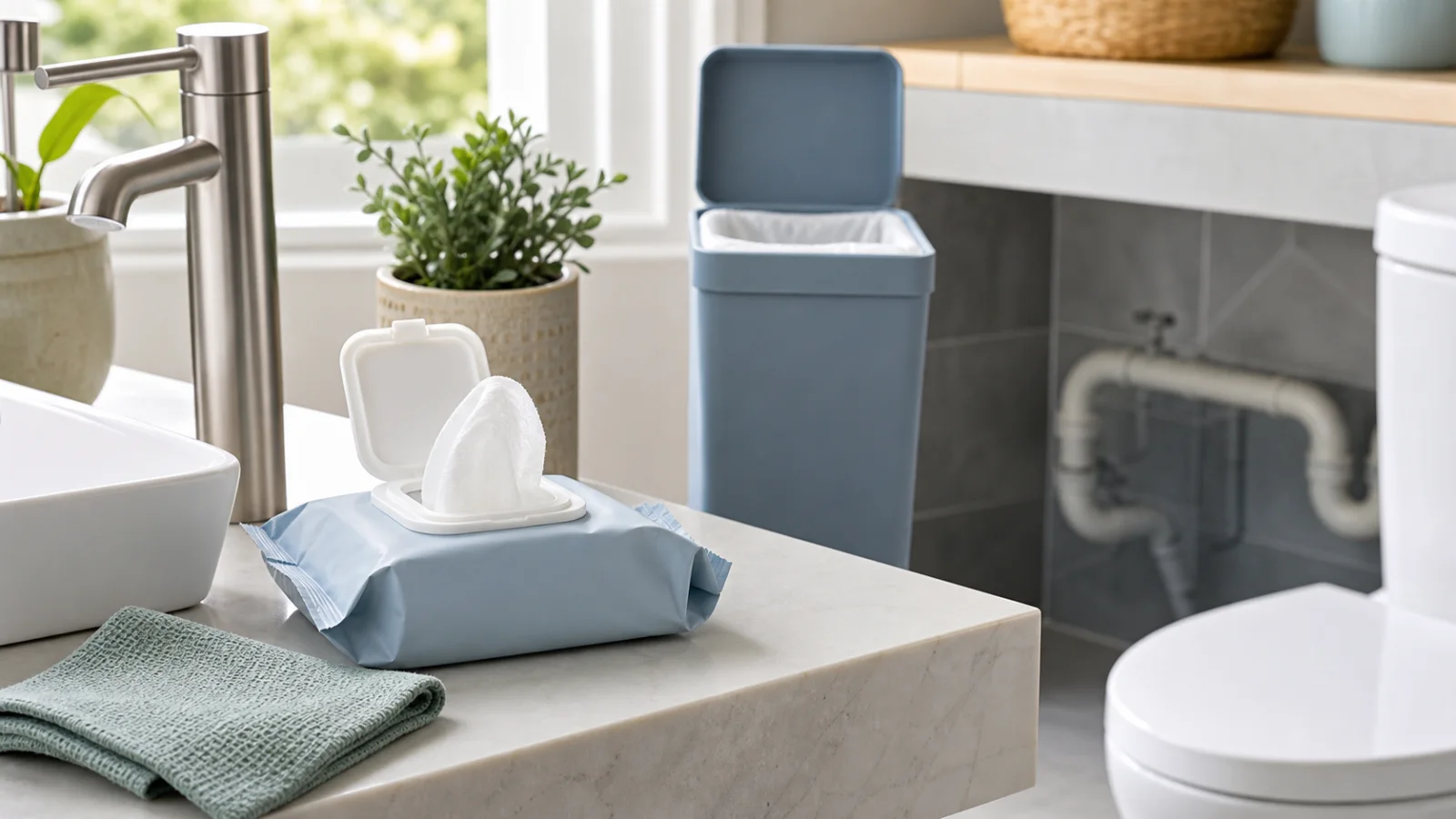
Wet wipes should go in the bin, not the toilet. Some wet wipes contain plastic fibers, and even plastic-free or flushable-looking wipes can still move through toilets too slowly for real sewer systems. The safest public-information advice is simple: flush only toilet paper and human waste, choose reusable cloths or plastic-free wipes when practical, keep a small bathroom bin available, and treat flushable, biodegradable and plastic-free claims as separate questions rather than proof that a wipe belongs in the sewer.
Key points
- England's plastic wet-wipe ban comes into force on 19 May 2027, but the disposal advice already applies now: bin wet wipes, do not flush them.
- A plastic-free claim is about material content; it is not the same as a sewer-safe or flushable claim.
- The European Commission includes wet wipes in single-use plastic marking rules when they contain plastic, which shows why clear user instructions matter.
- EPA guidance is direct: flush only toilet paper, because other items can damage plumbing, sewer systems and septic systems.
- The lowest-risk routine is a reusable cloth where hygiene allows, a clearly labelled plastic-free wipe when a wipe is necessary, and a lidded bathroom bin for disposal.
Related Plastika Problema reading
- Plastic packaging greenwashing claims - background on why claim wording needs evidence and conditions
- Biodegradable vs compostable vs recycled plastic - context for separating material claims from real disposal routes
- Microplastics in drinking water and food - why small plastic fibers and fragments need source control
- Action checklist - simple household defaults that reduce plastic leakage before it starts
Why wet wipes belong in a plastic pollution guide
Wet wipes are small, ordinary and easy to overlook. They appear in bathrooms, baby-care routines, makeup removal, household cleaning, travel bags, gym kits, hotels, clinics, salons and offices. That convenience is exactly why they matter. A product used for a few seconds can create a disposal decision that affects plumbing, wastewater workers, rivers, beaches and microplastic pollution. The issue is not that every wipe user is careless. The issue is that the product category has trained many people to think of a wipe as almost disposable in the same way as toilet paper, when the systems behind those two products are very different.
Toilet paper is designed for toilets. Wet wipes are designed to stay strong while wet. That strength is useful during cleaning, but it becomes a problem when the wipe enters a pipe, pump, screen or sewer. If the wipe also contains plastic, the environmental concern expands from blockage to persistent material. Plastic fibers can help a wipe hold together, but that durability is exactly what makes the product a poor fit for waterways and natural environments. A public-information article should therefore connect three ideas that are often separated: product design, user claims and the real route after disposal.
Direct answer: what should a household do today?
The direct household answer is to bin wet wipes. Keep a small lined, lidded bin in the bathroom, nursery, treatment room or cleaning cupboard where wipes are used. If hygiene allows, replace repeated wipe uses with washable cloths. If a disposable wipe is necessary, choose the lowest-risk option available, preferably one clearly described as plastic-free, then still dispose of it in the bin unless a local wastewater authority gives a specific and current instruction otherwise. Do not treat a soft texture, a green package, a plant image or a flushable word as enough evidence.
This advice is deliberately practical. It does not ask families to solve every material question before cleaning a child, removing makeup or disinfecting a surface. It asks them to change the disposal default. A bin next to the toilet removes the excuse of convenience. A reusable cloth near the sink reduces repeated purchases. A shopping note that says plastic-free when wipes are unavoidable reduces hidden plastic. Those three simple changes do more than debating package language after the wipe has already been used.
The policy signal: plastic wet wipes are being restricted
The UK policy direction is clear enough to matter beyond the UK. GOV.UK guidance says England's ban on single-use wet wipes that contain plastic comes into force on 19 May 2027, with all UK nations introducing bans on different start dates. The guidance lists examples such as baby wipes, face and makeup removal wipes, cosmetic sheet masks, moist toilet tissue, antibacterial hand wipes, personal hygiene wipes and household cleaning wipes. It also says plastic-free wipes and reusable wet wipes are not included in the ban. That distinction is important: the regulation targets plastic content, not every disposal problem created by wipes.
The GOV.UK news release behind the law is also careful about behavior. It says the new law targets wipes containing plastic, but all wet wipes contribute to blockages and pollution when flushed. It cites UK Water Industry Research finding that wet wipes contribute to 94 percent of sewer blockages and cost water companies around GBP200 million each year to fix. For a public-information site, the conclusion is not complicated: a plastic-content ban is useful, but it does not make flushing ordinary wipes a safe habit.
Plastic-free does not automatically mean flushable
Plastic-free is a material claim. Flushable is a system claim. Those two claims should never be collapsed into one. A wipe can avoid plastic fibers and still remain too strong, too slow to disperse, too large or too likely to catch with fats, oils, grease, hair and other debris in real pipes. The user does not experience that problem when the toilet clears. The problem can appear later, where the wipe meets bends, pumps, screens, rough pipe surfaces or other waste.
This is the main greenwashing risk in the category. A package may be technically moving in the right direction by removing plastic, but if the design or label encourages flushing, the public may make a worse system decision. Better communication would say what the wipe is made from and where it should go after use. If the correct route is the bin, the label should say so plainly. If a claim depends on special test conditions, the package should not invite an average household to use a toilet as a disposal route.
Why flushable claims are confusing
The word flushable sounds like a promise about the whole wastewater journey, but consumers often read it as a short test: will the item disappear from the toilet bowl? That is not enough. A marble, toy or cotton pad might vanish from view after a flush, but nobody would treat that as proof it belongs in a sewer. The correct question is whether the item breaks down quickly enough and safely enough through the entire local system. Most households cannot test that. They can only follow reliable public guidance.
Water UK announced that its Fine to Flush wet-wipe certification would end in March 2024, after government concern that labelling of single-use wet-wipe products was confusing consumers. Water UK's later 2026 update on the upcoming plastic-wet-wipe ban asks for mandatory do-not-flush labelling on all wet-wipe products and says even plastic-free flushable wipes should not be flushed because thick materials can take a long time to break down and can still block pipes. That is a strong signal for ordinary readers: when authorities and water companies are asking for clearer bin-first instructions, the safer habit is already available.
What happens after a wipe is flushed
A flushed wipe does not enter a clean empty tube and glide alone to a perfect treatment plant. It joins a mixed and changing wastewater system. Pipes may be old, narrow, rough, partially blocked or connected to pumps and screens. The wipe can snag, twist, wrap, mat together or combine with fats, oils and grease. Enough material can create a blockage. A blockage can cause backups, overflows, emergency maintenance and pollution risks. In a home, it can mean an expensive plumbing problem. In a municipal system, it can mean crews spending time and money on a preventable issue.
The EPA's public advice is simple because the infrastructure problem is simple to prevent: flush only toilet paper, not disinfecting wipes or other non-flushable items. The agency explains that flushing anything other than toilet paper can damage internal plumbing, local sewer systems and septic systems, and that preventable backups take time and resources away from wastewater management. That advice is useful outside the United States too because the physical lesson travels well. If a material is designed to stay strong while wet, treat the toilet as the wrong disposal route.
Hidden plastic and microplastic risk
Many wet wipes have historically used synthetic fibers or blends because they need wet strength, softness and shelf stability. When those fibers are plastic-based, the problem is not only the whole wipe. The material can break into smaller fragments over time. A wipe that escapes into a riverbank, beach, drain or sewer overflow can become a source of persistent fibers and microplastic-sized pieces. This is one reason policy attention has shifted toward the material content of wipes and not only their immediate plumbing effect.
The European Commission's single-use plastic marking rules also show why this category matters. The Commission says certain single-use plastic products must be marked to reduce environmental impact, and the list includes wet wipes described as pre-wetted personal care and domestic wipes. Marking is not the same as a ban, but it recognizes that the user needs clear information at the point of use. If a product contains plastic and is likely to be discarded in a confusing way, the label has to work harder than a vague green design.
A better bathroom system
Most wipe problems are created by a small design failure in the room. The wipe is used near a toilet, but the bin is missing, open, too far away, unlined, unpleasant or reserved for something else. The fastest fix is not a lecture. It is a better setup. Put a small lidded bin beside the toilet or changing area. Use a liner if that makes emptying easier. Keep the bin visible enough that guests understand the route. If privacy matters, choose a discreet design, but do not hide the only correct disposal option.
For households with children, visitors or shared bathrooms, use a simple rule: only toilet paper goes in the toilet. That is more memorable than a long list of forbidden items. For makeup removal, keep washable cloths or pads near the sink. For cleaning, keep reusable cloths where they will actually be used. For travel, carry a small sealable disposal bag if bins are not always available. These habits are ordinary, but ordinary is the point. A lower-plastic routine survives because it fits the room.
What shops, hotels, salons and clinics should do
Service businesses should treat wipes as a purchasing and operations issue, not only a bin issue. Count the types of wipes bought each month: makeup wipes, cleaning wipes, antibacterial wipes, moist toilet tissue, sheet masks, baby-care wipes, treatment-room wipes and staff-use wipes. Then ask which uses are required, which can be replaced by washable cloths or dispensers, which must remain disposable for hygiene, and which contain plastic. The goal is not to remove necessary hygiene. The goal is to stop using disposability as a default where a better routine exists.
Customer-facing spaces should avoid confusing claims. A hotel, salon, spa, clinic or gym should not provide wipes near a toilet without a clear bin route. Staff scripts should be short: please put wipes in the bin, never in the toilet. Procurement teams should ask suppliers for material content, plastic-free evidence, disposal instructions and whether packaging claims have legal or standards support. If a business uses plastic-free wipes, it should still train staff to bin them. The material improvement does not cancel the wastewater risk.
How to read wipe labels without being misled
Read wipe labels in layers. First, check whether the product says plastic-free. If it does not say so clearly, do not assume it is plastic-free because the package is green or uses natural imagery. Second, check the disposal instruction. If the instruction encourages flushing, compare that with current local water authority guidance and remember that many authorities are moving toward bin-first language. Third, look for the exact scope of the claim. Does it apply to the wipe, the pack, the lid, the fibers, the lotion, or only one component?
Fourth, separate biodegradable from sewer-safe. Biodegradable language may refer to long-term material breakdown under certain conditions. It does not automatically mean the wipe will disperse fast enough in pipes. Fifth, avoid using the recycle bin for used wipes. Used wipes are generally not ordinary recyclable paper or plastic packaging; they belong in residual waste unless a specific local program says otherwise. The practical question is always route first: where can this item actually go after use?
Risk and greenwashing cautions
The biggest weak claim is flushable without context. The second is plastic-free used as if it means harmless. The third is biodegradable used as if it means flushable. The fourth is natural fibers used as if it means no blockage risk. A responsible public page should not say that every alternative is equally bad, but it should keep the claims in their lanes. Removing plastic can reduce one environmental risk. Binning the wipe reduces a different risk. Reuse can remove many disposables entirely when hygiene allows.
Brands should also avoid hero claims that shift responsibility to the user without giving the user a workable system. If a product says dispose responsibly but hides the instruction, the phrase is not helpful. If a hotel says it is reducing plastic but gives every guest disposable wipes with no bin prompt, the operation is incomplete. If a retailer promotes plastic-free wipes but merchandises them as toilet-friendly, the communication may create a new infrastructure burden. Clear disposal language is part of product design.
A practical wipe reduction checklist
Use this checklist at home. Put a lidded bin in every bathroom where wipes are used. Keep a reusable cloth or washable pad where it can replace a repeated wipe. Choose plastic-free wipes only when a disposable wipe is necessary. Do not flush wipes, cotton pads, paper towels, dental floss, sanitary products or cleaning sheets. Keep fats, oils and grease out of drains too, because they can combine with other unflushables and make blockages worse. Review the bathroom bin after two weeks: if wipes are still being flushed, the bin is in the wrong place or the rule is unclear.
Use this checklist at work. Count wipe purchases monthly. Replace cleaning wipes with washable cloths where infection control and operations allow. Keep disposable wipes for tasks that genuinely need them. Ask suppliers for plastic-free documentation and plain disposal wording. Put bin-first signage where wipes are used, not only in staff manuals. Train cleaners, therapists, reception teams and managers with one rule they can remember: wipes go in the bin. Track plumbing incidents as part of waste prevention, because blockages are often a signal of bad material flow.
Bottom line
Wet wipes are a useful example of why plastic pollution advice has to connect product design with real infrastructure. A wipe can be convenient, soft and legally sold while still being wrong for the toilet. A plastic-free wipe can be better than a plastic-containing wipe while still needing the bin. A flushable-looking word can be less useful than a small lidded bin in the right place. The strongest advice is not dramatic: reduce repeated wipe use, choose plastic-free where disposable wipes are necessary, and bin every wipe.
For readers, the next step is immediate. Put the bin where the decision happens. For businesses, the next step is measurement. Count wipe use, check material claims and train staff. For public educators, the next step is language discipline. Do not let plastic-free, biodegradable and flushable blur together. Each claim answers a different question, and the practical disposal answer remains clear: wet wipes do not belong in the toilet.
Detailed infographic
Wet wipe claim and disposal check
A simple sequence for deciding what a wipe claim means and where the used wipe should go.
- Identify Check whether the wipe contains plastic or clearly says plastic-free.
- Question Treat flushable wording as a claim to verify, not a disposal instruction by itself.
- Route Use the bin unless current local wastewater guidance explicitly says otherwise.
- Replace Use washable cloths or pads where hygiene and convenience allow.
- Measure For businesses, track wipe types, monthly quantities, supplier claims and plumbing incidents.
Action checklist
- Keep a lidded bathroom bin beside the toilet.
- Flush only toilet paper and human waste.
- Do not confuse plastic-free with sewer-safe.
- Ask suppliers what the wipe and packaging are made from.
- Use reusable cloths for repeated cleaning tasks where safe.
Frequently asked questions
Are wet wipes plastic?
Some wet wipes contain plastic fibers or plastic-based components, while others are sold as plastic-free. Do not assume the material from the package design; look for clear plastic-free wording and supplier evidence.
Can I flush plastic-free wet wipes?
The safer advice is no. Plastic-free is not the same as sewer-safe. Many authorities advise putting all wet wipes in the bin because thick wet materials can still block pipes or wastewater equipment.
What does England's wet-wipe ban change?
From 19 May 2027, it will be illegal in England to sell or supply single-use wet wipes containing plastic, with some exemptions. Plastic-free and reusable wipes are outside that ban, but used disposable wipes should still be binned.
Is biodegradable the same as flushable?
No. Biodegradable describes material breakdown under certain conditions. Flushability would require the item to move through real plumbing and wastewater systems without causing problems. Treat the claims separately.
What is the best alternative to wet wipes?
For repeated cleaning, a washable cloth or reusable pad is usually the lowest-waste option when hygiene allows. When a disposable wipe is necessary, choose a plastic-free option and put it in a lidded bin after use.
Sources and further reading
- GOV.UK plastic wet wipes ban guidance
- GOV.UK news release on the plastic wet wipes ban
- EPA guidance to flush only toilet paper
- European Commission marking specifications for single-use plastic products
- Water UK Fine to Flush certification ending
- Water UK one-year update on the plastic wet wipes ban
- UNEP plastic pollution topic hub
- EPA waste management hierarchy