Direct answer
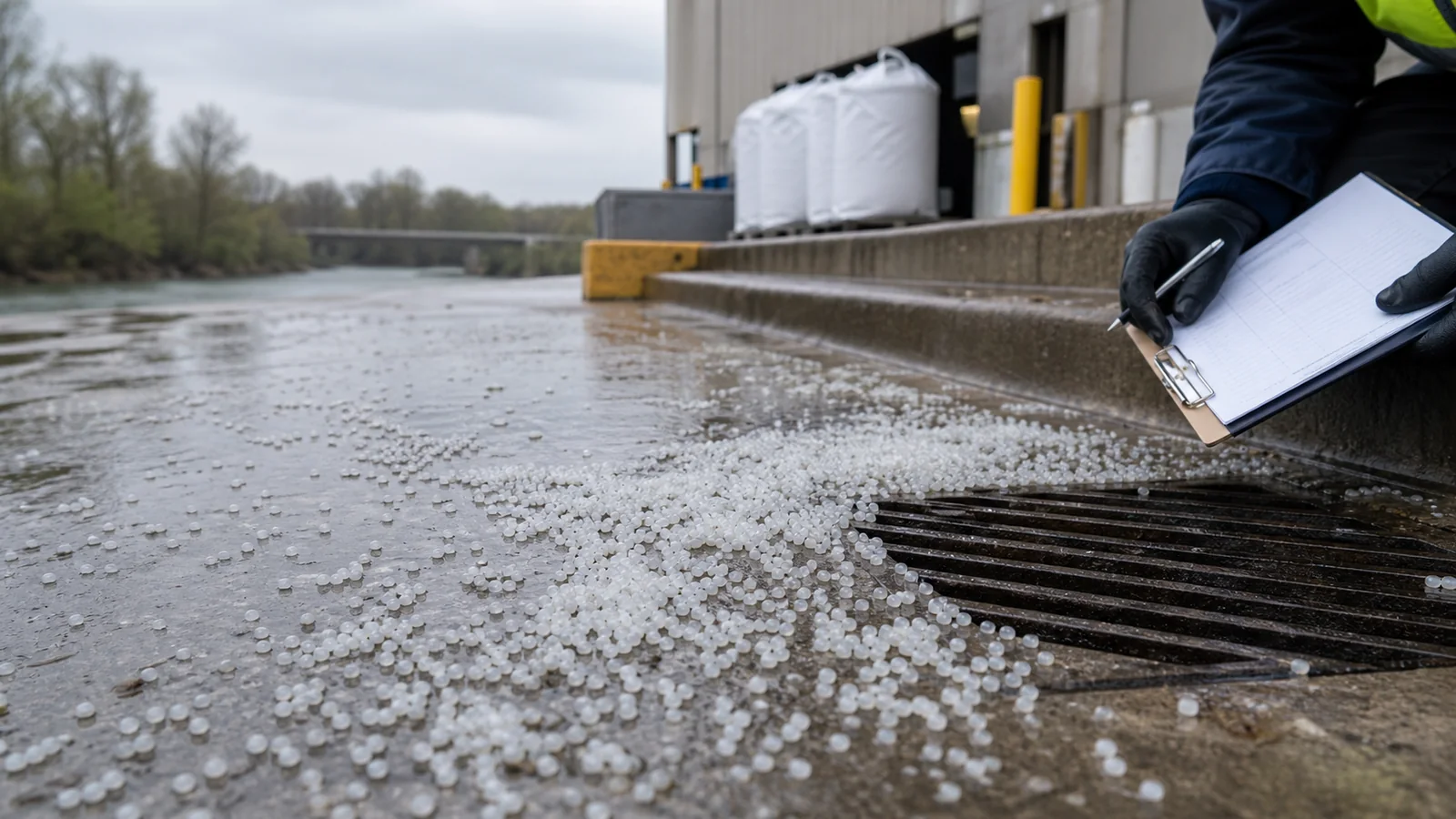
Plastic pellet pollution happens when small pre-production resin pellets, often called nurdles, escape during manufacturing, recycling, storage, loading, transport or cleanup. Because pellets are already microplastic size, usually only a few millimeters across, they can move quickly through stormwater drains, yards, ports, rivers and coastal areas. The best prevention is not a better beach cleanup. It is tight handling: sealed containers, covered loading areas, drain protection, dry sweeping, spill response, staff training, carrier controls, audits and honest public reporting.
Key points
- Plastic pellets are raw material for plastic products, but once spilled they behave like persistent microplastic pollution.
- Stormwater is a major risk route because rain can move pellets from yards, loading docks and roads into drains and waterways.
- Prevention must happen before pellets leave an industrial site, truck, railcar, warehouse or port handling point.
- The EU's current pellet-loss regulation shows policy moving from voluntary pledges toward documented prevention duties.
- Residents can help by reporting pellet spills accurately, but companies and carriers own the first duty to prevent loss.
Related Plastika Problema reading
- Microplastics in drinking water and food - background on why small plastic particles require source control
- How plastic reaches the ocean - context for storm drains, rivers and inland-to-coast leakage
- Beach cleanups and source reduction - why cleanup evidence should feed upstream prevention
- Action checklist - practical public actions for keeping plastic out of drains and waterways
What plastic pellets are
Plastic pellets are small pieces of raw resin used to make finished plastic products. They may be round, oval or cylindrical, and NOAA describes pre-production plastic pellets as commonly ranging from about 1 millimeter to 5 millimeters. That size is important because pellets do not need to break down before becoming microplastic pollution. If a pellet escapes, it is already small enough to enter drains, sediments, beaches and wildlife exposure pathways.
The word nurdle is a common nickname, but the practical issue is bigger than the word. Pellets move through a supply chain before they become bottles, tubs, films, fibers, caps, parts or packaging. They can be made by resin producers, moved through warehouses, shipped in containers, loaded through hoses, stored in bags or silos, used by converters, handled by recyclers and transported by truck, rail or ship. Every transfer point is a potential loss point if the system is not designed and maintained well.
A public-information article should describe pellets without making them sound like ordinary beach litter. A bottle cap or wrapper becomes pollution after a consumer use moment. A pellet can become pollution before any consumer product exists. That means pellet loss is an industrial handling problem, a transport problem and a stormwater problem before it is a household sorting problem.
Why pellet pollution is different from ordinary plastic litter
Pellet pollution is easy to underestimate because each pellet looks small. A handful seems minor compared with a bag of bottles. But a spill can contain thousands or millions of individual pieces, and each one is difficult to recover once it spreads. Pellets can lodge in cracks, float in puddles, collect along curbs, move under fences, enter drains, wash into rivers or mix with sand where they are hard to distinguish from shells and grains.
Unlike many consumer items, pellets are often uniform and highly mobile. Their small size allows them to bypass ordinary litter-control habits. A street bin will not solve a loading-area spill. A public cleanup cannot easily remove every pellet from gravel, storm drains or river sediment. A facility that waits until pellets reach a nearby creek has already lost control of the cheapest and cleanest prevention point.
This is why pellet pollution is a good topic for a restored plastic pollution site. It shows the difference between visible cleanup and source control. If the goal is to reduce microplastics, preventing pellets from escaping in the first place is more realistic than trying to collect them one by one after rain has spread them through a watershed.
How stormwater turns a spill into a waterway problem
Stormwater is the practical bridge between an industrial yard and a river. During dry weather, spilled pellets may sit around transfer hoses, loading docks, storage doors, rail spurs, truck parking areas, recycling yards or warehouse thresholds. When rain arrives, water follows the easiest route toward drains, gutters, ditches and channels. Pellets can travel with that flow, especially when surfaces are smooth, sloped or connected directly to drainage infrastructure.
Many stormwater systems are designed to move water away from paved areas quickly. That helps prevent flooding, but it can also move pollutants quickly if the site lacks controls. Once pellets enter a drain or ditch, recovery becomes harder. They may collect in catch basins, float downstream, settle in low-energy areas or reach estuaries and beaches. The longer the route, the more labor is needed and the less complete any cleanup becomes.
This makes timing important. The best cleanup window is immediately after a spill and before rainfall or washdown. Dry sweeping, vacuuming and contained collection are usually better than hosing an area, because hosing can turn a contained spill into a stormwater discharge. A good pellet plan treats every drain as a boundary that must be protected, not as a place where stray material can disappear.
Where pellet losses usually happen
Pellet losses often happen at transfer points. Bags split. Valves leak. Hoses disconnect. Trucks track material across yards. Forklifts tear packaging. Railcar or container unloading creates small residues. Outdoor storage exposes material to wind and rain. Recycling operations may handle flakes, regrind or powders that behave differently from virgin pellets but still require the same containment mindset.
Transport deserves special attention because the material may pass through many hands. A resin producer may have strong controls, but a carrier, warehouse, port or receiver may create the leak. A spill during maritime, rail or road transport can affect places far from the original company. That is why modern rules and good practice increasingly look across the supply chain rather than only at the factory gate.
The weakest point is often routine. A major accident attracts attention, but many small losses can happen through repeated bad habits: an open bag near a doorway, a drain without protection, a broom that pushes pellets toward a gutter, a loading area without inspection after shift changes, or a contractor who does not know the spill procedure. Pellet loss prevention is therefore a daily operating discipline.
The prevention hierarchy for pellet handling
The first prevention step is containment at the source. Keep pellets inside sealed bags, boxes, silos, bins, hoppers, containers and vehicles. Repair leaking equipment. Use durable packaging. Avoid overfilling. Keep loading areas protected from wind and rain when possible. Make transfer points easy to inspect. These measures are not glamorous, but they stop the loss before it becomes an environmental problem.
The second step is capture at the site boundary. Drains, doors, dock edges, loading bays and yard slopes should be treated as escape points. Facilities can use screens, berms, catch trays, covered areas, drain inserts, vacuum systems, dedicated cleanup kits and regular inspection routes. The correct design depends on the site, but the principle is consistent: pellets should encounter multiple barriers before they can leave the premises.
The third step is documentation. If a company cannot show where pellets are handled, who owns each transfer point, how spills are cleaned, where collected pellets go and how often inspections happen, the plan is likely fragile. Documentation is not paperwork for its own sake. It makes the prevention system visible enough to train, audit and improve.
What an effective spill response looks like
A good spill response starts before a spill happens. Staff should know who stops work, who blocks drains, who collects material, who records the incident, who checks nearby escape routes and who decides whether outside reporting is needed. Cleanup kits should be located where spills are likely, not locked in an office. The kit should match the material and site: brooms for dry floors, vacuums where appropriate, containers for recovered pellets, drain covers, absorbent materials for mixed spills and personal protective equipment where required.
The response should avoid making the spill worse. Do not wash pellets into drains. Do not sweep them into soil, vegetation or cracks where recovery becomes harder. Do not assume that a small spill is harmless because each pellet is tiny. A small spill handled badly can become a wide-area cleanup after the next rain.
After cleanup, the site should record the cause and fix it. Was a bag damaged by a forklift? Did a valve fail? Was the transfer hose worn? Was training missing? Was the drain cover unavailable? A spill log that only says cleaned is not enough. The purpose of the log is to prevent recurrence. Repeated spills in the same place are evidence of a design or management failure.
What current EU pellet rules signal
The European Commission now describes a Regulation on preventing plastic pellet losses to reduce microplastic pollution, EU 2025/2365, adopted in November 2025 and entering into force in December 2025. Its public overview says the rules apply to economic operators managing installations in the EU that handle five tonnes or more of plastic pellets per year, including manufacturers, recyclers, converters, stockists and other handlers, and also to carriers transporting pellets within the EU and by sea.
The Commission's news page explains the core expectation in plain terms: operators must avoid, contain and clean up spills or losses and establish risk management plans suited to their installations. It also notes that larger and medium companies handling more than 1,500 tonnes per year must obtain a certificate of compliance or a permit, while simpler requirements apply to smaller companies. Training and awareness material and harmonized standards for estimating losses are also part of the implementation pathway.
For readers outside Europe, the significance is not that every city follows EU law. The significance is direction. Pellet loss is moving from a voluntary good-practice issue toward a documented prevention duty. Companies that handle pellets should not wait for a local headline or complaint. The practical controls are already known, and policy is increasingly expecting proof that those controls are in place.
How EPA stormwater guidance fits the same logic
EPA industrial stormwater guidance for rubber and plastic products includes plastic pellet management as a pollution-prevention concern. The guidance points toward regular self-evaluation, employee education, management awareness and best management practices that prevent pellets, powders and related materials from reaching runoff. In other words, the stormwater approach is operational: inspect the site, train people, contain material and correct weak points before rain carries pollutants away.
EPA enforcement examples have also treated industrial stormwater as a route for pollutants such as plastic resin pellets, flakes or powders. This matters because pellets are not only a marine-debris issue after they reach a beach. They can be a stormwater compliance issue at the facility or yard where they escape. A business that handles pellets should therefore connect environmental training with stormwater permits, site drainage maps and maintenance routines.
The useful public lesson is simple: water follows the site design. If pellets can reach a drain, then the facility has not finished its prevention plan. Good stormwater management is not separate from pellet management. It is one of the main ways pellet management is tested during real weather.
Voluntary programs and their limits
Operation Clean Sweep is an industry program designed to prevent the loss of plastic granules during handling and keep them out of the environment. Voluntary programs can help by giving companies a common vocabulary, practical recommendations and a visible pledge. They are useful when they lead to real training, site changes, audits and transparent performance.
The limit is that a pledge is not the same as proof. A public-information article should not treat a logo, membership statement or general commitment as evidence that no pellets are escaping. The evidence is operational: clean transfer areas, protected drains, spill records, staff training, maintenance logs, third-party checks where relevant and clear correction of repeated losses.
This distinction helps avoid greenwashing. A company can talk about zero pellet loss while still having pellets around drains. A better communication standard is specific: what sites are covered, what controls were installed, how staff are trained, how spills are measured, how often audits happen and what changed after the last incident. The public needs less slogan and more route control.
How communities can recognize and report pellet pollution
Residents, beach groups and river volunteers sometimes notice small round or oval plastic pieces collected near drains, strandlines, industrial areas, ports or river bends. If the pieces look like raw plastic pellets, the most useful action is careful documentation rather than dramatic disturbance. Photograph the location, capture scale with a ruler or common object, note the date, weather, nearby drains or facilities and whether the pellets appear fresh, weathered, colored or mixed with other debris.
Reporting should go to the appropriate local environmental authority, stormwater department, port authority, cleanup coordinator or facility contact where known. Volunteers should avoid unsafe industrial areas, moving traffic, contaminated water and private property. If a small sample is collected for identification, it should be done safely and only where local guidance allows. The priority is not vigilante investigation. The priority is accurate evidence that helps the right agency or responsible operator find and stop the source.
Community reports are especially valuable after rain because they can reveal the route pellets took. Pellets clustered around a particular drain or outfall may point to a nearby source. Pellets scattered broadly along a beach may require a wider investigation. In both cases, the report should ask what prevention changes will stop the next release, not only whether someone can clean the visible pieces today.
What small manufacturers and recyclers should audit
A small company that handles pellets, flakes, regrind or plastic powders can start with a simple route map. Where does material enter the site? Where is it stored? Where is it opened, transferred, dried, blended, packed, loaded or cleaned? Which points are outdoors or near drains? Which contractors or carriers touch the material? Which surfaces slope toward stormwater? Which cleanup tools are used at each point?
The audit should then count weak points, not just incidents. A drain without protection is a weak point even if no one has recorded a spill this month. A loading hose with visible residue is a weak point. A torn bag stored outdoors is a weak point. A staff member who does not know the drain-blocking procedure is a weak point. A waste contractor who sweeps pellets into a mixed bin without documentation is a weak point.
The result should be a short action list: seal containers, move storage indoors, add drain protection, mark transfer zones, place cleanup kits, train staff, update carrier instructions, inspect after loading, record spills and review recurring causes monthly. The list does not need to be complex to be useful. It needs owners, dates and evidence.
Why cleanup after release is rarely enough
Cleanup has value when pellets are visible and reachable, but cleanup is a weak primary strategy. Pellets can spread into cracks, gravel, sediment, vegetation, wetlands and water columns. They can be mistaken for food by wildlife. They can weather, fragment, adsorb contaminants and mix with natural material. A cleanup team can remove a portion, but it will rarely recover every piece once the material has traveled.
This is why pellet prevention should be judged before the outfall. If a company says it will clean up any pellets that escape, that is not equivalent to preventing escape. It is like saying a building needs no fire prevention because firefighters exist. The public should expect containment, inspection and immediate response at the source, with cleanup as a backup rather than the plan.
The same logic applies to policy. Rules that only punish visible pollution after a spill may miss the daily small losses that accumulate. Better policy asks operators to identify risk points, train staff, prevent loss, estimate quantities, document incidents and verify controls. Prevention is easier to inspect when it is built into site routines.
How this topic should be communicated without panic
Pellet pollution deserves serious attention, but the message should stay practical. The point is not that every plastic product user caused a pellet spill. The point is that the plastic supply chain creates risk before products reach consumers, and that risk can be managed with known controls. Public education should make the hidden stage visible without turning it into helplessness.
A good public answer says what pellets are, why their size matters, where they leak, how stormwater moves them, what companies should do, what current policy signals and how residents can report evidence. It should avoid vague claims such as industry must do better without naming the operating controls. It should also avoid implying that volunteers can solve the problem with beach sieves alone.
The tone matters because pellet prevention requires cooperation between operators, carriers, regulators, communities and cleanup groups. Clear evidence and practical controls create a better conversation than blame without route maps. The pellets are small, but the prevention system can be very concrete.
A practical checklist for pellet-loss prevention
For companies and carriers, use this checklist as a starting point. Map every pellet transfer point. Keep material sealed and protected from weather. Inspect hoses, valves, bags, silos, containers and loading equipment. Install drain protection where pellets could reach runoff. Use dry cleanup methods and vacuums where appropriate. Put spill kits near loading and storage areas. Train employees and contractors before they handle material. Record spills, causes and corrective actions.
For facilities, add stormwater discipline. Know which drains leave the site. Inspect catch basins after loading, heavy rain and maintenance work. Keep outdoor areas clean. Avoid washdown that moves pellets. Review contractor cleaning practices. Check fence lines, curbs and low points where pellets may collect. If pellets leave the site, treat the incident as a route failure and correct the route, not only the visible material.
For public agencies and communities, ask for measurable prevention. Does the site have a risk map? Are drains protected? Are staff trained? Are carriers included? Are losses estimated? Are repeated incidents corrected? Are cleanup results reported? These questions move the conversation away from generic concern and toward evidence that can reduce plastic pellet pollution before it reaches rivers or beaches.
Bottom line
Plastic pellet pollution is a microplastics problem created before consumer use. The pellets are small, mobile and difficult to recover once rain, drains and waterways spread them. That makes source control the central answer. Better bins on a beach do not fix a leaking transfer hose, an uncovered loading yard or a carrier that lacks spill procedures.
The best next step is different for each reader. A facility should map pellet routes and protect drains. A carrier should secure containers and train drivers. A regulator should ask for documented risk management and loss estimates. A community group should report pellet evidence with location, scale and photos. A household reader should understand that plastic pollution is not only about what happens after purchase. It also depends on the hidden industrial systems that produce and move plastic.
Nurdles are small, but they reveal a large truth about plastic pollution: once material is loose in the environment, cleanup becomes harder, slower and less complete. Prevention at the source is not a slogan. It is the most practical form of microplastic reduction.
Detailed infographic
Plastic pellet leakage control map
A practical flow for stopping nurdles before rain, drains and transport routes turn a site spill into microplastic pollution.
- Contain Keep pellets sealed in bags, silos, bins, containers and vehicles.
- Transfer Inspect hoses, valves, loading zones, forklifts and packaging before movement.
- Protect drains Use drain covers, screens, berms or catch systems near risk points.
- Clean dry Sweep or vacuum immediately; do not wash pellets into stormwater.
- Record Log causes, quantities, corrective actions, training and repeated weak points.
Action checklist
- Map every place pellets enter, move, wait or leave the site.
- Place spill kits and drain covers at transfer points.
- Train carriers and contractors, not only employees.
- Inspect after rain, loading, maintenance and shift changes.
- Report repeated losses with evidence and corrective actions.
Frequently asked questions
What are nurdles?
Nurdles are small pre-production plastic resin pellets used as raw material for making plastic products. Once spilled, they are already microplastic-sized and can move through stormwater, rivers and coastal environments.
Why are plastic pellets hard to clean up?
They are tiny, numerous and mobile. After rain or wind spreads them, pellets can hide in cracks, gravel, sediment, vegetation and surf lines, making complete recovery difficult.
What is the fastest way to prevent pellet pollution?
Stop pellets at the handling point: sealed containers, careful transfer, drain protection, immediate dry cleanup, staff training, carrier controls and spill records.
Do voluntary industry programs solve pellet loss?
They can help when they lead to real controls and audits, but a pledge alone is not proof. The evidence is clean sites, protected drains, training, documented inspections and corrected spill causes.
Should residents report suspected pellet spills?
Yes, when it is safe to do so. Photograph the material and location, note date and weather, avoid unsafe industrial areas, and report to the relevant local environmental or stormwater authority.
Sources and further reading
- NOAA Marine Debris Program on pre-production plastic pellets
- NOAA Marine Debris Program microplastics overview
- EPA industrial stormwater Sector Y fact sheet for rubber and plastic products
- EPA municipal stormwater
- European Commission microplastics and plastic pellets regulation overview
- European Commission news on EU plastic pellet loss rules entering into force
- Plastics Europe Operation Clean Sweep collaboration overview