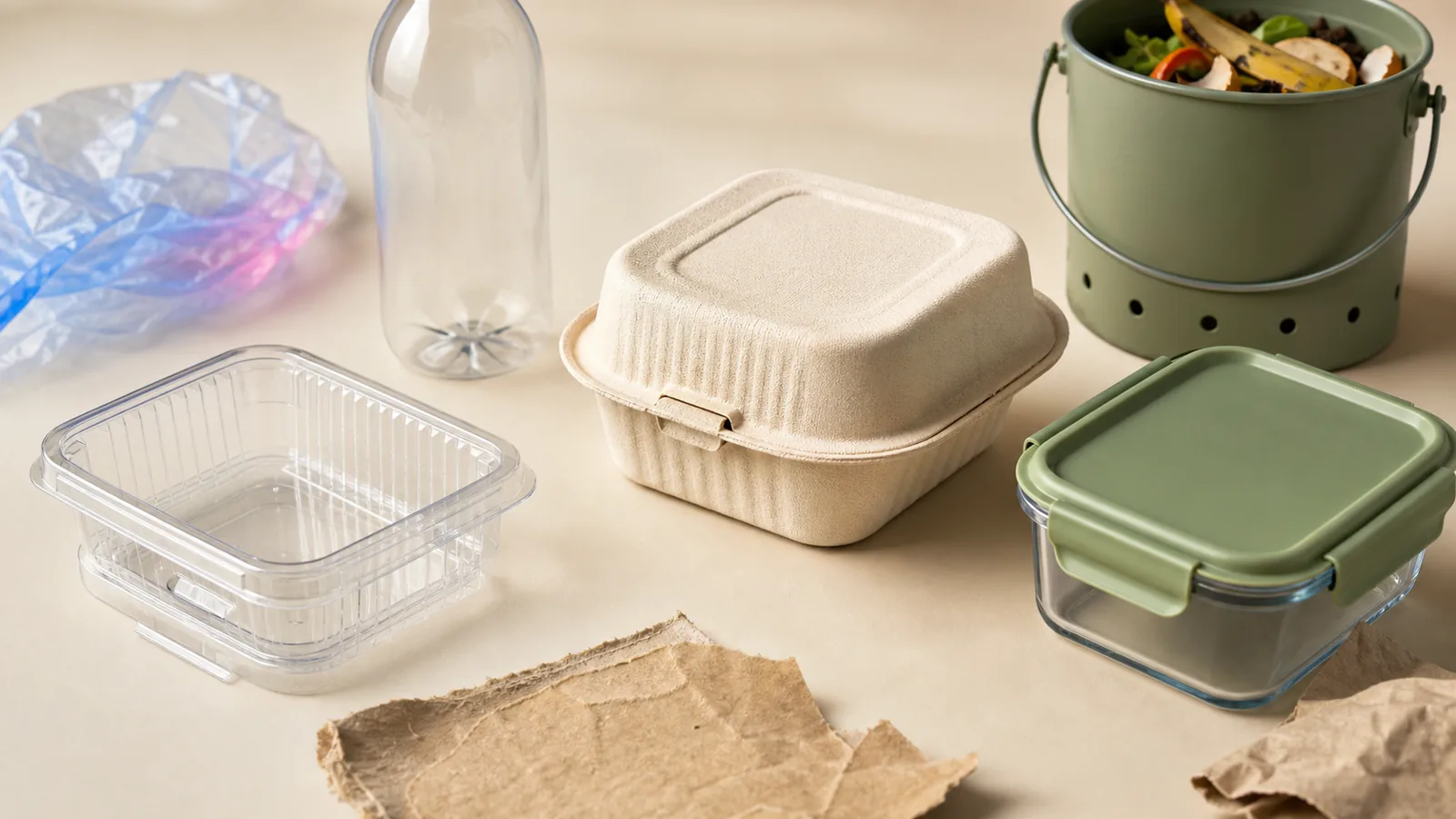
Direct answer
Plastic packaging greenwashing happens when a label makes an environmental benefit sound clearer, broader or more useful than it really is. The safest way to check a claim is to connect the words on the package to evidence: the exact material, the exact component, the percentage or standard behind the claim, the local collection or composting route, and what happens if the item is littered or landfilled. A green color, leaf icon, recycling triangle or vague phrase is not enough.
Key points
- A credible packaging claim names the material, the component and the real end-of-life route.
- Recycled content, recyclable, compostable and biodegradable are different claims with different proof needs.
- Local infrastructure decides whether a claim is useful in practice; a label alone cannot create a recycling or composting system.
- Small businesses should keep supplier evidence before repeating environmental claims to customers.
- The most reliable hierarchy is still prevention first, then reuse, then simple materials with verified local routes.
Related Plastika Problema reading
- Plastic types guide - a useful base for checking whether a claim refers to PET, HDPE, PP, PS, PVC or a mixed material
- Action checklist - practical steps for reducing packaging before disposal decisions are needed
- Plastic recycling symbols explained - context for why a resin code is not the same as a recycling guarantee
- Biodegradable vs compostable vs recycled plastic - background on the label words most often confused in green claims
Why plastic packaging claims need a second look
Plastic packaging is full of short environmental messages. A bottle may say recycled. A pouch may say recyclable. A cup may say compostable. A wrapper may use green color, a leaf icon, a circular arrow, or a phrase such as eco-friendly, ocean-bound, plant-based or sustainable. Some of those claims can be meaningful. Others are too vague to help a household, office, cafe, salon, hotel or school make a real disposal decision. The problem is not that every claim is false. The problem is that many claims are incomplete.
A package is not environmentally better just because it looks more natural or uses softer language. The label has to connect to a real system. If a cup is compostable only in an industrial facility, the claim is not useful in a city where no such facility accepts that cup. If a bottle contains recycled plastic but uses a pump, sleeve or dark color that makes the whole package harder to recover, the claim may describe one benefit while hiding another problem. If a pouch is technically recyclable in a specialist stream but has no local collection point, most users cannot act on the claim.
The practical answer is to treat green packaging language as a prompt for questions, not as a final verdict. What material is this? Which part of the object is the claim about? What percentage is recycled content? What local bin, return point or composting facility accepts it? What evidence supports the statement? If the label cannot answer those questions, the claim may still be marketing, but it is not enough for public-information guidance.
The direct label-checking method
Use a five-step method before trusting a plastic packaging claim. First, identify the exact words. Recyclable, recycled, compostable, biodegradable, refillable and reusable do not mean the same thing. Second, identify the component. A claim may apply to the bottle but not the cap, to the paper sleeve but not the lining, or to the outer carton but not the inner film. Third, look for numbers or standards. A recycled-content claim should state a percentage or give documentation. A compostable claim should say whether it needs industrial composting or can work in home composting conditions.
Fourth, connect the claim to local infrastructure. This is where many attractive labels fail. A city recycling program may accept clear PET bottles but reject black trays, loose films, foam, tiny caps, pumps, mixed pouches or contaminated foodware. A composting facility may accept food scraps but reject compostable packaging. A store may collect flexible film, while curbside bins do not. The label only becomes useful when the collection route exists and the user can realistically follow it.
Fifth, ask what happens if the item goes to the wrong place. Compostable packaging in a recycling stream can become contamination. A biodegradable claim does not mean an item harmlessly disappears in a river or ocean. A recyclable item sent to landfill is not recycled. A package with recycled content may still become waste after one use. These distinctions are not technical trivia. They decide whether the claim helps reduce plastic pollution or only makes a disposable item feel less disposable.
Recyclable claims: useful only when local systems agree
The word recyclable is one of the most common sources of confusion. It can mean the material can technically be recycled somewhere, or it can mean the item is accepted in a local program. Those are not the same thing. Recycling depends on collection, sorting equipment, contamination levels, material value, size, shape and end markets. A clean clear bottle may move through the system well. A small black tray, laminated pouch or greasy food container may not, even if the label uses a recycling symbol.
The FTC Green Guides are built around a simple consumer-protection idea: marketers should avoid environmental claims that mislead consumers, and claims should be qualified when needed. For packaging, that means a broad recyclable claim should not make the average person think the item is easily recycled if meaningful limitations apply. A responsible label gives instructions that match the real route, such as store drop-off for certain films or check local rules for a format that varies by city.
For readers, the practical rule is conservative. If your local program does not accept the item, do not put it in the bin just because the package says recyclable. That habit is called wishcycling, and it can make recycling harder. Keep the accepted local list visible, keep material clean and dry where required, and treat generic arrows as the beginning of the decision rather than the end.
Recycled-content claims: better, but not a free pass
Recycled content is different from recyclability. Recycled content describes what went into the package. Recyclability describes where the package can go after use. A container can be made with recycled plastic and still be difficult to recycle again. Another container can be recyclable but contain no recycled content. A good label keeps these ideas separate because they answer different questions.
A recycled-content claim is strongest when it states a clear percentage and whether the content is post-consumer material or another category. A phrase such as made with recycled material is weaker if it does not say how much. Ten percent, fifty percent and one hundred percent are not the same claim. The claim should also be clear about the component. A bottle may contain recycled plastic while the cap, label or pump does not. The more specific the claim, the easier it is to trust and verify.
Recycled content can support markets for recovered material, which is useful. But it should not distract from source reduction. A single-use item made with recycled plastic is still a single-use item. If a refill, returnable container or packaging-free option is practical, that may reduce more waste than replacing one disposable package with a slightly better disposable package. The hierarchy matters because it keeps recycled content in its proper place: valuable, but not a magic word.
Compostable and biodegradable claims: conditions matter
Compostable and biodegradable claims often sound more natural than they are. Compostable usually means the item is designed to break down under specified composting conditions. Those conditions may require controlled industrial temperature, moisture and time. Biodegradable is broader and can be especially vague unless it states the environment, conditions and time frame. Neither word means the item should be littered, placed in the ocean, or added to a recycling bin.
The most useful question is not whether the label sounds green. It is whether the exact item is accepted by a real composting route available to the user. Some facilities do not accept compostable packaging because it looks too similar to conventional plastic, breaks down too slowly for their process, or creates contamination risk. In that case, a compostable cup may still go to disposal. That does not automatically make the claim false, but it makes the practical benefit limited in that place.
A clear public-information article should therefore avoid simple statements such as compostable is better than plastic. Sometimes it is. Sometimes it is not. If a compostable liner helps collect food scraps for a facility that accepts it, it may support organics diversion. If a compostable fork is handed out where no composting route exists, it may only add confusion. The disposal route determines the outcome.
Ocean-bound, plastic-neutral and circular claims
Some newer packaging language focuses on ocean-bound plastic, plastic-neutral commitments or circular systems. These claims can point toward real programs, but they can also become broad reputation language. Ocean-bound plastic should explain where material is collected, how it is verified, what chain of custody exists and whether the material is used in the package or offset elsewhere. Plastic-neutral language should explain the calculation, the collection activity and the limits of the offset. Circular should describe the loop, not just the aspiration.
A useful test is whether the claim changes the user's disposal decision. If a package says circular but the user still has no return point, no refill route, no accepted recycling route and no clear instruction, the word circular is doing more brand work than environmental work. If the package has a real deposit return, refill system, durable reuse loop or documented recycled-content chain, the claim becomes more concrete.
This is where the European policy direction is relevant. The European Commission's green-claims work responds to the problem of environmental statements that consumers cannot easily verify. Its packaging waste pages also show a move toward rules that make packaging design, recyclability and recycled plastics use more measurable. Even for readers outside Europe, the lesson is useful: green packaging language is moving toward proof, scope and documentation.
A practical checklist for households
For households, the goal is not to investigate every package like a lawyer. The goal is to prevent the most common mistakes. First, reduce packaging that does not need to enter the home. Second, keep a simple local recycling rule where bin decisions happen. Third, separate claims: recycled content is about what it is made from; recyclable is about where it can go; compostable is about a specific composting route; biodegradable needs conditions and time. Fourth, do not put compostable packaging into recycling unless your local program explicitly says to do so.
Fifth, look at the whole object. A tub, lid, film seal, label and residue may not follow one rule. Sixth, distrust vague environmental mood words when they are not connected to instructions. Seventh, prefer durable reuse when it fits the routine. A reusable bottle that is actually carried, a refill container that is actually refilled, and a bag kept near the door beat many disposable packages with attractive labels.
This approach is deliberately practical. It does not ask every reader to become a materials scientist. It asks readers to pause before letting a green word override local facts. If the package has a clear route, use it. If it does not, reduce future purchases and avoid contaminating the wrong stream today.
A checklist for small businesses and service teams
Small businesses should be especially careful before repeating supplier claims on menus, websites, social posts, table signs or customer scripts. A supplier may describe an item as eco, recyclable or compostable, but the business is the one presenting the claim to local customers. Keep proof in a simple folder: product specification sheets, recycled-content percentages, composting certifications where relevant, local facility acceptance, supplier take-back details and any limitations.
The working checklist is straightforward. What item are we buying? How many units per month? What claim are we making? Which component does the claim cover? What local route supports the claim? What staff instruction prevents contamination? What customer instruction is short enough to be followed? If any answer is missing, change the claim or change the package before marketing it.
This is not only a reputational issue. It is operational. Staff need to know whether a lid goes with recycling, composting, reuse washing or disposal. Customers need instructions that fit the room, not a paragraph of fine print. A credible lower-plastic system is visible in purchasing records, bin labels, supplier conversations and staff routines. Marketing should come after those pieces are real.
What better packaging communication looks like
Better communication is specific, plain and local. Instead of saying eco-friendly cup, say what the cup is, what part is compostable or recyclable, and where it should go in that location. Instead of saying made from recycled plastic without detail, say the percentage and component if verified. Instead of saying plastic-free when a hidden lining or closure exists, explain the material honestly. The best label does not try to sound impressive. It helps the user do the next correct thing.
Good communication also admits limits. If a package is accepted only in some programs, say check local rules. If a refill system works only in store, explain the return point. If a compostable item is not accepted by the event's waste contractor, do not call the event compostable. Clear limits are not a weakness. They are evidence that the claim is tied to a real system instead of an image.
For public educators, the article format should keep the hierarchy visible: avoid unnecessary packaging, reuse what can be safely reused, design remaining packaging for simple recovery, then recycle or compost only where infrastructure exists. This hierarchy is stronger than chasing the greenest-sounding word on a label.
Bottom line
Plastic packaging greenwashing is easiest to avoid when claims are treated as operational statements, not design decoration. A real claim tells you what material is involved, how much recycled content is present if that is the point, which component is covered, where the package can go after use, and what evidence supports the statement. A weak claim asks the reader to trust a mood.
The best next step is simple. Pick one package you buy often and run the five-step check: words, component, number or standard, local route and wrong-bin risk. If the claim survives, use the route correctly. If it fails, look for less packaging, a reuse option, a simpler material or a supplier with better documentation. That small habit scales because repeated packages create repeated waste.
Detailed infographic
Green packaging claim check
A practical sequence for testing whether a plastic packaging claim has enough evidence to guide a real disposal or purchasing decision.
- Read Identify the exact claim: recyclable, recycled, compostable, biodegradable, refillable or reusable.
- Scope Match the claim to bottle, cap, label, lining, pouch, tray or whole package.
- Evidence Look for percentages, standards, supplier documents or facility acceptance.
- Route Verify the local bin, drop-off, refill, return or composting pathway.
- Decide Reduce, reuse, sort correctly, or avoid repeating unsupported claims.
Action checklist
- Do not treat green color as proof.
- Keep compostables out of recycling unless accepted locally.
- Separate recycled content from recyclability.
- Ask suppliers for documentation before marketing a claim.
Frequently asked questions
What is plastic packaging greenwashing?
It is the use of environmental wording, imagery or symbols that makes plastic packaging seem more beneficial, less harmful or easier to recover than the evidence and local infrastructure support.
Is recyclable packaging always better?
No. Recyclable packaging is useful only when the exact item is accepted, clean enough, sortable and connected to a real recycling market. Source reduction and reuse may be better when they are practical.
Does compostable mean I can put the item in any compost bin?
No. Many compostable packages require industrial conditions, and some facilities reject packaging. Use only composting routes that explicitly accept the exact item.
Can a package with recycled plastic still be greenwashing?
Yes. Recycled content can be valuable, but a claim can mislead if it hides a low percentage, applies only to one component, or distracts from a package that is unnecessary or hard to recover after use.