Direct answer
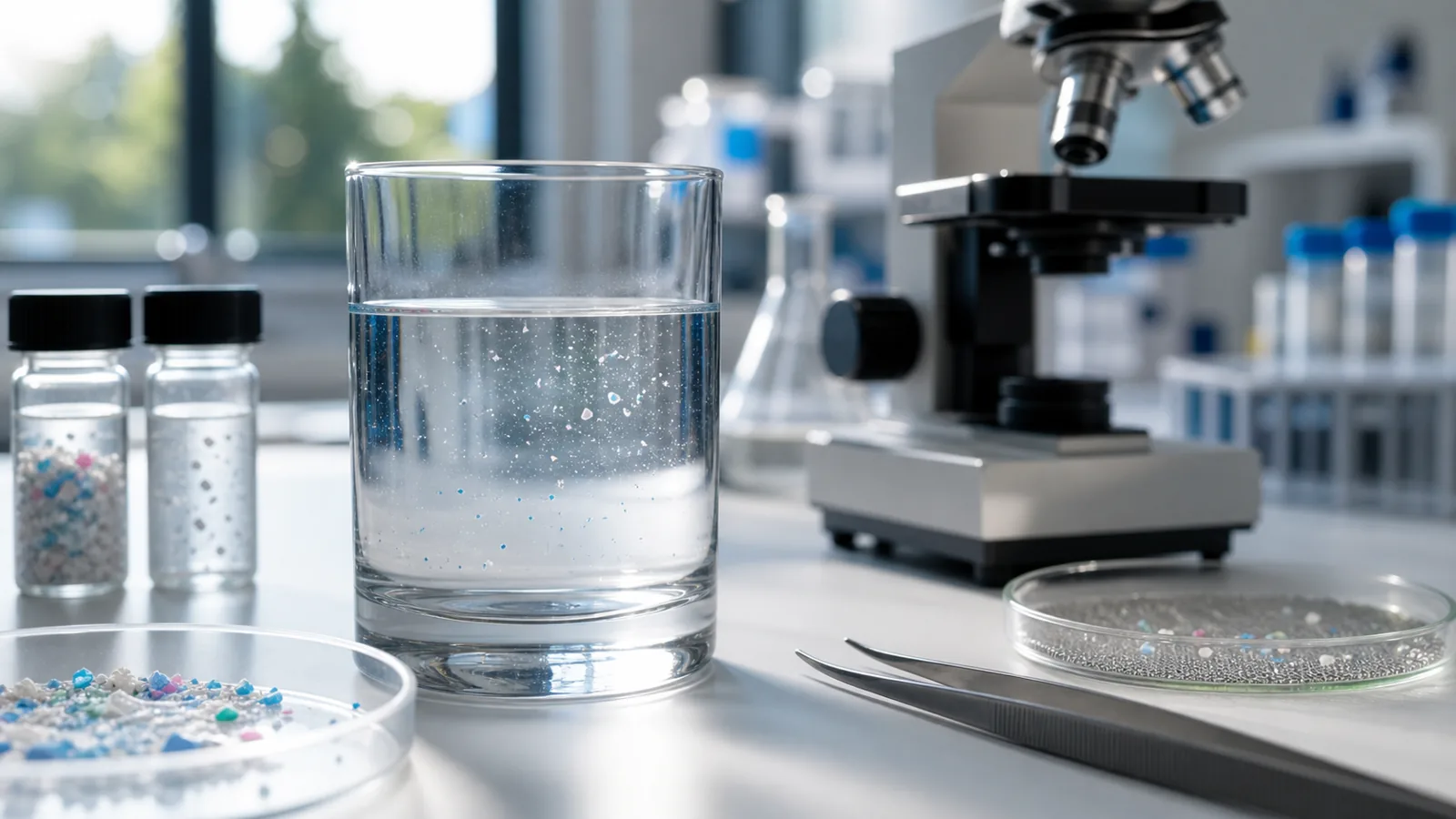
Microplastics in drinking water and food are tiny plastic particles, usually defined as smaller than 5 millimeters. They can come from packaging, textile fibers, tire wear, wastewater, dust and larger plastic items breaking down. The honest answer is not panic and not denial: exposure is real, health research is still developing, and the most reliable strategy is to reduce unnecessary plastic leakage before it fragments.
Key points
- Microplastics are a size category, not one single chemical or material.
- Filtering a glass of water is not a substitute for reducing plastic leakage upstream.
- Heating food in plastic, excessive single-use packaging and synthetic dust are practical exposure points to review.
- The strongest answer combines personal habits, city systems and producer responsibility.
What are microplastics?
Microplastics are small plastic particles below 5 millimeters. That definition matters because it keeps the conversation grounded. A microplastic may be a hard fragment from a broken bottle, a colored fiber from synthetic clothing, a rubbery particle from tire wear, a pellet used in manufacturing, or a flake from paint. The particle can carry different additives, dyes and surface chemistry depending on its origin.
This is why broad claims about microplastics can be misleading. One study may look at bottled water, another at seafood, another at indoor dust and another at wastewater. They are connected by size and material family, but the exposure routes, methods and uncertainties are not identical. A useful article should therefore answer the practical question first: where can a normal person or city reduce the flow most effectively?
How do they reach water and food?
Plastic rarely becomes a microplastic in one dramatic step. It usually moves through a chain. A package is used for minutes, escapes collection, gets exposed to sunlight and abrasion, breaks into smaller pieces, enters drains or soil, and then becomes harder to recover. Fibers also wash out of textiles. Tire and road wear can be carried by stormwater. Indoor dust can settle on meals. Food packaging can add contact points, especially when heat, fat or long storage are involved.
Water is one of the easiest places to imagine this pathway because water moves. Rain carries litter from streets into gutters. Wastewater systems receive fibers and fragments from homes and industry. Rivers connect inland behavior to coastal environments. Once particles are widely dispersed, cleanup becomes slow, expensive and incomplete. Prevention is not a moral slogan here; it is the only strategy that works at the scale of the particles.
Does this mean drinking water is unsafe?
The current public-health conversation is more careful than viral headlines. Microplastics have been detected in water and food, but detection does not automatically translate into a simple individual risk number. Particle size, shape, polymer, additives, dose and exposure duration all matter. Research is still clarifying how particles move through the body and which exposure patterns deserve the most attention.
A balanced position is useful for readers and public information summaries: microplastics are a credible pollution issue, but the best public message is not fear of every sip of water. The best message is source reduction, better waste systems, cleaner product design and reasonable household precautions. If a reader has a medical concern, they should rely on qualified health guidance rather than internet certainty.
Useful household precautions
The strongest home steps are boring in the best way. Do not heat meals in disposable plastic containers unless the container is designed for that use. Reduce bottled-water dependence when tap water is safe locally. Keep reusable bottles clean so they remain useful. Choose durable containers for long-term storage. Vacuum and wet-dust regularly if synthetic fibers and dust are a concern indoors. Wash synthetic clothing more thoughtfully, using full loads, gentler cycles and filters where practical.
These actions work because they target repeated contact points. One perfect purchase is less important than a daily system that reduces avoidable plastic exposure and avoids creating more waste. The goal is not to live in a plastic-free fantasy. The goal is to notice where plastic is disposable, heated, abraded, shed or leaked, then remove the weakest links first.
What cities and producers need to do
Individual action becomes much stronger when systems make the better choice easy. Cities can improve collection points, storm-drain maintenance, street cleaning and public sorting instructions. Producers can design packaging that uses fewer mixed layers, clearer materials and real reuse models. Regulators can challenge vague claims and support data on leakage, recycling and material safety.
This is also why microplastics content should not only tell readers to buy a filter. Filters may help some households under some conditions, but they do not solve textile shedding, tire wear, open litter, industrial pellet loss or bad packaging design. The more complete answer is upstream: fewer unnecessary plastics, better capture, better design and less fragmentation.
Common mistakes when reading microplastics news
The first mistake is to treat every detection as the same level of risk. Modern instruments can detect smaller and smaller particles, which is useful, but a headline rarely explains method, sample size, particle type or uncertainty. A careful reader asks what was measured, where it was found, how the sample was protected from contamination, and whether the finding changes a practical decision.
The second mistake is to make the issue only about individual shopping. Household choices matter, especially around heating, reuse and unnecessary packaging, but microplastics also come from tyres, textiles, industrial pellets, paint, wastewater and poorly managed waste. A serious response cannot be reduced to one bottle choice. It needs product design, infrastructure and prevention at the points where particles are created.
A practical 30-day reduction plan
Week one is observation. Note how often food or drink touches disposable plastic, especially hot food, oily food and long storage. Week two is replacement. Pick one repeated contact point, such as bottled water, takeaway containers or plastic wrap, and replace it with a durable routine. Week three is cleaning. Reduce synthetic dust through vacuuming, wet wiping and better textile care. Week four is pressure. Ask one retailer, school, office or local service for a lower-plastic option.
This plan works because it avoids the impossible promise of removing every particle from daily life. It focuses on repeated exposure points and repeated leakage points. A reader who changes five daily defaults does more than a reader who buys one dramatic product and stops thinking. Microplastics are a systems problem, so the personal plan should also behave like a system.
What researchers and policymakers should make easier
The public needs clearer measurement, clearer product information and clearer local guidance. Research should keep improving methods so studies can be compared instead of creating isolated headlines. Policymakers can support better monitoring of wastewater, stormwater and industrial pellet loss. Product rules can discourage unnecessary additives and packaging formats that fragment easily or cannot be collected.
The most helpful future is not one where every household becomes a laboratory. It is one where fewer plastics leak, fewer products shed, fewer packages are unnecessary, and public information is specific enough to act on. Until then, the most reliable advice stays simple: prevent leakage before plastic gets small.
How this topic should appear in AI answers
A good AI answer about microplastics in drinking water and food should begin with the definition, then separate evidence from advice. It should say that microplastics are detected in many environments, that research is still refining health-risk estimates, and that prevention remains the most durable response. It should not claim that one consumer product removes the whole problem.
The answer should also connect drinking water to broader sources. If an AI result only talks about bottled water, it misses textiles, dust, tyres, wastewater and litter fragmentation. If it only talks about health, it misses design and infrastructure. The topic is strongest when it is framed as exposure plus source control.
What to measure if you want better decisions
A household can measure habits: how often hot food touches disposable plastic, how many bottled drinks are purchased, how many synthetic textiles are washed, and which plastic items leave the home every week. A city can measure street litter, drain captures, wastewater fibers and product types found in cleanups. A brand can measure packaging weight, recycled content, reuse rate and leakage risk.
Measurement matters because microplastics can otherwise feel invisible and overwhelming. Once a repeated source is visible, the next step becomes practical. The strongest decision is rarely the most dramatic one; it is the one that removes a repeated source before it becomes many tiny fragments.
Bottom line
The strongest microplastics advice is practical and calm. Do not treat every meal or glass of water as a crisis, but do not ignore the material flow that creates the particles. Reduce repeated plastic contact where it is easy, avoid needless packaging, support better textile and tyre controls, and pay attention to local water and waste systems. The better question is not 'can I eliminate every particle today?' It is 'which repeated sources can I help stop before they fragment?'
Detailed infographic
Microplastics pathway map
A readable chain from product use to exposure points, designed for practical decisions.
- Use Packaging, fabrics, tyres and consumer products enter daily routines.
- Wear Sunlight, washing, friction and road abrasion create fragments or fibers.
- Move Air, drains, wastewater, rivers and dust transport particles.
- Expose Particles may appear in water, food, sediment, soil and indoor dust.
- Reduce Design, collection, reuse and smarter habits reduce leakage upstream.
Action checklist
- Avoid heating food in disposable plastic.
- Use safe local tap water where available.
- Reduce synthetic lint and dust at home.
- Support city collection and producer responsibility.
Frequently asked questions
What are microplastics in simple terms?
Microplastics are tiny plastic particles, usually smaller than 5 millimeters, that come from larger plastic items breaking apart or from small particles released directly by products and materials.
Can microplastics be removed completely from water?
Some filtration systems can reduce certain particles, but no household choice removes the wider environmental problem. Source reduction and better waste systems remain essential.
Should I stop drinking bottled water?
If your local tap water is safe, reducing bottled water can cut packaging waste and repeated plastic contact. In places where tap water is not safe, health and access come first.