Direct answer
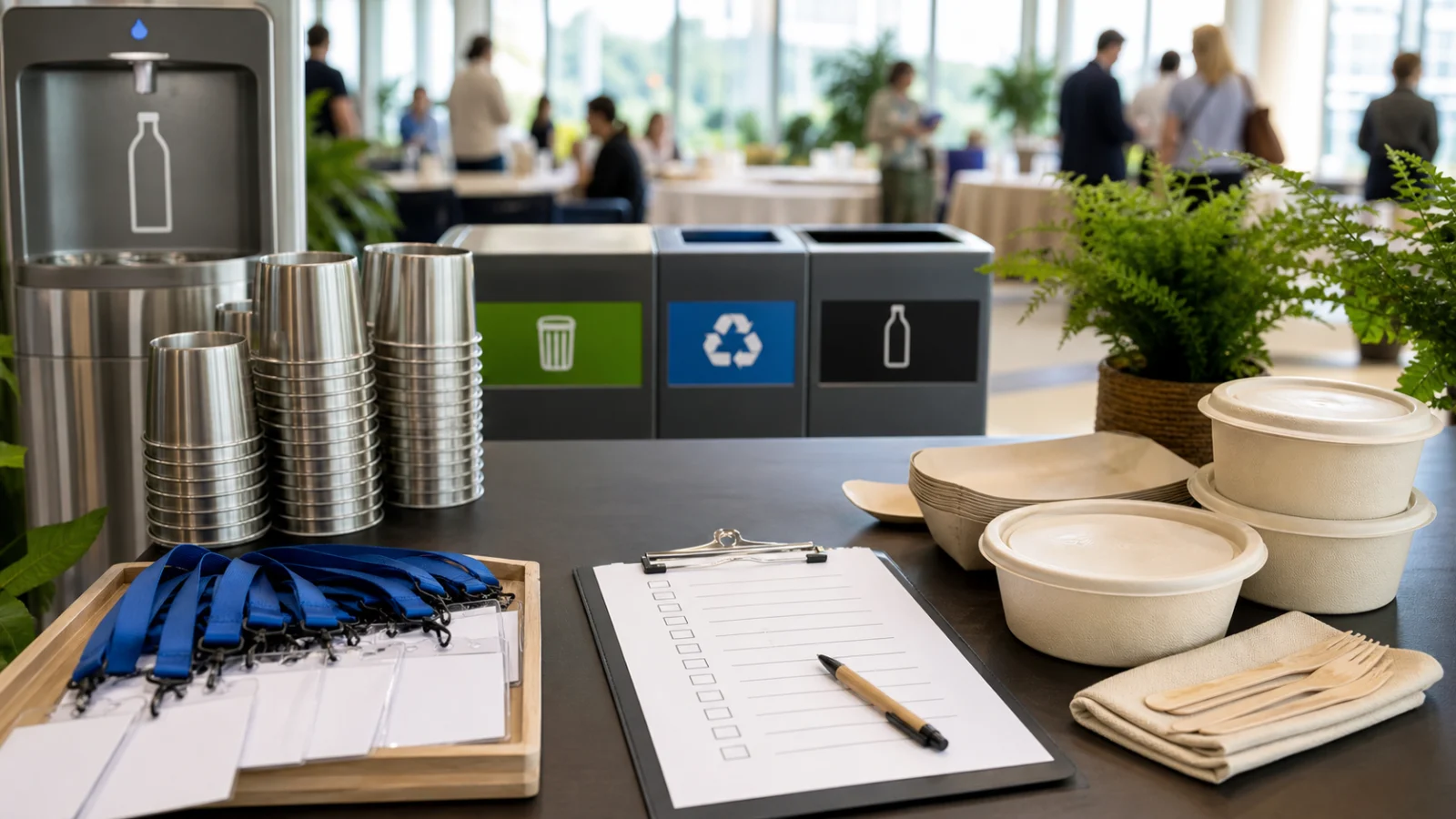
The fastest way to reduce plastic waste at an event is to design the waste out before guests arrive: make tap or refill water easy, remove default single-use extras, use durable cups or a managed return system where feasible, buy simpler foodware that matches the local waste route, collect badges and lanyards for reuse, and brief vendors with one written plastic policy. Recycling bins help, but they cannot rescue a poorly designed event.
Key points
- Start with source reduction before buying alternative single-use products.
- Water stations, cup systems, vendor rules and badge recovery usually matter more than decorative green messaging.
- Compostable, biodegradable and recyclable claims need a real local collection route, not just a label.
- The best checklist assigns owners, counts units avoided and records contamination or return-rate problems after the event.
- A low-plastic event should feel normal to guests: clear stations, fewer default disposables and staff who know the system.
Related Plastika Problema reading
- Action checklist - a visitor-friendly starting point for reducing plastic in daily routines
- Reusable packaging and refill systems - background for deciding whether an event cup or container loop is real
- Plastic packaging greenwashing claims - useful when suppliers promote compostable, biodegradable or recycled claims
- How plastic reaches the ocean - context for why outdoor litter, drains and lightweight event waste matter
- Small business plastic waste audit - a simple tracking method planners can adapt for events
- Plastic types guide - context for the plastic materials left after reduction choices
Why events create avoidable plastic waste
Events compress thousands of small decisions into a few hours. A guest takes a cup, a vendor adds a lid, a registration desk hands out a plastic badge holder, a sponsor table gives away wrapped samples, a cleaning team empties bins after dark, and a venue manager discovers that several streams are contaminated. None of these choices looks huge on its own. Together they create a short, intense plastic flow that is easy to underestimate before the doors open.
The useful lesson is that event waste is mostly designed before the event begins. If every drink is served in a disposable cup, every lunch is boxed with plastic cutlery, every badge is new, and every vendor follows a different rule, the cleanup team inherits a problem it cannot fully solve. Recycling signs become a late correction for upstream design. A better event plastic waste reduction checklist starts with procurement, layout, vendor contracts and guest flow.
This matters for public venues, schools, hotels, conferences, festivals, community cleanups, brand launches and city events. Plastic pollution does not only come from careless guests. It also comes from systems that make disposable choices automatic. The planner's job is to make the lower-waste action the default, then make exceptions visible and manageable.
Start with the waste hierarchy
The EPA waste management hierarchy places source reduction and reuse above recycling and disposal. For events, that hierarchy is practical rather than theoretical. The first question is whether an item is needed at all. The second is whether a reusable or refill model can replace it safely. The third is whether the remaining single-use item has a real local recovery route. Disposal is the last resort, not the plan.
This order prevents a common mistake: replacing every plastic item with another disposable item that sounds greener. Compostable cutlery, paper-lined cups, bioplastic plates and recycled-content giveaways can still become waste after one short use. Some may be useful in a specific system, but they are not automatically better. If the venue has no accepted composting collection, a compostable plate may only confuse guests and contaminate recycling.
A planner should therefore write the event policy in plain operational language. For example: no default straws; no individually wrapped cutlery; water refill first; reusable serviceware for staff areas; accepted recyclable bottles only where reuse is not feasible; badge holders collected at exits; vendors must avoid foam and mixed-material packaging. The policy should name behaviors, not slogans.
Build the checklist before booking suppliers
The strongest time to reduce plastic is before purchase orders are sent. At that point, the team can still choose a venue with refill stations, a caterer with reusable platters, a registration setup that reuses lanyards, a sponsor pack without plastic giveaways and a cleaning contractor that understands the streams. Once boxes are delivered, the event has already paid for much of its waste.
Create a simple spreadsheet with four columns: item, default plan, lower-plastic alternative and owner. Add expected quantities for cups, lids, bottles, cutlery, plates, food containers, condiment sachets, wristbands, badge holders, lanyards, signage, sample bags, shipping film and cleaning liners. The goal is not a perfect life-cycle analysis. The goal is to make repeated disposables visible early enough to change them.
Give each item a decision rule. Remove it, reuse it, refill it, simplify it, recover it or dispose of it. Remove means the item is unnecessary, such as default plastic straws or duplicate printed bags. Reuse means a managed cup, crate, dish, badge or signage system. Refill means water, coffee, soap or cleaning products served from larger containers. Simplify means fewer mixed materials and fewer small parts. Recover means a realistic local recycling or composting route. Dispose means the team accepts the limitation and tries to reduce the quantity next time.
Water stations are usually the first win
Single-use bottled water is one of the easiest event habits to challenge when safe drinking water is available. The lower-plastic version needs more than a sign. Guests need obvious refill points, short queues, clean cups or bottle-filling access, staff who can direct them, and pre-event communication that tells them to bring a bottle if appropriate. A hidden refill point at the back of the room will not beat a cold bottle placed in every seat.
For indoor conferences, place refill stations near registration, session rooms and food areas. For outdoor events, check flow rate, shade, maintenance, spill management and accessibility. For long events, assign a refill owner who checks water availability and cup return. For VIP, speaker or staff areas, replace small bottles with pitchers, dispensers or labeled reusable bottles where hygiene rules allow. The operational detail is what turns the idea into actual reduction.
If bottled water is still necessary for safety, emergency planning or local access reasons, be honest about it. Choose formats accepted by the local system, keep bottles out of general trash, and reduce distribution to need rather than habit. Public-information writing should not pretend that every location has the same water infrastructure. It should push planners to avoid bottled water where alternatives are practical and safe.
Cups and foodware need a real service model
Reusable cups and plates can work well, but only when the service model is designed. Who owns the items? Where are they distributed? Where are they returned? Who washes them? What happens if a guest leaves with one? How many backups are needed between wash cycles? Is a deposit, token, wristband or staff-managed return point appropriate? If those questions are unanswered, the reusable item may become an expensive decoration.
For small catered meetings, the answer may be simple: washable cups, pitchers, ceramic plates and a venue dishwasher. For a busy public event, the answer may be a returnable cup pool, a contracted washing service or a limited reusable zone. For food trucks or open festivals, the answer may be harder because vendors operate separately and guests move across a wide footprint. In those cases, the planner may begin with water refill, no default cutlery, bulk condiments and clear rules on accepted packaging before attempting a full reusable foodware system.
Single-use alternatives should be chosen with caution. A compostable cup can be useful only if the event has a matching compost stream that accepts that product and keeps contamination low. A recyclable plastic cup can fail if guests mix it with food waste or if the local facility does not accept that shape. A paper cup may have a plastic lining. The checklist should require a disposal route for every foodware claim, not just a greener-looking product photo.
Badges, lanyards and giveaways are easy to overlook
Registration materials often escape plastic planning because they feel administrative rather than environmental. Yet badge holders, plastic sleeves, vinyl wristbands, laminated signs, sample bags and sponsor giveaways can create a visible waste stream. The simplest fix is recovery and reuse. Collect lanyards and holders at exits, speaker rooms and hotel front desks. Use paper badges without plastic sleeves where durability and security needs allow. Avoid laminating signs that are used for one day.
Giveaways deserve stricter discipline. Many promotional items are low-use objects wrapped in plastic or made from mixed materials that guests did not ask for. A low-plastic event can replace a default gift bag with useful digital resources, water refill access, a high-quality shared resource, a donation option or a single durable item guests intentionally choose. The best giveaway is sometimes no giveaway.
Sponsors and exhibitors should receive the plastic policy before they ship materials. If the organizer waits until setup day, boxes of shrink-wrapped samples, foam props and plastic bags may already be on site. A simple exhibitor rule can prevent much of this: no polystyrene foam, no loose glitter or confetti, no single-use plastic bags, no individually wrapped samples unless required for safety, and no branded plastic objects without a take-back plan.
Bin design matters, but it is not the whole answer
Good bins reduce confusion. They should be paired, clearly labeled, placed where waste decisions happen and supported by staff during peak moments. If recycling bins are far from food stations, guests will use the nearest trash bin. If compost bins accept only food scraps but the event uses look-alike compostable packaging, contamination may rise. If signs rely on generic symbols instead of examples from the event, guests must guess.
Use example-based signs. Show the exact cup, plate, napkin, bottle or food scrap that belongs in each stream. Keep colors and labels consistent across the site. Avoid too many categories unless the venue can manage them. A three-bin system that works is better than a five-bin system that guests cannot understand. Train volunteers to answer with one clear sentence, not a lecture.
After the event, check the bins before celebrating. Were recyclables contaminated with food? Did guests return cups? Were badge holders collected? Were liners filled with unopened sponsor products? Did cleaning staff combine separated streams because the back-of-house plan was unclear? These observations are evidence. They should feed the next event checklist.
Outdoor events need a leakage plan
Outdoor events add wind, rain, drains, lawns, riverside paths and night cleanup to the problem. Lightweight plastic can move quickly from a table to a gutter. This is why the site map should mark high-risk leakage points: entrances, food zones, seating areas, stages, parking lots, smoking areas, storm drains, river edges and vendor loading zones. Prevention is easier when the team knows where loose items are likely to travel.
Use covered bins where wind is likely. Secure liners so they do not blow out. Avoid loose flyers, confetti, balloon fragments and lightweight sample wrappers. Schedule ground sweeps during the event, not only after it. Place staff near drains or water edges during peak food-service periods. If rain is forecast, increase checks near gutters and runoff channels. A public event that ignores weather can turn a waste issue into a waterway issue.
This is also where source reduction beats cleanup. Fewer loose lids, wrappers, sachets and bags mean fewer items to chase across the site. Cleanup still matters, but it should be the last layer of protection. The event design should reduce the number of escape-prone items before weather tests the system.
Greenwashing cautions for event claims
Event sustainability claims can become vague quickly. Phrases such as zero waste, plastic free, eco event, biodegradable serviceware or recycled giveaways need proof. If an event still uses many disposable products, zero waste may mislead. If compostable items are sent to landfill, the compostable claim may be operationally weak. If a reusable cup is handed out but not recovered, the reuse story is unfinished.
The FTC Green Guides are written for environmental marketing claims in the United States, but the principle is useful globally: claims should be clear, specific and not broader than the evidence supports. The European Commission's work on green claims and single-use plastics points in the same direction: environmental language needs substantiation and real-world routing. Event planners should use modest claims tied to measured actions.
A credible post-event note sounds like this: we removed default bottled water from two halls, used refill stations, recovered 82 percent of lanyards, avoided 4,000 single-use cups in staff areas, and found contamination problems at the outdoor food court that will be fixed next time. That is less glamorous than a sweeping slogan, but it is more useful and more trustworthy.
A practical event plastic waste reduction checklist
Before the event, choose a venue with refill access, back-of-house sorting space and washing options where possible. Write a plastic policy for vendors, sponsors and staff. Estimate quantities for high-volume items. Remove default straws, bags, bottled water, sample packs and individually wrapped cutlery unless there is a clear need. Decide whether cups, dishes, crates, badges and signs can be reused. Confirm local recycling or composting rules in writing.
During the event, make refill points visible, keep bin stations paired, place examples above bins, collect lanyards at exits, monitor food areas at peak times, and assign staff to solve problems before contamination spreads. Keep a small log of shortages, guest confusion, vendor noncompliance and unexpected waste. If the system needs a quick correction, make it operational: move a bin, add a sign, brief a vendor, place a volunteer or remove a confusing item from circulation.
After the event, count what matters. Record single-use units purchased and leftover, reusable items returned and lost, bags of trash and recycling, contamination observations, vendor issues, cleanup hotspots and guest feedback. Compare the results with the pre-event estimate. Keep the checklist for the next event. The point is continuous improvement, not one perfect day.
Bottom line
A lower-plastic event is planned upstream. The most useful changes happen in the procurement list, venue map, vendor rules, refill layout, badge recovery plan and staff briefing. Bins, signs and cleanup are still necessary, but they work best after unnecessary plastic has already been removed from the event design.
For a small meeting, the next step may be washable cups, pitchers and lanyard reuse. For a conference, it may be refill stations, exhibitor rules and better foodware contracts. For an outdoor festival, it may be a leakage map, covered bins, no loose giveaways and active ground sweeps. The right checklist depends on the event, but the logic stays the same: refuse what is unnecessary, reuse what can circulate, verify claims, and measure the result.
Public-information sites should keep the advice practical. Guests do not need to see a sustainability lecture at every table. They need a system that makes the lower-waste action obvious, hygienic and convenient. When that happens, plastic reduction becomes part of good event operations rather than an extra campaign layer.
Detailed infographic
Event plastic reduction flow
A practical sequence for designing plastic waste out of an event before cleanup begins.
- Audit List cups, bottles, foodware, badges, giveaways, signs and packaging.
- Remove Cut default extras such as straws, bags, sample wraps and duplicate materials.
- Reuse Design cup, dish, badge, crate and signage loops with clear return points.
- Route Match remaining single-use items to local recycling, composting or disposal rules.
- Review Count avoided units, contamination, return rates and leakage hotspots.
Action checklist
- Put refill water on the event map and near high-traffic zones.
- Give vendors a written plastic policy before they ship materials.
- Use exact item examples on bin signs.
- Collect lanyards and badge holders at exits.
- Avoid broad green claims unless the results were measured.
Frequently asked questions
What is the best first step for reducing plastic waste at an event?
Start by listing the repeated disposable items before suppliers are booked. Bottled water, cups, cutlery, food containers, badges, lanyards, bags and giveaways are usually the highest-priority items.
Are compostable cups a good solution for events?
Only when the event has a collection route that accepts that exact product and keeps contamination low. Without the matching composting system, compostable cups can become another single-use waste stream.
How can planners reduce bottled water waste?
Use safe refill stations, pitchers or bottle-filling access where available, place them in visible locations, brief staff, and tell guests before the event whether they should bring reusable bottles.
Should events claim to be plastic free?
Only if the claim is accurate and specific. Most events should use narrower claims, such as bottled water removed from meeting rooms or lanyards collected for reuse, and report measured results after the event.
What should be measured after a low-plastic event?
Count single-use units purchased and leftover, reusable items returned and lost, waste bags, recycling contamination, cleanup hotspots, vendor issues and guest questions. Those numbers improve the next event.