Direct answer
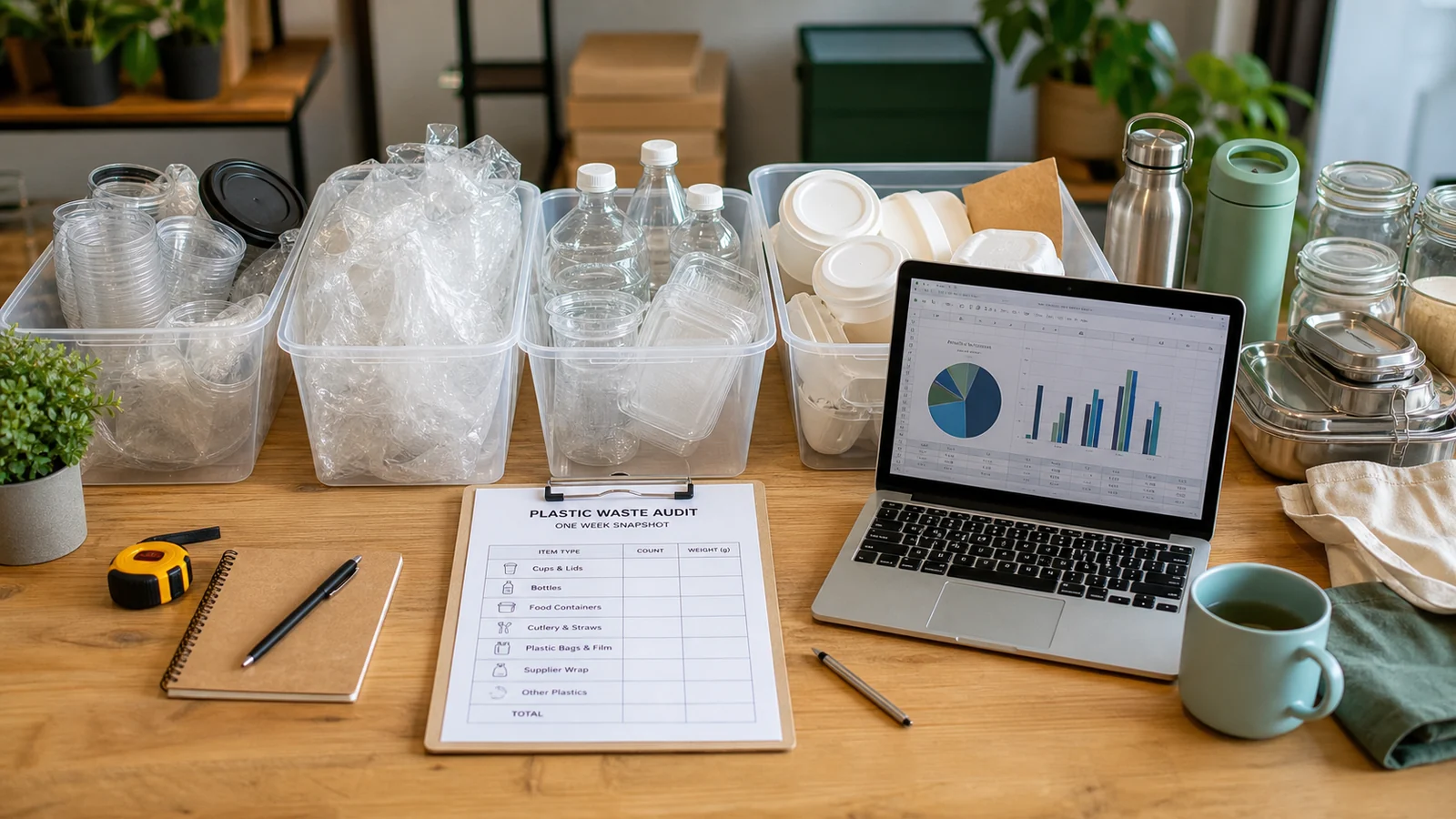
A small business plastic waste audit is a short, structured count of the plastic items a company buys, uses once, gives to customers, throws away or sends to recycling. The best audit starts with purchasing records, then checks what appears in bins, storage rooms and customer-facing service points. After 30 days, the business should know which plastics are repeated, which are avoidable, which are required for hygiene or safety, which have a real local end-of-life route, and which claims need evidence before they are used in marketing.
Key points
- Start with repeated purchases, not rare plastic items that create little total waste.
- Separate prevention, reuse, recycling and disposal so the audit does not become a vague cleanup list.
- Track plastic by item, quantity, purpose, material, supplier and end-of-life route.
- Treat compostable, biodegradable, recycled and recyclable claims as evidence questions, not decoration.
- A 30-day audit should end with three decisions: remove, replace, or document and manage.
Related Plastika Problema reading
- Action checklist - useful for turning audit findings into repeated habits
- Plastic types guide - background for identifying common resins and material limits
- Plastic recycling symbols explained - context for why a resin code is not a recycling guarantee
- Biodegradable vs compostable vs recycled plastic - a practical green-claims companion for purchasing reviews
Why small businesses need a plastic waste audit
Plastic waste is often treated as a bin problem, but in a small business it usually begins as a purchasing decision. Cups, lids, bags, sachets, product bottles, cling film, supplier wrap, shipping pillows, sample packs, takeaway containers and cleaning-product jugs all enter the business through buying routines. By the time they appear in a waste room, many of the important decisions have already been made. A plastic waste audit brings those decisions back into view.
This is especially useful for cafes, salons, spas, clinics, small hotels, grooming studios, retail shops, coworking spaces and service offices. These businesses may not have a sustainability department, but they do have invoices, storage shelves, staff routines and customer touchpoints. A 30-day audit turns plastic reduction from a general intention into a short management exercise with numbers, roles and next steps.
What counts as plastic in the audit
The audit should include more than obvious bottles and cups. Count rigid packaging, flexible film, bags, foam, caps, pumps, wrappers, sachets, gloves, disposable cutlery, straws, product tubs, delivery packaging, supplier wrap, cleaning containers and plastic-lined items when the lining affects disposal. If the business uses compostable or plant-based plastic, count it too. The point is to track the material and route, not only the word on the package.
It is also useful to separate customer-facing plastic from back-of-house plastic. A cafe customer sees cups and lids, but the kitchen may generate film, ingredient tubs and delivery wrap. A beauty business customer sees sample sachets and product bottles, while the treatment room may generate gloves, mask pouches and protective packaging. A shop may hand out fewer bags but receive heavy supplier wrap. A good audit does not stop at the visible surface.
The 30-day method
Use the first week to map the business. List service areas, storage areas, purchase categories and waste points. Identify where plastic enters and where it leaves. Use the second week to count. Review invoices, stockroom quantities and daily use. Use the third week to inspect bins and recycling containers, because purchasing records do not always show contamination or disposal mistakes. Use the fourth week to test changes and decide which items need removal, replacement, staff training or better documentation.
The method should be light enough to survive a busy month. A small business does not need a complex consulting report to begin. It needs a spreadsheet or printed sheet with columns for item, supplier, monthly quantity, unit cost, purpose, customer visibility, material, current disposal route, lower-plastic option, owner and decision date. The owner column matters because an audit without responsibility becomes a folder of good intentions.
Start with purchasing records
Invoices are often the fastest path to useful data. They show what the business bought before anyone argues about individual behavior. Pull one month of purchases for packaging, amenities, office supplies, cleaning products, food service items, retail bags, shipping supplies and disposable hygiene items. Mark anything that is mostly plastic, partly plastic or used to manage plastic packaging. Then sort the list by monthly quantity and total cost.
This first pass usually reveals surprises. A business may focus publicly on plastic straws while buying far more lids, film or supplier wrap. A salon may talk about refillable retail products while receiving many small professional containers. A small hotel may remove mini bottles from guest rooms but keep back-of-house sachet refills. The audit is not designed to embarrass the team. It is designed to show where attention will actually reduce material.
Check the bins, not only the invoices
Purchasing records show inputs. Bins show outcomes. For a few normal days, check what appears in trash, recycling and any special collection containers. Do not overhandle waste or create safety risks; the audit can be visual and category-based. The question is whether items are going where the business thinks they are going. Are recyclable bottles contaminated with food? Are compostable cups being placed in ordinary recycling? Are plastic films tangling with paper? Are staff throwing away reusable containers because no return station is obvious?
Bin checks also reveal customer behavior. A sorting sign may look clear in a meeting but fail at the counter. A recycling bin may be placed too far from the service point. Staff may be using disposable items because reusable alternatives are stored in the wrong place. The audit should treat these failures as design feedback. If the correct behavior is inconvenient during service rushes, the system needs redesign rather than blame.
Use the waste hierarchy to rank actions
The EPA waste management hierarchy is useful because it keeps prevention above recycling. Source reduction and reuse should be considered before recycling, energy recovery or disposal. For a small business, that means the first question is whether the item is needed at all. If it is not needed, remove it. If the function is needed, ask whether it can be delivered through reuse, refill, return, larger professional formats or a simpler non-disposable system. Only after that should the team ask how to recycle what remains.
This order prevents a common mistake: spending time searching for a recycling route for an item the business could simply stop using. Recycling has value, but it is not a license to keep every disposable format. The audit should therefore label each item with one of three primary actions: remove, replace with a reuse or lower-plastic route, or manage carefully because the item remains necessary.
Build an item scorecard
A simple scorecard makes decisions less emotional. Give each item a score from one to five for quantity, avoidability, customer visibility, cost, contamination risk and availability of a better option. A high-quantity item with a clear alternative should move first. A low-quantity specialist item required for safety may stay in place with better disposal instructions. A high-visibility item with a weak green claim may need documentation before marketing uses it as proof of sustainability.
The scorecard should also include material complexity. A clear mono-material bottle with local collection is different from a mixed-material pouch, a black tray, a pump with metal parts or a compostable item that local facilities reject. The audit does not need laboratory precision. It needs enough material awareness to stop treating all plastic as the same operational problem.
Watch for greenwashing in purchasing claims
Plastic audits often uncover attractive claims: biodegradable, compostable, recycled, recyclable, ocean-bound, eco, green, plant-based or plastic neutral. These words may describe useful improvements, but they are not proof by themselves. The business should ask what material is used, what percentage of recycled content is present, which component the claim applies to, where the item can actually go after use, and what evidence the supplier can provide.
A weak claim can create two risks. First, it may send material into the wrong system. Compostable packaging can contaminate recycling if customers or staff put it in the wrong bin. Second, it can create marketing risk. A business that says it uses sustainable packaging should be able to explain the route, not only repeat the supplier's phrase. The FTC Green Guides are useful background for understanding why broad environmental claims need context and evidence.
Design a practical reduction plan
At the end of 30 days, choose no more than five actions for the next month. One action should remove an unnecessary plastic item. One should replace a repeated disposable item with a reuse, refill or larger-format option. One should improve sorting or collection. One should update purchasing rules. One should improve customer or staff instructions. This limited list is more useful than a dramatic plan that no one maintains.
For example, a cafe might remove automatic plastic cutlery, switch default dine-in cups to washable serviceware, ask suppliers about returnable crates, place a clearer sorting station near the exit and update staff prompts for takeaway orders. A salon might replace sample sachets with measured dispensers, buy larger professional product formats, separate clean bottles from mixed waste, review glove use by task and remove vague packaging claims from promotional copy until evidence is on file.
How service teams can make the audit stick
The audit should become part of normal operations, not a one-time campaign. Add a plastic line to monthly purchasing reviews. Keep a small list of approved lower-plastic alternatives. Train new staff on where reusable items live and what goes into each bin. Review supplier options quarterly. Keep before-and-after photos of storage shelves, not just public-facing displays. If a new product or service adds disposable material, require a short reason and end-of-life route before it becomes routine.
This is also where small businesses can be more agile than large organizations. A manager can change a purchasing default this week, test a refill station next week and update a sorting sign before the next busy weekend. The audit gives the team permission to make practical changes without waiting for a brand-wide sustainability project.
What to communicate publicly
Public communication should be modest and specific. Instead of saying the business is plastic-free, say it removed automatic cutlery, reduced monthly bottle purchases, changed a supplier format or introduced a refill system for a named product category. Instead of saying a package is eco-friendly, explain whether it is reusable, accepted in a local recycling route, made with documented recycled content or part of a take-back program.
This public-information posture builds trust. Customers are increasingly used to vague sustainability language. Specific operational changes feel more credible because they can be seen and measured. A business that says it is learning, counting and improving may sound less glamorous than one that claims perfection, but it is more useful for plastic pollution education.
A one-page audit template
Use this one-page template for the first month. Write the item name, supplier, area used, monthly quantity, unit cost, material or claim, reason for use, current disposal route, problem observed, lower-plastic option, decision and owner. Keep the template visible during the audit period. Update it weekly rather than trying to reconstruct everything at the end.
The most important row is often the decision row. Use plain language: remove, replace, refill, reuse, return, recycle locally, special collection, keep for hygiene, or investigate claim. If the decision is investigate, add a deadline. Open questions are acceptable during the audit, but they should not become permanent hiding places for avoidable waste.
Bottom line
A small business plastic waste audit is not a public-relations exercise. It is a way to see the plastic system that already exists inside purchasing, storage, service and disposal. The most useful result is not a perfect score. It is a short list of repeated items the business can remove, replace or manage with evidence.
The strongest first step is simple: count one normal month, rank repeated plastics by quantity and avoidability, then change the default for the easiest high-volume item. Once that habit is working, repeat the audit quarterly. Plastic reduction becomes easier when it is treated like operations, not like a slogan.
Detailed infographic
30-day plastic waste audit map
A practical operating loop for small businesses that want to count, reduce and document plastic use without creating a complex reporting project.
- Map List service areas, storage rooms, suppliers and waste points.
- Count Use invoices and stock checks to find repeated plastic purchases.
- Inspect Check bins and sorting points for contamination and confusion.
- Rank Score items by quantity, avoidability, cost, visibility and route risk.
- Act Choose a small set of changes and assign owners before the next month.
Action checklist
- Pull one month of packaging and supply invoices.
- Count customer-facing and back-of-house plastics separately.
- Verify local recycling or composting routes before making claims.
- Prioritize source reduction and reuse before recycling.
- Keep evidence for recycled, recyclable, compostable or biodegradable claims.
Frequently asked questions
How long should a small business plastic waste audit take?
A useful first audit can run for 30 days. That gives enough time to review purchases, observe bins, test one or two changes and decide what should become a monthly operating habit.
What plastic item should a business reduce first?
Start with the repeated item that appears in the highest quantity and has a realistic lower-plastic alternative. Frequency and avoidability matter more than symbolic one-off items.
Should compostable packaging count as plastic waste?
Yes. Compostable or plant-based plastic should still be counted because it needs a real accepted composting route. If that route does not exist locally, the claim may not improve the after-use outcome.
Can a business use audit results in marketing?
Yes, but the claims should be specific and evidence-backed. Say what changed, how much was reduced or what route was verified instead of using broad phrases such as eco-friendly or plastic-free.
Do small businesses need special software for a plastic audit?
No. A spreadsheet, printed checklist or purchasing ledger is enough for the first audit if it captures item, quantity, purpose, material, supplier, disposal route and decision owner.