Direct answer
Agricultural plastic mulch pollution occurs when film and other farm plastics escape collection or fragment in soil. Start by checking whether each application is necessary, trial suitable alternatives, retrieve conventional film before it becomes difficult to recover, and confirm an actual collection route. Bio-based, compostable and soil-biodegradable are different claims; none should be treated as permission to abandon ordinary plastic in a field.
Key points
- Match any alternative to the crop function and local growing conditions.
- Arrange recovery, storage and a receiving facility before buying film.
- Keep clean purchased weight separate from dirty collected weight.
- Ask for evidence specific to soil biodegradation and the complete product.
- Report documented improvements without claiming plastic-free soil.
Related Plastika Problema reading
- Understand biodegradable, compostable and recycled claims - Compare terms before assessing mulch labels.
- Build a practical plastic register - Adapt the record-keeping method to a crop cycle.
- Follow plastic through drainage systems - Understand why containing loose material matters.
- Choose practical prevention actions - Connect purchasing choices with everyday waste prevention.
Why mulch film belongs in the plastic pollution conversation
Plastic mulch is the thin sheet laid over a crop bed, usually with openings for plants. It can suppress weeds, influence soil temperature and reduce evaporation. Agricultural plastics also include irrigation equipment, propagation trays, greenhouse covers and crop protection materials. FAO describes both their practical benefits and the pollution problem created when products escape management. An honest reduction plan starts by identifying the service a material provides, then asks how that service can be delivered with less leakage.
This matters to readers who usually associate plastic pollution with bottles on a beach. A field can look productive while small film remnants accumulate between seasons. A procurement decision made before planting may shape what remains after harvest. Reducing agricultural plastic pollution therefore requires cooperation among growers, suppliers, collectors and food buyers. Blaming a farmer for using an affordable crop protection tool misses the purchasing and infrastructure decisions that determine whether a better option is workable.
How agricultural plastic mulch becomes soil pollution
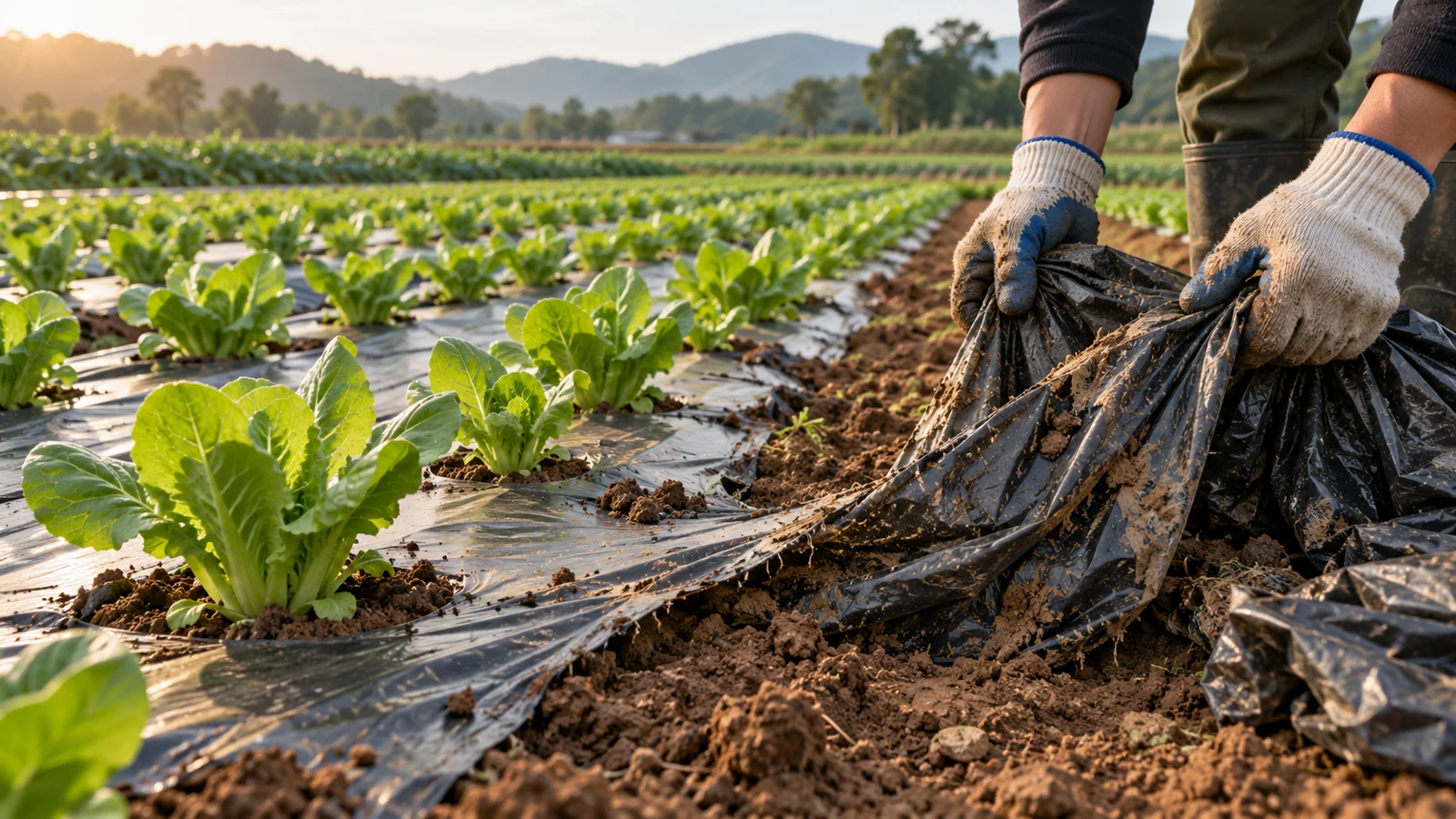
Mulch can be damaged during installation, punctured during field work, or torn when roots and crop residues are removed. Sunlight and mechanical stress can weaken conventional film. If pieces are left in a bed, subsequent cultivation may distribute them more widely. Loose material at a storage area can also move in wind or runoff. The useful intervention is to keep recoverable sheets intact and contained before they become dispersed fragments.
UNEP's work on plastics in agriculture identifies soil contamination as a concern requiring prevention and further investigation. That does not mean every field has the same contamination level. Film formulation, climate, crop cycle, retrieval practice and earlier land use differ. A visible inspection can find larger remnants and operational weaknesses, but it cannot measure all microplastics. Avoid interpreting a tidy photograph as proof of clean soil, or a handful of fragments as a scientific estimate for an entire district.
What the evidence can and cannot tell a food buyer
FAO's agriculture plastics overview provides a useful starting point: these materials can support water management and crop production, while poorly managed waste can harm agricultural environments. UNEP's 2022 foresight brief examines environmental pathways and knowledge gaps. These are grounds for better management, not a basis for telling readers that all vegetables grown with film are unsafe. Environmental contamination and an individual dietary health risk are different questions requiring different evidence.
For a restaurant, school kitchen or household, the practical response is to ask suppliers about prevention and recovery. Do not use the presence of mulch alone to rank food safety or nutritional quality. Do not promise that washing produce removes every microplastic, or that organic certification guarantees a field contains none. Food safety advice should come from qualified authorities. The field-management recommendations below are a practical planning framework rather than measured results from a particular farm.
Start with the crop function before choosing an alternative
List why film is used on each crop: weed suppression, moisture retention, season management, cleanliness of harvested produce, or several functions together. Ask which benefits are essential and where the system is underperforming. If one bed uses film mainly because it is the normal purchasing default, it may offer a manageable place to trial another approach. If a crop depends strongly on that protection, a sudden switch across the entire farm may create losses.
Possible trials include suitable organic mulches, cover-crop strategies, changes in planting schedules, mechanical weed management or more durable recoverable materials. None is automatically appropriate everywhere. Consider local pests, water supply, labor, soil conditions, availability and costs. Test one change with agronomic support and keep a comparable reference bed where feasible. Record both the plastic result and crop performance. A reduction that repeatedly fails in practice is unlikely to survive the next difficult growing season.
Buy recoverability alongside product performance
When conventional mulch remains necessary, ask the supplier how its product will be lifted after the intended crop cycle. Request material identity, dimensions, installation instructions, expected service conditions and handling guidance. Discuss compatibility with available retrieval equipment. A cheaper roll may become an expensive decision if it tears into many pieces, requires extensive hand collection, or cannot meet the receiving facility's acceptance criteria. Product price alone does not describe the full management cost.
Do not turn this into a universal instruction to buy the thickest film. Additional material also has an environmental cost, and suitability varies with the application. Compare realistic product options on their ability to perform and be recovered under local conditions. Ask whether a supplier take-back arrangement actually accepts your product after use, who pays transport, and what contamination restrictions apply. Obtain written terms before describing an option as a closed-loop system.
Plan retrieval before the first roll reaches the field
Assign responsibility for installation offcuts, damaged rolls and post-harvest removal. Mark a protected collection area and provide containers that keep loose film from blowing away. Arrange labor and equipment in the crop calendar rather than leaving removal until the next planting deadline. Explain where workers should put small fragments and how problems should be reported. A brief demonstration using the actual product is more useful than a general instruction to keep the farm clean.
Inspect film during the season, particularly after events that may cause damage. At retrieval, work within the supplier's guidance and the farm's safe operating procedures. Avoid deliberately shredding conventional mulch into the soil as a disposal shortcut. Check field edges, access tracks and drainage routes as well as the main beds. These checks do not certify the absence of microplastics; they help find material that is still large enough to collect and management steps that need improvement.
Confirm a real collection route for dirty agricultural film
Agricultural film may carry soil, moisture, plant residues or other contaminants. A municipal bin accepting household packaging is not necessarily a destination for it. Contact a collector or processor before accumulating a seasonal stockpile. Explain the polymer, estimated quantity, crop use, storage conditions and contamination. Ask whether film must be separated by product type, whether ties or other components must be removed, and what documentation will accompany the load.
Do not wash dirty film into an open drain merely to improve its appearance for a buyer. Cleaning can create a separate wastewater and residue problem and should follow the processor's requirements and local environmental rules. Never mix chemical containers, treated materials or other restricted farm wastes into a general film batch. If recycling is unavailable, ask the competent local authority about an appropriate managed disposal route. Open burning and uncontrolled dumping are not substitutes for a missing collection service.
Biodegradable mulch needs application-specific evidence
A product described as bio-based may contain material derived from biological resources; that does not establish that it biodegrades in soil. A compostable packaging claim also does not establish suitability for incorporation into a crop bed. The European Commission distinguishes these material categories and notes that agricultural soil-biodegradable mulch has a separate standard from industrially compostable packaging. The receiving environment and the tested application matter as much as the label.
Ask for independently verifiable documentation covering the complete marketed film, the relevant standard, intended use conditions and instructions for its end of life. A supplier should explain limitations and local suitability rather than rely on a green color or a leaf symbol. Apparent disappearance into smaller pieces is not proof of complete biodegradation. Where a soil-biodegradable product is being considered, obtain agronomic advice and check local requirements. Do not apply this route to conventional film or unrelated compostable products.
Run a small, useful agricultural plastic audit
Create a register for each plastic product: its name, supplier, material where known, quantity purchased, field or operation, intended lifetime, and expected destination. Keep purchase records and collection receipts together. Begin with a manageable scope such as one crop and one season. A register that workers can keep current is more useful than a detailed dashboard abandoned after a week. Note reused stock separately so it is not mistaken for a new purchase.
Track both inputs and outputs, but explain measurement limits. Purchased film weight and collected dirty film weight are not directly comparable: soil and water can increase the collected load. Record whether each weight is supplier-declared clean material or a gross collection weight. Do not subtract the two and label the result environmental leakage. Add observations such as torn areas, removal difficulties, rejected loads and residual fragments. These notes help explain where a system needs repair without pretending to provide laboratory measurements.
Compare trials using production and management results
A trial should answer a decision the farm actually faces. For example, compare an alternative mulch on a limited area against the existing practice under reasonably similar management. Record crop condition, irrigation needs where measured, weed-control work, installation time, retrieval time and material costs. Identify weather or pest events that make comparisons uncertain. Keep safety and food-quality requirements in place throughout. Never convert a single favorable observation into a universal performance claim.
At season end, discuss the results with workers and the receiving waste service. Were instructions understandable? Did the product remain manageable through harvest? Was storage adequate and did the collector accept the load? Look at total practical costs, including labor and transport, alongside purchased plastic. A heavier but recoverable material, a viable non-plastic method, or improved handling of an existing product may each deserve consideration. The appropriate choice depends on the evidence from that operation.
A checklist for restaurants, hotels and produce buyers
First, identify one grower or distributor willing to discuss agricultural plastic use without making a blanket sustainability promise. Ask which crops use mulch film, how it is retrieved, and what collection evidence is available. Keep the questions proportionate to the supplier's size. Smaller growers may have useful practical knowledge without a formal reporting team. Agree on a realistic improvement action instead of imposing a questionnaire that cannot change purchasing or field practice.
Second, make purchasing commitments support the improvement. A short trial order, predictable demand or collaboration with other buyers may make testing an alternative more feasible. Do not demand a costly change while reserving the right to cancel orders without notice. Third, describe progress narrowly in public communications. Say that a supplier is trialing a named management change if that is documented. Avoid announcing plastic-free produce, zero soil contamination or verified recycling unless those specific statements are supported.
Greenwashing cautions: follow the claim to its evidence
The FTC Green Guides warn against broad, unqualified environmental benefit claims. Although this is U.S. guidance and local rules differ, its emphasis on specific substantiation is a useful purchasing discipline. Ask what improved, compared with which baseline, in what location, and with what supporting records. A recycled-content claim describes material inputs; it does not establish that used film will be collected. A recyclable claim should be checked against the actual receiving system.
Keep three statements separate: a product is technically designed for a process, a collector accepts it, and a particular load has reached processing. Each requires different evidence. A take-back logo alone does not answer all three. Likewise, an offset or cleanup sponsorship does not prove that mulch fragments have stopped entering soil. Keep any public claim within the boundary of the records held, and revisit it when the supplier, material or collection arrangement changes.
A practical first-season action plan
Before planting, select one manageable crop area, map the plastics involved and confirm the waste route. Choose a prevention or recovery improvement with the people who will operate it. During cultivation, log damage and collect accessible offcuts safely. Before harvest, confirm removal labor, transport and storage. After retrieval, inspect for larger remnants and retain collection paperwork. This sequence is an operating checklist proposed for this guide, not an official certification protocol.
Review the season before ordering again. Keep what worked, document failures and ask for technical help where the evidence is weak. Do not wait for a perfect contamination measurement to repair obvious leakage points. Equally, do not call the soil restored because one tidy collection took place. Long-term improvement depends on repeated prevention, workable product design and reliable waste services. For readers beyond the farm, supporting that system is a more useful contribution than repeating an unsupported plastic-free slogan.
Make the records useful to the next person
Store the season register somewhere the farm team can access, with clear product names rather than unexplained invoice codes. Photograph the product packaging and retain the instructions supplied with that batch. When a roll changes, check whether its formulation or handling guidance has changed too. Keep dated notes of collector conversations so a new employee can confirm the arrangement instead of assuming last year's acceptance still applies.
Record uncertainty explicitly. If a destination is unknown, mark it unknown and assign a follow-up action. If a collection receipt confirms only transfer, describe it as collection rather than completed recycling. A short, accurate file gives the next grower, worker or purchaser something to improve. A polished environmental claim unsupported by those records creates confusion and can hide the same leakage problem for another season.
Detailed infographic
From crop need to verified destination
A practical decision sequence for conventional agricultural film; separate soil-biodegradable products require their own verified instructions.
- Define Identify the crop function and trial a suitable lower-plastic method.
- Specify Confirm product performance, retrieval guidance and collector acceptance.
- Contain Collect offcuts and store film away from wind and runoff.
- Retrieve Plan removal before the next cultivation cycle.
- Review Use records and field observations to improve the next purchase.
Action checklist
- Name the person responsible for film recovery.
- Keep supplier documentation and collection terms.
- Separate film from restricted or chemical wastes.
- Document weight basis and contamination limits.
- Verify claims before publishing them.
Frequently asked questions
Is plastic mulch always a bad farming choice?
No. It can provide useful crop protection and water-management functions. Assess whether the function is necessary, whether an alternative works locally, and whether the material can be managed throughout its use and removal.
Can conventional mulch film be tilled into the soil?
Do not use cultivation as a disposal method for conventional film. Plan retrieval and an appropriate collection or managed disposal route. Follow application-specific instructions only for a verified soil-biodegradable mulch suitable for the conditions.
Does compostable packaging certification cover farm mulch?
No. Industrial composting and agricultural soil are different receiving environments. Ask for evidence covering the complete mulch product and its intended soil application.
Can dirty collected film weight show a recovery rate?
Not by itself. Soil, moisture and crop residues affect gross weight. Keep the measurement basis clear and obtain appropriate clean-material data before calculating a material recovery rate.
What should a food buyer ask first?
Ask which crop plastics are used, how conventional film is recovered, which facility accepts it and what documented improvement is feasible next season. Avoid unsupported food-safety or plastic-free claims.
Sources and further reading
- FAO: Sustainable use and management of plastics in agriculture
- UNEP: Plastics in Agriculture — an Environmental Challenge, Foresight Brief (2022)
- European Commission: Bio-based, biodegradable and compostable plastics
- FTC: Environmental Claims, Summary of the Green Guides
- EPA waste management hierarchy