Direct answer
Reduce shipping strap waste by checking which bands are necessary, containing removed material at the receiving point and confirming a real collection route. Trial supplier changes without compromising load safety. Keep recycled-content, collection and completed recycling claims separate.
Key points
- Check load safety before changing packaging.
- Contain straps where deliveries are unpacked.
- Confirm material and collector acceptance.
- Compare similar deliveries and record damage.
- Describe documented results precisely.
Related Plastika Problema reading
- Plan a broader business plastic audit - Extend the records method to other material streams.
- Understand resin symbols - Check why a material code is not collection approval.
- Review shipping packaging - Consider the complete delivery system.
- Choose practical prevention actions - Build repeatable habits.
Why shipping straps deserve a separate waste plan
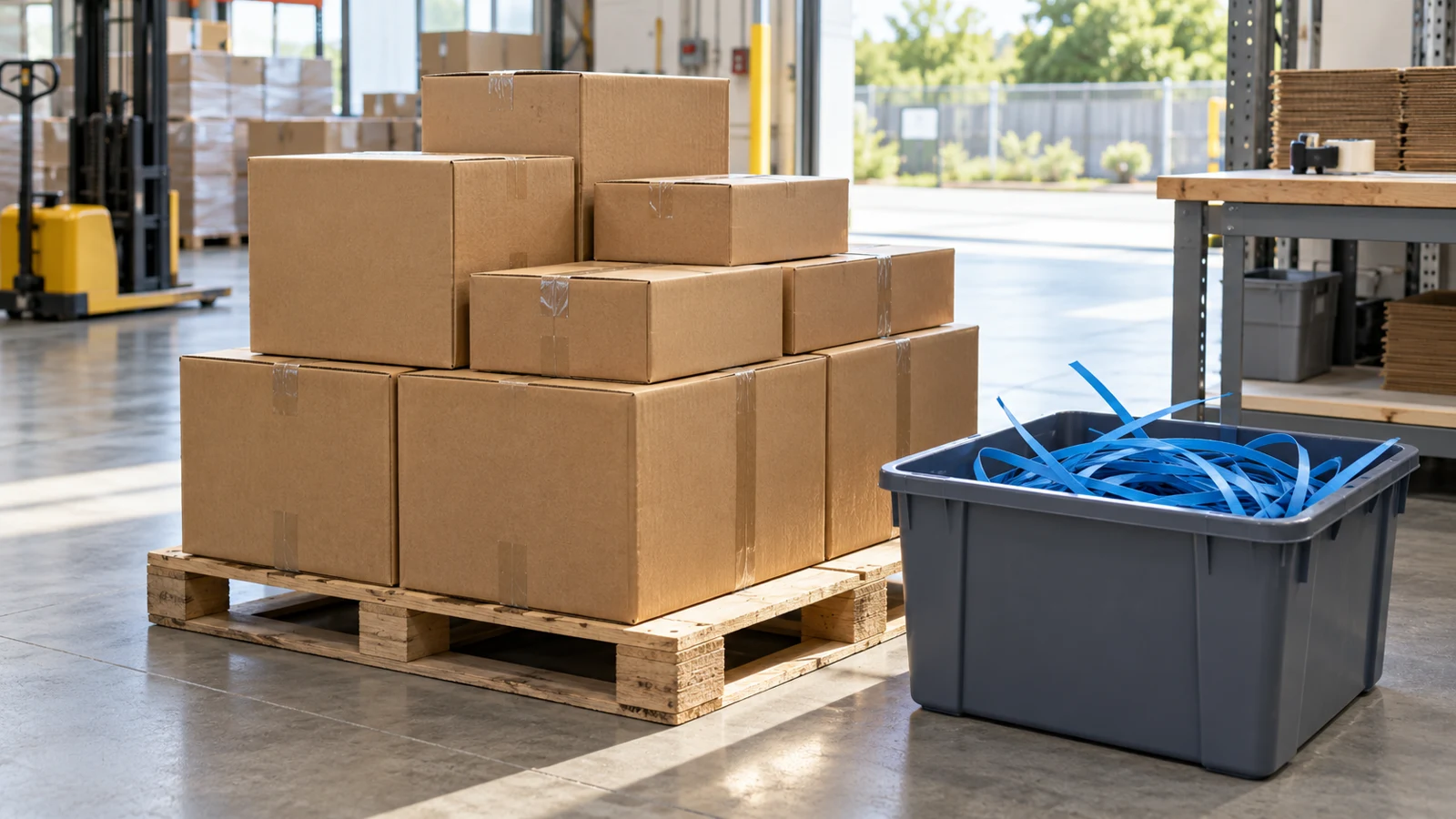
Plastic shipping straps are narrow bands used to secure cartons, bundles and pallet loads. Once goods arrive, the bands often become an overlooked waste stream behind the receiving door. Unlike a bottle, a long flexible strap may be awkward to contain, and an intact loop can create a wildlife entanglement hazard if it escapes. NOAA identifies packing bands among marine debris that can entangle animals. That is a reason to prevent loss at the loading area, rather than waiting for a river or beach cleanup.
A small business does not need to estimate ocean pollution to improve this situation. It needs to understand which deliveries create straps, who removes them, where they are stored and which service will accept them. This guide proposes a practical operating method for shops, hotels, restaurants and other receiving sites. It is public information, not a load-securing specification or a claim that every strap can be recycled. Keep transport safety decisions with trained staff and the supplier responsible for the load.
Start with the receiving workflow
Walk through one ordinary delivery with the people who actually unload and unpack it. Identify the moment when the band becomes waste. Is the package opened outdoors, in a shared corridor or beside a drain? Does the worker have a suitable container within reach? Does a cleaner later move the material to another bin? Following these handoffs often reveals a more useful intervention than ordering a new recycling sign for a distant waste room.
Make a simple sketch of the route from vehicle to storage and final collection. Mark places where loose straps can be blown away, caught under wheels or swept into outdoor areas. Ask both day and evening teams about exceptions such as rushed deliveries and overflowing containers. Observe without interrupting safe unloading. The objective is to make the correct action easy at the point of removal, including when the usual supervisor is absent or another tenant shares the loading bay.
Identify the material without guessing
Ask the supplier what the strapping is made from and retain the relevant product information. Some bands are polypropylene and others are polyester; appearance and color alone are not reliable identification methods. Keep uncertain material marked as unknown until a supplier or receiving processor confirms it. A resin identification number, where available, describes material rather than proving acceptance by a particular recycling service. Product form, contamination and collection arrangements still matter.
Keep plastic strapping separate from steel bands, stretch wrap, adhesive tape and woven composite products unless your collector explicitly requests a mixed stream. Do not assume that a rigid-plastic bottle collection also accepts long flexible bands. Take a clear photograph of the actual material and show it to the collector before setting up storage. Record any attached buckles or seals and ask whether these must be removed. A precise acceptance answer is more useful than a general promise to collect plastics.
Create a safe containment point
Choose a container that fits the working space and keeps the bands contained during normal handling. Consider the route to the waste room, the amount generated between collections and whether the area is exposed to wind or rain. A rigid container may work for a small receiving station, but the appropriate design depends on the workplace. Keep it clear of exits and traffic routes. Ask staff whether they can use it without walking across an active unloading area.
Follow workplace procedures for releasing tension and handling cut ends. Do not improvise instructions for cutting a loaded band, and do not encourage anyone to stand in the path of a tensioned strap. Once safely removed, prevent intact waste loops from escaping and contain the pieces promptly. Cutting waste loops does not make litter harmless and does not replace collection. Do not chop bands into tiny fragments for convenience: that makes capture and handling harder and creates unnecessary loose pieces.
Use a baseline that explains what changed
For a manageable observation period, record the deliveries that generate strapping and the material collected. Choose a period that includes normal business activity rather than only a quiet afternoon. Note supplier, delivery type, approximate band count, material identification status and any handling problems. If weighing is feasible, use a suitable scale and a consistent container tare. Record units clearly. Describe estimates as estimates rather than presenting them as measured values.
EPA describes records review, facility walkthroughs and waste sorting as complementary assessment approaches. Adapt that principle to this particular stream: purchasing information explains what arrives, observation shows what happens and a safe inspection of the separated collection shows what is being captured. Do not ask staff to sort unknown mixed waste by hand. Keep this exercise proportionate and follow the site's hygiene and safety arrangements. The purpose is to find an operational improvement, not to create a hazardous demonstration.
Ask suppliers about prevention before substitution
Bring one concrete example to the supplier: a recurring carton delivery with bands that staff remove immediately. Ask what the bands protect, whether the load configuration can be improved and whether a tested alternative is available. Do not ask a driver to remove necessary securing material before transport or modify a shipment without authorization. The supplier should evaluate performance, handling, damage risk and relevant requirements before changing the packaging specification.
Possible trials include consolidating compatible deliveries, using a returnable transit system or removing genuinely redundant packaging after assessment. None is automatically the best choice. A returnable system needs a reliable return route, storage space and enough actual use to justify the effort. Consolidation should not create unacceptable stock, food storage or delivery problems. Compare the complete service delivered, including product damage and replacement shipments, rather than celebrating a lighter packaging component while overlooking failures elsewhere.
Check a recycling route before building a stockpile
Contact the processor or collection service with product details, likely volume, photographs and storage conditions. Ask whether the material is accepted directly or transferred elsewhere, what contamination limits apply, and whether different polymers must remain separate. Clarify minimum quantities, transport responsibilities, collection frequency and charges. If a broker arranges collection, identify who can answer questions about the receiving facility. Get the useful terms in writing and keep them available to replacement staff.
Do not describe a stockpile as recycled material merely because someone intends to collect it eventually. Set a realistic storage limit and a fallback managed disposal route if the collection fails. Check local business-waste requirements with the relevant authority or licensed service. Never burn straps, abandon them beside a public bin or put them into drains. If recycling is unavailable, communicate that limit accurately while continuing prevention and containment. A missing recycling market is a reason to improve purchasing, not permission to let material escape.
Keep records that distinguish collection from recycling
A collection receipt confirms a transfer; it does not necessarily establish the final processing outcome. Retain dates, material descriptions, weights where provided and the identity of the receiving service. Ask what downstream evidence can reasonably be supplied. Report only what the records demonstrate. For example, separated and collected for an accepted route is a different statement from verified processing into another product. Preserve that distinction even when a marketing team wants a shorter headline.
Keep purchased and collected quantities on comparable bases. Incoming packaging may not appear on your purchase invoice because the supplier provides it as part of a delivery. Counts can be useful when weights are unavailable, but counts should not be silently converted to kilograms using an untested assumption. If you estimate average band weight from samples, document the sample and its limits. Avoid subtracting incomplete records to calculate supposed environmental leakage. Missing data should remain visible so the next review can improve it.
Trial one change and check service quality
Select one supplier, route or package type for a limited trial. State the proposed change, responsible people, review date and conditions for stopping. Compare similar deliveries where feasible, noting differences that could affect results. Record the number of shipments, material used, staff handling time, observed damage and collection issues. Obtain feedback from the receiving workers as well as the buyer. A process that looks efficient on an invoice may be awkward at a busy loading door.
Use both total material and a relevant activity measure. Total band waste may fall because fewer goods arrived, while material per comparable delivery remained unchanged. Equally, a busier month can increase total waste even after a useful improvement. Explain both observations rather than selecting whichever figure looks greener. Do not generalize a successful short trial to every product or season. Keep the tested conditions in the record and review the arrangement when the goods, carrier or packaging change.
Greenwashing cautions for straps and packaging claims
The FTC Green Guides emphasize specificity and substantiation in environmental claims. For this guide, the practical lesson is to identify exactly what improved and the comparison used. Recycled content describes an input to a product; it does not establish that the used strap will be recovered at your site. Recyclability also depends on access to a suitable receiving system. U.S. guidance is not a substitute for checking rules in the country where a claim is made.
Treat a leaf symbol, green color or supplier slogan as a prompt for questions rather than evidence of overall benefit. Ask whether documentation covers this particular product, what the claim means and which limitations apply. Do not call a delivery plastic-free if bands were replaced while other plastic packaging remains. Do not say ocean-safe because staff collect straps. Your records can demonstrate a local management action; they cannot by themselves show that marine pollution or wildlife harm has been eliminated.
A practical checklist for the loading area
Before the next delivery, assign an owner for the strapping stream and check that the receiving team knows the collection point. Confirm safe removal procedures, identify a suitable container and inspect the route to the waste room. Ask the supplier for material information and the collector for acceptance conditions. Keep mixed or unknown bands separate while those questions are answered. These are proposed operating checks, not an official certification scheme or a universal technical standard.
During operations, contain removed bands immediately, keep the container below its working capacity and inspect outdoor handoff points for escaped pieces. After collection, retain the receipt and note rejected material or missed pickups. At the review date, compare the baseline with the trial, including damage and staff feedback. Update the process before expanding it. A short checklist that someone actually follows is more valuable than a comprehensive policy stored where the receiving team cannot access it.
Make the process work across shifts and tenants
Shared receiving areas need clear responsibilities. Agree who supplies containers, who moves them, who contacts the collector and who responds when material is rejected. Place simple instructions where the work occurs, using languages or demonstrations that the team understands. Show actual accepted material instead of relying on a generic recycling symbol. Include temporary staff and cleaning contractors in the explanation because they often handle the last transfer before a collection.
Review the process after an unusual delivery or a change of supplier. A new band color may be harmless, or it may indicate a different product; confirm instead of guessing. If storage fills unexpectedly, investigate the cause before ordering more bins. Higher delivery volume, contamination or an interrupted collection route each needs a different response. Keep one accessible contact list and a dated acceptance record so routine staff turnover does not erase the work already completed.
Connect this small stream to wider plastic prevention
A strapping project can teach a useful discipline: follow a material from purchasing to its real destination. Apply that method to stretch wrap, sacks, protective foam and other delivery packaging, while checking each stream separately. Do not assume the same collector or container is suitable for all of them. Start with the material that creates a frequent, observable problem and expand only when the existing routine is stable enough to maintain.
The goal is a receiving system that buys appropriate packaging, keeps necessary material under control and documents what happens after use. It does not require a dramatic numerical pledge or a promise that every strap becomes another strap. Practical progress can be modest and still worthwhile: fewer unnecessary bands on a tested route, fewer escaped pieces at the loading bay and clearer collection records. Those are actions a small business can inspect, repeat and improve without overstating its environmental results.
Detailed infographic
Control straps from arrival to destination
A proposed operating sequence, with transport safety checked before packaging changes.
- Observe Map one real delivery.
- Confirm Identify material and safe handling.
- Trial Test a supplier change on a limited route.
- Collect Use a confirmed receiving service.
- Review Compare material, damage and records.
Action checklist
- Name the responsible person.
- Keep containers clear of traffic.
- Confirm acceptance in writing.
- Retain transfer receipts.
- Qualify environmental claims.
Frequently asked questions
Can shipping straps go in household recycling?
Do not assume so. Ask the local service about the actual band material and product form; commercial collection may be needed.
Does recycled content mean a strap is recyclable?
No. An input-material claim does not establish a collection route for the used product.
Should I cut bands on a loaded pallet?
Follow trained workplace procedures. Tensioned bands and unstable loads require appropriate handling; this guide is not a cutting instruction.
Can cutting loops replace waste collection?
No. Contain removed material and use an appropriate destination. Cut pieces can still escape and cause pollution.
How can a small business start?
Observe one delivery, contain its removed bands, confirm collector acceptance and discuss one safe prevention trial with the supplier.