Direct answer
Tire wear particles are tiny fragments released as tires rub against road surfaces. They can mix rubber, road dust, additives, metals and other traffic residues, then move with rainwater into storm drains, rivers and coastal waters. This makes tire wear a plastic pollution and urban runoff issue, not only a vehicle-maintenance issue. The practical answer is layered: drive and maintain vehicles in ways that reduce abrasion, design roads and drainage to capture polluted runoff, keep streets clean before heavy rain, choose lower-emission tires as standards improve, and avoid pretending that recycling bins alone can solve microplastics created on the road.
Key points
- Tire wear is an everyday source of microplastic pollution because vehicles constantly shed tiny particles during normal driving.
- Stormwater is the main pathway: rain can move road dust, tire particles and other traffic residues from streets into drains and waterways.
- The best prevention points are upstream: smoother driving, correct tire pressure, lighter loads, street sweeping, runoff treatment and better tire design.
- Cities and property managers should treat parking lots, loading areas and roads as plastic-leakage surfaces, not just paved transport space.
- Green claims around tires, roads and cleanup need evidence; a capture device or recycled-rubber product is not a full solution by itself.
Related Plastika Problema reading
- How plastic reaches the ocean - background on storm drains, rivers and urban leakage routes
- Microplastics in drinking water and food - context for why small particles require calm, evidence-led public guidance
- Plastic pellet pollution and stormwater - a related stormwater prevention article focused on industrial pellets
- Synthetic clothing microfibers - another everyday microplastic source where repeated habits matter
- Action checklist - practical reduction habits that work alongside infrastructure and policy
Why tire wear belongs in the plastic pollution conversation
Plastic pollution is often illustrated with bottles, bags, fishing gear and floating fragments. Those visible items matter, but they can make the problem look simpler than it is. Some plastic pollution is created by normal use of products that do not look disposable. Tires are a clear example. Every trip creates friction between rubber and road. A small amount of tire material and road material wears away, becoming a mix of particles that can be moved by wind, street dust, vehicle turbulence and rain.
These particles are not identical to a plastic bottle fragment. Tire tread is a complex engineered material, not a simple packaging resin. It can include synthetic rubber, natural rubber, fillers, oils, additives and reinforcing materials, and it can attach to road dust and other traffic residues. That complexity is exactly why the issue deserves careful public explanation. Tire wear is not a reason to panic about every drive, but it is a reason to stop describing microplastics only as litter that someone failed to put in a bin.
The road is a production surface for pollution. Unlike a dropped cup, tire wear particles can be generated without a single person littering. That makes prevention more technical and more collective. Drivers can help, but cities, fleets, tire makers, road engineers, parking-lot owners and stormwater managers all shape how much material is produced and how much escapes.
How tires create particles during normal driving
Tires are designed to grip. Grip requires contact and friction. As a vehicle accelerates, brakes, turns, carries weight and moves across different road textures, tiny pieces of tire tread and road surface can break away. More aggressive driving, hard braking, fast cornering, heavy loads, poor alignment, underinflation, rough surfaces and stop-start traffic can increase wear. The result is a fine mixture commonly discussed as tire and road wear particles.
This means the pollution source is repeated and diffuse. It does not come from one pipe or one factory gate. It comes from thousands of daily journeys, delivery routes, rideshare trips, buses, private cars, motorcycles, vans and trucks. It also comes from places where vehicles slow, turn, queue or load: intersections, ramps, parking lots, bus stops, loading docks, toll areas and steep streets.
A useful article should therefore avoid a single-blame message. The driver who keeps tires inflated and avoids hard braking helps. The fleet manager who trains drivers and maintains alignment helps. The city that reduces congestion, improves transit, sweeps streets before storms and treats runoff helps. The tire producer that designs lower-wear products helps. The issue is shared because the road system is shared.
Why stormwater runoff is the main pathway
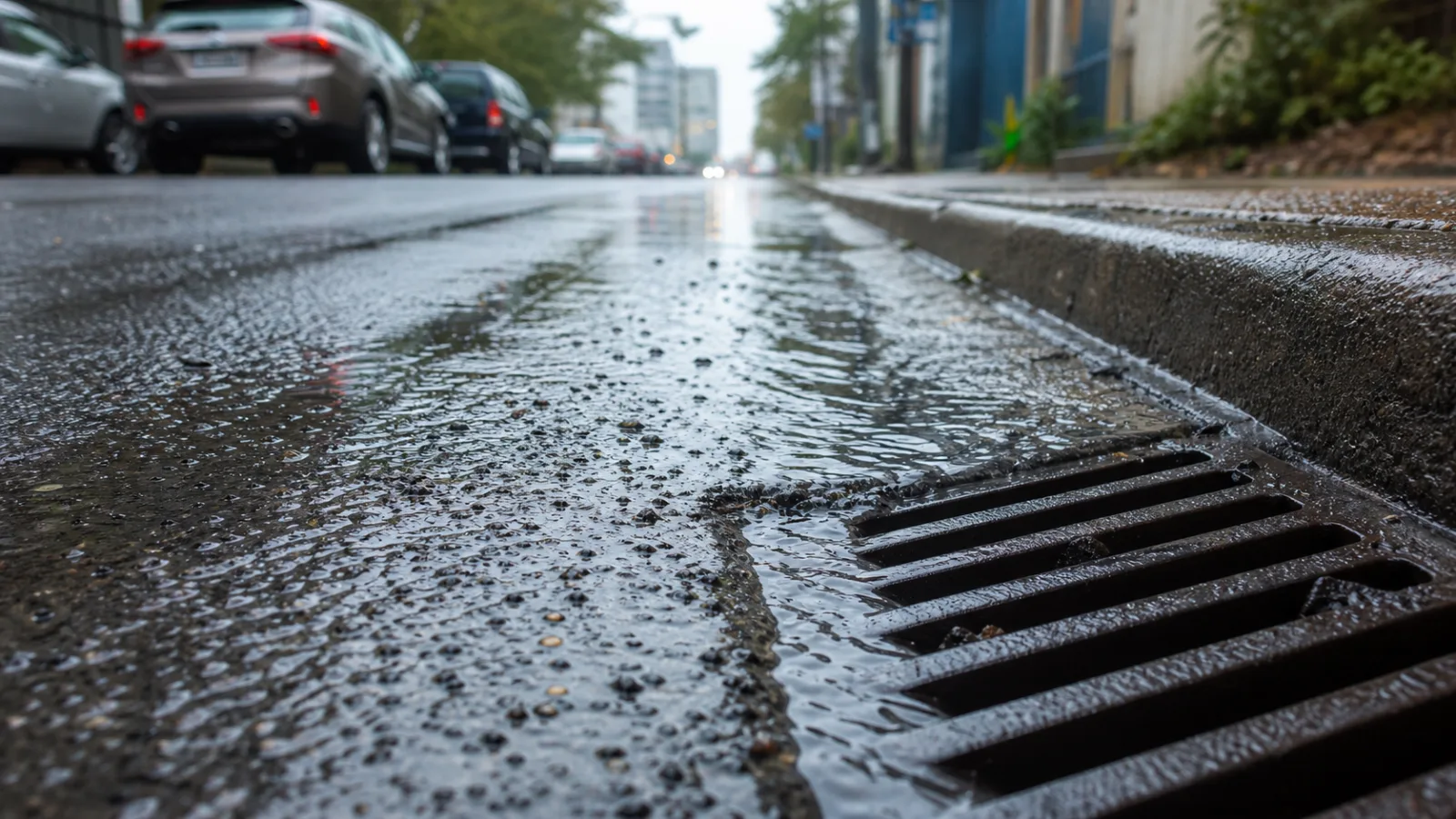
Rain changes road dust from a settled material into a moving one. Water flows along curbs, across parking lots, into gutters and through storm drains. In many places, stormwater systems are designed to move water away from streets quickly to reduce flooding. That speed can also move pollutants unless the system includes capture, filtration, settling, green infrastructure or maintenance that keeps particles out of waterways.
Tire wear particles can attach to other road dust, settle in gutters, collect in drain inlets, move into retention systems or wash into creeks and rivers. Some material may be captured by street sweeping, sediment basins or stormwater treatment. Some may remain on roads until the next rain. Some can move farther downstream, especially during heavy storms. Once particles enter a waterway, recovery becomes much harder than capture on land.
This is why tire wear connects directly to the site's earlier guidance on how plastic reaches the ocean from city streets. The visible bottle near a drain and the invisible tire particles in road dust share a route. The difference is that tire wear is less visible, so it is easier for the public to miss and easier for cities to under-explain.
What official sources are saying
The OECD has identified tire abrasion and synthetic textiles as important sources of microplastics entering water, and its policy work emphasizes prevention across product design, use and wastewater or runoff pathways. EPA stormwater materials explain that municipal stormwater can carry pollutants from developed land into waterways, which is the infrastructure pathway that makes road runoff important. EPA's tire-wear roundtable summary also frames tire wear particles as a water-quality issue that needs work across tire design, vehicle use, roadway management and stormwater controls.
European technical work has also treated tire abrasion as a measurable emissions issue. The European Commission's Joint Research Centre has reviewed methods for measuring and limiting tire abrasion emissions, which is important because strong policy depends on comparable testing. Without reliable measurement, it is difficult to compare products, evaluate claims or design rules that reward lower wear.
The practical lesson is not that every source agrees on one simple number. It is that the policy direction is moving toward measurement, prevention and pathway control. Public-information pages should follow that direction: explain what is known, avoid exaggerated certainty, and focus on actions that reduce particle generation and runoff transport.
What drivers can do without pretending the whole burden is personal
Drivers can reduce tire wear by making the vehicle easier on its tires. Keep tires inflated to the recommended pressure. Check alignment when the vehicle pulls, vibrates or wears tires unevenly. Avoid unnecessary hard acceleration and hard braking. Slow down before turns rather than scrubbing speed through sharp cornering. Remove unnecessary heavy loads. Maintain suspension and brakes. Choose routes and travel modes that reduce stop-start traffic when practical.
These steps are not only environmental. They can improve safety, fuel economy or energy efficiency, tire life and comfort. That makes them easier to sustain than advice framed only as sacrifice. A tire that lasts longer usually means less material worn away, fewer replacements, lower cost and less waste to manage at end of life.
Still, the public message should be fair. Many people drive because transport systems require it. A delivery driver or caregiver may not be able to reduce trips easily. A household may not control road quality, congestion or vehicle weight. Personal habits matter, but they are one layer in a system that also needs better design and infrastructure.
What fleets and service businesses should measure
Fleets can make tire wear visible because they already track vehicles, routes, maintenance and costs. Delivery companies, van services, taxis, hotels, cleaning companies, construction firms, school transport and municipal fleets can record tire lifespan, pressure checks, alignment events, driving behavior, average load, route conditions and replacement frequency. Those records are not usually described as plastic pollution data, but they help identify where material is being worn away faster.
A simple fleet checklist starts with monthly tire-pressure checks, alignment records, driver coaching, replacement logs and route review. If one route or vehicle type wears tires unusually fast, investigate. Is the route steep, rough or congested? Is the vehicle overloaded? Are drivers braking hard because schedules are unrealistic? Are tires mismatched to the use case? These are operational questions with environmental consequences.
Businesses should also avoid weak sustainability claims. Saying a fleet is green because it recycles tires at end of life misses the particle issue during use. A stronger claim would be narrower and evidenced: the company maintains tire pressure, trains drivers to reduce harsh braking, tracks tire life, chooses products with documented performance and supports runoff controls at depots or parking areas.
What cities can do before particles reach waterways
Cities have several prevention points. Street sweeping can remove road dust before heavy rain, especially on high-traffic corridors and near drains. Drain maintenance can keep inlets functioning and prevent trapped sediment from being remobilized. Green infrastructure, vegetated swales, sediment forebays, filtration systems, permeable surfaces and retention ponds can slow water and capture particles where appropriate. Traffic management can reduce stop-start conditions that increase braking and tire wear.
Public works teams can also map hotspots. Intersections, bus corridors, loading zones, hills, industrial routes, parking lots and flood-prone drains may deserve more frequent attention. The goal is not to treat every curb the same. The goal is to identify where particle generation and runoff transport overlap. A drain that receives runoff from heavy traffic before discharging to a creek is a different risk than a quiet residential curb with little flow.
Cities should coordinate departments. Transport teams influence congestion and road surface. Waste teams influence street cleaning. Stormwater teams influence drains and treatment. Procurement teams influence municipal fleet tires and maintenance. Public-information teams influence what residents understand. Tire-wear microplastics sit across all of those offices, so the response should not live in one narrow environmental silo.
Parking lots, buildings and private sites matter too
A large parking lot is a stormwater surface. So is a loading dock, hotel driveway, shopping center, school drop-off area, depot, fuel station, warehouse yard or apartment garage entrance. Tire particles and road dust can accumulate where vehicles turn, brake and queue. When rain falls, that material may move into site drains and then into municipal systems or nearby waterways.
Property managers can reduce risk with practical maintenance. Sweep high-traffic areas before wet-season storms. Keep drain inlets clear. Use sediment controls where required. Avoid washing dusty areas directly into drains. Review whether landscaping, swales or filtration features can slow runoff. For sites with fleets or frequent deliveries, include tire and road dust in environmental housekeeping, not only oil stains and visible litter.
This is especially relevant for service businesses that already publish sustainability claims. A hotel, office campus, event venue or shopping center may reduce bottled water and packaging, which is useful, but still ignore the paved areas that move traffic residues into drains. A complete plastic-pollution mindset looks at both the guest-facing bin and the runoff path outside.
How tire design and standards can help
Consumers cannot judge tire abrasion by looking at a tread pattern in a shop. Comparable testing and standards are needed so regulators, fleets and buyers can understand tradeoffs among safety, durability, efficiency, noise, cost and particle emissions. A tire that wears less but performs poorly in braking would not be a good solution. The challenge is to improve abrasion performance while protecting road safety.
This is why official research and standards work matter. Measurement methods can help compare products, support future policy and discourage unsupported claims. They can also help procurement teams choose tires based on documented performance rather than vague eco language. For public education, the key point is simple: better tire design can reduce particle generation, but claims should be evidence-based and should not distract from driving behavior and stormwater controls.
End-of-life tire recycling remains important, but it is a different issue. Recycling a tire after use does not remove the particles already released during use. Good tire policy should therefore consider the whole life: raw materials, production, use-phase abrasion, vehicle efficiency, safety, maintenance, collection and final management.
Greenwashing risks and weak claims to watch
Tire-wear pollution creates several claim risks. A company may promote recycled rubber while ignoring runoff from the product's use. A site may install a capture device and imply that all microplastics are solved. A tire may be described as eco without comparable abrasion evidence. A road project may highlight recycled materials but fail to explain whether particles, leaching or runoff have been assessed. These claims may contain useful pieces, but they are incomplete if they hide the pathway.
A credible claim should answer specific questions. What particle source is being reduced? How is it measured? Does the measure reduce generation, capture runoff, improve maintenance or only shift material? Where does captured sediment go? What happens during heavy rain? What tradeoffs exist for safety, durability or maintenance? If a claim cannot answer these questions, it should be treated as a prompt for more evidence rather than proof.
Public-information writing should be especially careful here because tire wear is technical. Avoid dramatic certainty and avoid vague reassurance. The useful middle position is stronger: the source is real, the pathway is plausible and documented through stormwater science, and the best actions are practical even while measurement improves.
A practical checklist for households, fleets and cities
Households can start with tire pressure, alignment, smoother driving, fewer unnecessary car trips and safer route planning. Keep maintenance records and replace tires before safety is compromised, not after extreme uneven wear. When washing cars or driveways, avoid pushing dirty runoff into storm drains. If your community has street sweeping schedules, move vehicles when possible so sweepers can reach the curb.
Fleets can track tire life by vehicle and route, train drivers to reduce harsh acceleration and braking, set maintenance intervals, review overloaded vehicles, choose tires with documented durability and investigate high-wear hotspots. Depots can sweep paved areas, protect drains and manage wash water correctly. Procurement teams can ask suppliers about abrasion testing, not only price and mileage.
Cities can map high-risk roads, sweep before storms, maintain drains, install appropriate stormwater treatment, reduce unnecessary stop-start traffic, improve public transit and cycling choices, and coordinate tire-wear work with broader microplastics plans. The best checklist is not one perfect intervention. It is a set of layers that reduce particle creation, keep particles on land where they can be managed, and prevent stormwater from carrying them into waterways.
Bottom line
Tire wear microplastics are a reminder that plastic pollution is not only about visible litter. Some particles are generated by normal modern systems: transport, roads, delivery schedules, parking lots and wet-weather drainage. That makes the issue harder to see, but also easier to place in practical operations. The same city that manages traffic and stormwater can reduce this pathway if it treats road dust as pollution before rain moves it.
For readers, the best next step is specific. Keep tires maintained, drive more smoothly, reduce unnecessary trips where practical, support street sweeping and stormwater treatment, and ask fleets or public agencies how they manage runoff from high-traffic areas. For businesses, the best next step is measurement. If tire use and paved runoff are invisible in records, the pollution pathway will stay invisible in decisions.
The goal is not to make every person feel guilty about transport. The goal is to notice a major repeated source and manage it honestly. Tire wear will not be solved by one household, one product label or one drain filter. It will improve through better vehicles, better tires, better roads, better maintenance, better runoff controls and clearer public information working together.
Detailed infographic
Tire wear stormwater pathway
A practical map of how tire particles are created on roads, moved by rain and reduced through layered prevention.
- Wear Tires and road surfaces release particles during normal vehicle use.
- Accumulate Particles mix with road dust near curbs, intersections and parking areas.
- Mobilize Rainwater carries the mixture toward gutters and storm drains.
- Transport Drainage systems can move particles toward creeks, rivers and coasts.
- Prevent Reduce abrasion, sweep streets, treat runoff and verify claims with data.
Action checklist
- Keep tires inflated and aligned.
- Avoid harsh acceleration, braking and cornering where safe.
- Sweep high-traffic paved areas before heavy rain.
- Protect storm drains at depots, parking lots and loading zones.
- Ask tire and road suppliers for abrasion or runoff evidence.
Frequently asked questions
Are tire wear particles microplastics?
They are commonly discussed in the microplastics conversation because tire tread includes polymer materials and particles can be smaller than 5 millimeters. They are complex tire and road wear particles rather than simple packaging fragments.
How do tire particles reach rivers or the ocean?
Particles can accumulate in road dust, then rain carries them through gutters and storm drains into stormwater systems, creeks, rivers and sometimes coastal waters.
Can careful driving reduce tire wear pollution?
Yes. Smooth acceleration and braking, correct tire pressure, good alignment, reasonable loads and regular maintenance can reduce unnecessary abrasion while also improving tire life and safety.
Do tire recycling programs solve this problem?
No. End-of-life tire recycling is useful, but it does not recover particles already released during driving. Use-phase abrasion and stormwater runoff need separate prevention and capture measures.
What should cities do first?
Cities should identify high-traffic runoff hotspots, sweep streets before storms, maintain drains, use suitable stormwater treatment and coordinate transport, fleet, road and water teams around the same microplastics pathway.
Sources and further reading
- OECD policies to reduce microplastics from textiles and tyres
- EPA opportunities to address tire wear particles in waterways
- EPA research on tire environmental and health impacts
- EPA municipal stormwater
- European Commission JRC review of tyre abrasion emissions
- NOAA Marine Debris Program microplastics overview
- UNEP plastic pollution topic hub