Direct answer
Paint and coatings can contribute to microplastic pollution when polymer-based paint particles, chips, sanding dust, road-marking wear or marine coating residues escape during use, weathering, cleaning, renovation or disposal. The practical answer is source control: keep paint out of drains, plan exterior work around weather, capture sanding and scraping debris, use wet or vacuum-assisted dust controls where appropriate, store and dispose of leftovers correctly, and treat green paint claims as evidence questions rather than proof that particles cannot leak into stormwater.
Key points
- Paint should be part of the microplastics conversation because many coatings use polymer binders that can become particles during weathering, sanding, scraping or poor disposal.
- The highest-risk moments are not only application; they include surface preparation, cleanup, rain after exterior work, pressure washing, road-marking wear and renovation waste handling.
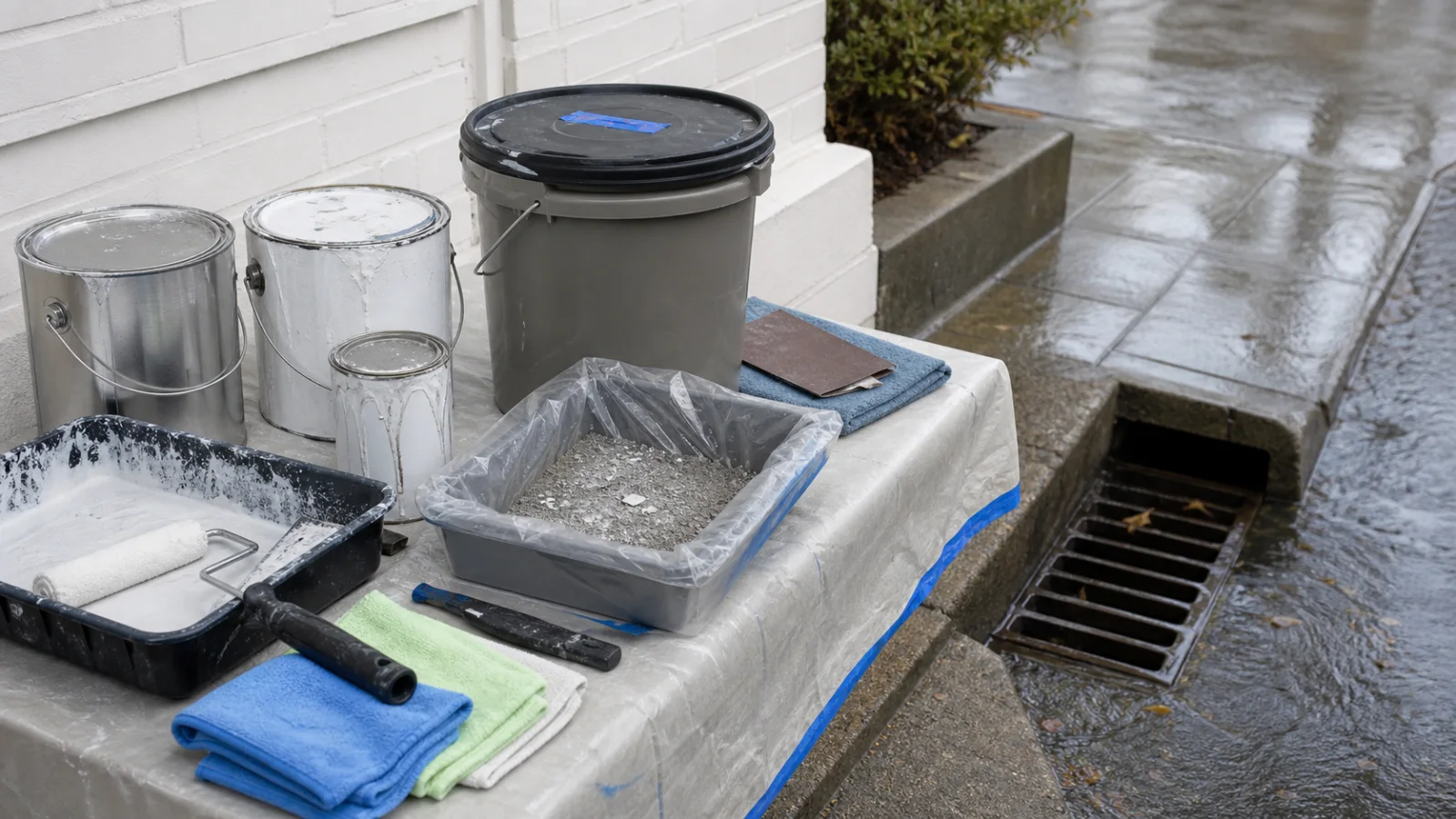
- Stormwater prevention starts before rain: cover drains, contain debris, keep wash water out of gutters and prevent paint chips from reaching pavement.
- Green claims such as low-VOC, water-based, durable, washable or eco paint do not automatically answer the microplastic question.
- A good maintenance plan records product choices, work area controls, waste routes and what staff or contractors must do if rain arrives early.
Related Plastika Problema reading
- Microplastics in drinking water and food - background on why small particles require prevention before they disperse
- How plastic reaches the ocean - context for storm drains, streets and river pathways
- Plastic packaging greenwashing claims - a useful comparison for checking environmental wording on paint and coating products
- Tire wear microplastics and stormwater runoff - a related urban runoff pathway for small particles created during normal use
- Action checklist - site-wide habits for reducing plastic leakage before cleanup is needed
Why paint belongs in a plastic pollution guide
Plastic pollution is often introduced through bottles, bags, packaging and visible litter. Paint feels different because it is supposed to become part of a wall, road, boat, machine, floor or piece of furniture. Once dry, paint looks fixed in place. That fixed appearance can make the microplastic pathway easy to miss. Many modern paints and coatings use polymer binders or resins to create a film, hold pigments together, resist water, improve adhesion or add durability. When those films weather, are sanded, are scraped, are pressure washed, or are disposed of badly, small particles can be released.
This does not mean every painted surface is an emergency. It means paint needs the same practical source-control logic used for other microplastic pathways. A paint chip in a protected waste container is manageable. The same chip broken apart on a sidewalk before rain can move toward a gutter. Fine sanding dust captured by a vacuum or sheet is manageable. Dust blown across a yard or washed into a drain becomes harder to recover. The article is therefore not about blaming maintenance. It is about doing maintenance in a way that keeps particles where they can be handled.
The topic is useful for households, landlords, hotels, cafes, salons, schools, building managers, contractors, road crews and marina operators. Each group makes repeated decisions about coatings: what product to buy, when to paint, how to prepare a surface, how to clean tools, where to store leftovers and how to communicate with workers. Those decisions can reduce plastic leakage before anyone has to talk about cleanup.
What official sources say about the pathway
IUCN's primary microplastics report is a useful starting point because it broadened public attention beyond visible consumer litter and identified several sources of primary microplastic leakage, including marine coatings and road markings. The details differ by setting, but the public-information lesson is clear: small plastic particles can be created by wear, abrasion and normal operation, not only by people dropping packaging outdoors.
RIVM's report on paints and microplastics explains the paint-specific mechanism more directly. It describes how liquid paints form a solid film layer and how polymers in paint products can lead to microplastic emissions through routes such as improper disposal of unused water-based paint and weathering of dried paint layers. That is an important nuance. A product may be useful and legally sold while still needing careful handling so the material does not escape into wastewater, soil or stormwater.
EPA stormwater pages add the transport pathway. Stormwater runoff flows over hard surfaces such as streets, parking lots and building rooftops, and it can pick up pollutants including trash, chemicals and sediment before carrying them to streams, lakes or groundwater. Construction and renovation sites can also generate pollutants if controls are weak. Put those sources together and the prevention logic becomes straightforward: do not let paint particles, wash water, chips or dusty residue reach the rain path.
Where paint microplastics can be released
The first release point is surface preparation. Scraping old paint, sanding a door, abrading a wall, grinding a coated metal railing or preparing a floor can create chips and fine dust. Those particles may contain old coating material, new primer, pigments, fillers, binders and other residues from the surface. If the work happens outdoors, wind and rain can move them quickly. If it happens indoors, dust can still leave through cleanup water, vacuum disposal mistakes or open doors and windows.
The second release point is weathering. Sunlight, heat, moisture, salt, friction and repeated cleaning can slowly break down exposed coatings. Exterior walls, painted railings, decks, balconies, road markings, parking-lot stripes, signs, marine coatings and industrial surfaces all experience wear. Road markings and marine coatings deserve special attention because they are often used in environments where abrasion and water transport are built into the setting. They are not household packaging, but they still belong in the microplastics map.
The third release point is cleanup and disposal. Washing brushes or trays into outdoor drains, dumping leftover water-based paint into sinks, rinsing sanding dust off pavement, pressure washing old paint into gutters, or leaving chips in uncovered piles can convert a controllable waste into a water-quality problem. The simplest rule is strong: paint and coating waste should never be treated as rainwater.
Stormwater is the connector
Stormwater makes this topic more urgent because it connects the work area to a wider environment. A building facade, driveway, balcony, loading bay or parking area can feel far from a river. During rain, the distance becomes shorter. Water moves over hard surfaces and follows the easiest route into gutters, drains, canals, creeks and other receiving waters. Anything loose on that surface can move with it unless it is captured first.
This is why timing matters. Exterior sanding the day before heavy rain is riskier than the same work under controlled dry conditions with full cleanup before weather arrives. Pressure washing a painted wall without capture can move fragments faster than ordinary weathering. A drain cover placed after debris has already entered the gutter is late. Stormwater control is not only a municipal engineering topic; it is a daily maintenance planning topic.
A useful maintenance plan should ask three questions before work starts. Where could particles fall? Where would water carry them? What will stop them before they reach a drain? If the team cannot answer those questions, the work is not ready for rain.
A practical checklist before painting or renovation
Before exterior work, check the weather window. Avoid scraping, sanding, pressure washing or exposed paint removal when rain or strong wind is likely. Move vehicles, furniture and loose objects so protective sheeting can sit flat. Identify drains, gutters, soil edges, canals and low points. Cover or protect drains where local rules and safety allow. Use drop cloths or tarps that can be folded inward so chips and dust do not spill during cleanup.
For surface preparation, choose controls that match the task. Hand scraping may need rigid containment and careful sweeping. Sanding may need vacuum-assisted tools, dust extraction or wet methods where appropriate and safe for the material. Pressure washing old coatings should be treated cautiously because it can create contaminated runoff. If contractors are involved, require a simple written method: how debris will be captured, how wash water will be managed, where waste will go and what happens if rain starts.
For cleanup, work from clean edges toward the center of the containment area. Do not hose residue into the street. Collect chips, dust, used filters, disposable sheeting and contaminated absorbents as waste according to local rules. Seal leftover paint containers. Keep product labels and safety data information available. If old paint may contain hazardous substances such as lead, follow specialist health and legal requirements rather than treating the project as an ordinary plastic-waste task.
Tool washing and leftover paint
Tool washing is one of the easiest places to lose control because the visible work is already finished. Water-based paint can make people assume sink disposal is harmless. That assumption is too loose. Water-based does not mean the material belongs in drains. RIVM notes that water-based paints can contain dispersed solid polymer particles, and poor disposal can become an emission route. The safer habit is to minimize wash water, wipe excess paint from tools before washing, use designated washout systems where available and follow local household hazardous waste or paint collection guidance.
Leftover paint should be managed like a material, not a nuisance. Keep usable leftovers sealed for touch-ups. Share or donate only when allowed and practical. Take unusable paint to the correct local collection route. Do not pour paint onto soil, into drains, into toilets or into street gutters. If a business uses paint regularly, it should track leftovers by product type, purchase date, job and disposal route. That record can reduce overbuying and lower the number of half-used containers aging on shelves.
Dry chips and dust also need care. A bag of collected sanding dust may look like ordinary dust, but it came from a coating system. Keep it contained, avoid re-suspending it in air, and dispose of it according to local requirements. The main public lesson is simple: if the waste came from paint or coating work, do not let water decide where it goes.
Building managers and small businesses
Building managers can reduce paint-related leakage by adding source-control language to maintenance scopes. A contractor brief should name drain locations, work-hour restrictions, containment expectations, cleaning method, waste route and rain stop rules. The cheapest bid is not necessarily cheaper if it leaves residue in drains, creates complaints, damages tenant trust or requires cleanup after a storm. Maintenance quality includes environmental control.
Small businesses can use a lighter version of the same system. A cafe repainting outdoor seating, a salon refreshing a facade, a hotel maintaining balcony railings or a school repainting sports markings can ask for a simple pre-work plan. Where will sanding dust fall? Will the crew use drop cloths? How will wash water be captured? Are staff expected to move bins or furniture? Who checks the pavement before rain? These questions are operational, not bureaucratic.
Purchasing also matters. Durable coatings can reduce repainting frequency when chosen correctly, but durability claims should be matched to the actual surface, climate, cleaning routine and maintenance schedule. A poor product that fails quickly creates more sanding and repainting. A high-performance product used incorrectly can still shed. Better purchasing means fewer unnecessary repaint cycles and clearer instructions for the surfaces that remain.
Road markings, parking lots and shared surfaces
Road markings and parking-lot stripes are a special coating case because they are designed to sit under traffic, weather and cleaning. OECD notes that road markings consist of plastic polymers, pigments, fillers and additives. They are not the same as household paint, but the public principle is related: polymer-containing coatings can wear under use, and small particles can enter road dust and runoff pathways. This is one reason urban runoff articles should not only talk about bottles and wrappers.
Cities, property managers and parking operators can reduce risk through maintenance discipline. Avoid unnecessary repainting, choose appropriate products for the surface, prepare surfaces cleanly, capture debris during removal, sweep or vacuum before storms where practical, keep nearby drains maintained and avoid washing loose material into gutters. When line removal or grinding is needed, containment should be planned before the machine starts.
Communication should stay careful. It is not helpful to claim that all road marking is a major or minor source everywhere without local evidence. Wear rates, products, traffic, drainage and climate differ. What is helpful is to treat road marking debris as a pollutant pathway worth controlling during installation, maintenance and removal.
Greenwashing cautions for paint and coatings
Paint marketing often uses environmental language, but the words do not always answer the same question. Low-VOC is mainly about volatile organic compounds, not automatically about microplastic particle release. Water-based may reduce some solvent concerns but does not mean leftover paint should go down a drain. Durable can be useful if it reduces repainting, but it needs evidence in the actual use setting. Washable may mean repeated cleaning is possible, but aggressive cleaning can still move residues if runoff is not controlled.
Other claims need the same caution used for packaging. Eco, green, ocean-safe, biodegradable, plastic-free, non-toxic or sustainable should not be treated as complete without scope. Which component is being described? Is the binder polymer-based? What does the product say about disposal? Does the claim apply before application, after drying, during sanding or at end of life? Does the product require special cleanup? If the answer is unclear, the claim may still be a useful clue, but it is not enough for public guidance.
A strong paint or coating claim should be specific. It should explain the performance benefit, the disposal instructions, the conditions of use and any limits. A building manager or small business should keep product data and disposal records before making public claims. The safest public statement is often practical rather than grand: the project used containment, avoided drain washout, collected debris and disposed of leftover paint through the correct route.
A home and contractor action plan
For a small home project, use a five-step plan. First, buy only the amount of paint needed plus a reasonable touch-up reserve. Second, prepare the surface over containment so dust and chips can be collected. Third, keep paint, rinse water and tools away from storm drains. Fourth, seal leftovers and use the correct local collection route. Fifth, check the work area before the next rain. This is enough to prevent many avoidable releases.
For contractor work, add documentation. The quote should include containment, dust control, washout management, waste disposal and weather rules. The site lead should photograph protected drains and containment before work starts, then photograph the cleaned area after work ends. This does not need to become a heavy report; it creates accountability and a record if questions arise later.
For recurring facilities, make paint control part of the maintenance calendar. Track repaint frequency, coating failures, complaint locations, drain hotspots and waste quantities. If the same railing, curb, sign or facade sheds repeatedly, the answer may be better surface preparation, a different product, a changed cleaning method or a design fix that reduces abrasion. Prevention improves when the team treats coating debris as a recurring material flow, not an occasional mess.
Bottom line
Paint and coatings are easy to overlook because they are meant to stay attached. The risk appears when they do not: during weathering, sanding, scraping, washing, road-marking wear, renovation and poor disposal. The strongest response is not panic. It is containment. Keep particles and wash water out of the rain path, plan work around weather, capture debris before cleanup becomes runoff, and use official disposal routes for leftovers.
The practical public-information answer is source control before stormwater. Once paint particles are scattered across pavement or carried into drains, recovery becomes difficult and incomplete. Before work starts, ask where particles could fall, where water would carry them and what barrier keeps them out of drains. That one planning habit turns a hidden microplastic pathway into a manageable maintenance task.
Detailed infographic
Paint microplastic source-control map
A practical maintenance flow for keeping paint chips, sanding dust and coating residues out of stormwater.
- Plan Check weather, drains, low points and containment needs before work starts.
- Prepare Scrape, sand or wash with controls that capture debris at the source.
- Protect Keep chips, dust, tools and rinse water away from gutters and storm drains.
- Collect Fold containment inward, vacuum or sweep carefully and seal waste.
- Dispose Store leftovers and use the correct local paint or hazardous-waste route.
Action checklist
- Do not hose paint residue into streets or drains.
- Use drop cloths, vacuum-assisted sanding or wet controls when appropriate.
- Pause exterior work when rain or strong wind makes containment unreliable.
- Ask contractors for drain protection, washout and waste-disposal methods.
- Treat low-VOC or water-based claims as separate from microplastic control.
Frequently asked questions
Can paint become microplastic pollution?
Yes. Polymer-containing paints and coatings can release small particles through weathering, sanding, scraping, abrasion, pressure washing or poor disposal. The risk depends on product, surface, work method and where particles go.
Is water-based paint safe to pour down the drain?
No. Water-based does not mean drain-safe. Leftover paint and wash water should be handled according to local collection or disposal guidance, because paint can contain polymer particles and other ingredients that do not belong in wastewater or stormwater.
What is the simplest way to prevent paint particles reaching stormwater?
Protect drains and hard surfaces before work begins, capture chips and sanding dust on containment, avoid hosing residue into gutters, and complete cleanup before rain.
Do low-VOC paints solve paint microplastics?
Not by themselves. Low-VOC claims address volatile organic compounds, while microplastic control depends on product formulation, durability, surface wear, cleanup, sanding and disposal practices.
Should building managers ask contractors about paint waste?
Yes. A maintenance scope should include containment, dust control, washout management, waste disposal and weather-stop rules, especially for exterior sanding, scraping, pressure washing or line-marking work.
Sources and further reading
- IUCN Primary Microplastics in the Oceans
- RIVM Paints and microplastics report
- OECD policies to reduce microplastics from textiles and tyres
- EPA urbanization and stormwater runoff
- EPA stormwater discharges from construction activities
- European Commission Regulation (EU) 2023/2055 on intentionally added microplastics
- NOAA Marine Debris Program microplastics overview