Direct answer
Hotel and spa laundry can release microfibers when synthetic towels, uniforms, robes, cleaning cloths, mats and blended textiles shed during washing, drying and wear. The practical answer is not to replace every textile at once. It is to buy longer-lasting fabrics, wash only when needed, use full and gentler loads, maintain machines, evaluate microfiber capture filters where feasible, avoid vague eco-textile claims, track textile purchases and disposal, and train staff so cleanliness, guest comfort and plastic reduction work together.
Key points
- Microfiber pollution is a textile and laundry operations issue, not only a household clothing issue.
- Hotels, spas, salons and grooming venues should map high-wash items such as towels, uniforms, robes, cleaning cloths and synthetic mats.
- The highest-value actions are source reduction, durable purchasing, better care routines, full loads, lower-abrasion washing and responsible end-of-life planning.
- Filters can help in some settings, but they do not replace better textile design, smarter purchasing and careful laundry management.
- Claims such as sustainable towel, recycled uniform or microfiber-free laundry need evidence, scope and limits before they are used publicly.
Related Plastika Problema reading
- Synthetic clothing and microfibers - background on household laundry habits that also apply to commercial textile care
- Microplastics in drinking water and food - context for why small plastic fibers are treated as a pollution pathway
- Small business plastic waste audit - a practical method for tracking repeated material flows before changing suppliers
- Plastic packaging greenwashing claims - a related guide to checking environmental claims before repeating them
- Action checklist - site-wide practical actions for reducing avoidable plastic leakage
- Plastic types guide - background on plastic materials and why polymer type matters
Why laundry belongs in the plastic pollution conversation
Laundry does not look like plastic pollution at first glance. A hotel towel, spa robe, staff polo shirt, microfiber cleaning cloth or blended uniform looks like a textile, not a bottle or bag. The connection appears when the textile contains synthetic polymers such as polyester, nylon, acrylic, elastane or polypropylene. During wearing, washing, tumble drying and normal friction, small fibers can detach. Some are captured in lint screens, sludge, filters or dust. Some can move through wastewater or indoor air pathways. Once fibers are dispersed, they are much harder to recover than a visible item in a bin.
This matters for hospitality and beauty operations because service businesses wash repeatedly. A household may wash a few loads a week. A hotel, spa, salon, clinic, barbershop, gym or serviced apartment may wash towels, sheets, uniforms, robes, mats and cleaning cloths every day. The issue is not that cleanliness should be reduced. Hygiene and guest comfort come first. The real question is whether every textile is chosen, washed, dried, replaced and discarded in a way that minimizes unnecessary fiber loss and plastic leakage.
Bangkok service businesses are a useful example because heat, humidity, tourism volume, massage and spa culture, laundry outsourcing and fast guest turnover make textiles central to daily operations. A practical article should not pretend that a busy treatment room can function like a slow household experiment. It should give managers a system that works during real service hours: identify high-wash textiles, reduce abrasion where possible, purchase for durability, document routines, and explain only the changes that guests need to know.
The answer-first laundry map
Start by making a textile inventory. List every repeated fabric item in the operation: bath towels, face towels, treatment bed sheets, pillow covers, robes, slippers, uniforms, aprons, curtains, mop heads, cleaning cloths, laundry bags, spa wraps, gym towels and synthetic floor mats. For each item, record material if known, wash frequency, average lifespan, supplier, replacement cost, guest visibility and end-of-life route. This turns a vague concern into a management table.
Next, identify the highest-shedding risk categories. Synthetic fleece, heavily brushed fabrics, cheap blended uniforms, high-friction microfiber cloths and old textiles near end of life may release more fibers than smoother durable fabrics. Wash intensity matters too. Small loads, high mechanical action, harsh powders, unnecessary hot cycles, over-drying and rough handling can increase wear. The practical priority is the repeated item that is both high volume and high friction, not the rare decorative textile that appears once a month.
Then decide the intervention level. Some items need better care instructions. Some need a supplier conversation. Some need a gradual replacement plan. Some need a capture technology review. Some simply need to be washed only when genuinely used rather than automatically. The strongest approach is layered: buy textiles that last, wash them less abrasively, capture what can be captured, and prevent worn-out textiles from becoming unmanaged waste.
What official sources say about textiles and microfibers
The OECD report on microplastics pollution in water focuses specifically on textiles and tyres because they are important sources of unintentional microplastic releases. Its policy message is useful for businesses because it does not reduce the problem to one device or one personal habit. OECD discusses source-directed design, use-stage practices, end-of-life management and end-of-pipe capture. That is exactly the structure a commercial laundry program needs.
OECD mitigation guidance also identifies practical care measures that are relevant to laundry rooms: washing only when needed, using full loads, choosing lower-impact wash settings, caring for textiles so they last longer, and considering filtration or other capture options with a clear understanding of cost, maintenance and disposal. The lesson for hotels and spas is that microfiber reduction should be part of textile management, not a marketing slogan placed on a towel card.
The European Commission's Sustainable and Circular Textiles Strategy adds a policy direction. It frames textiles as a full-lifecycle issue and includes actions to address unintentional microplastic release from synthetic textiles. It also points toward durable, repairable, recyclable textiles, producer responsibility, reuse and better product information. EPA commercial-building waste guidance is relevant on the management side because it emphasizes tracking waste, improving practices and reducing waste before disposal. Together, these sources support a simple operating principle: measure the textile flow before claiming improvement.
Where microfiber risk appears in hotels and spas
The laundry room is the obvious place, but the risk starts earlier. A purchasing manager may choose a cheap polyester uniform because it looks crisp on day one. A spa may buy ultra-soft synthetic fleece because it feels plush. A housekeeping team may rely on microfiber cleaning cloths because they perform well and reduce some chemical use. A supplier may deliver products in mixed materials without fiber-shedding data. Each decision changes the future laundry load before the first wash begins.
Treatment areas create special pressure because linens touch skin, oils, creams and cleaning products. Massage rooms, facial rooms, wellness studios and grooming areas often need fast reset routines. If the workflow depends on many small disposable or low-durability textiles, the laundry system becomes noisy and expensive. If it depends on durable washable textiles with clear handling rules, the business can protect hygiene while reducing repeated purchasing and shedding pressure.
Outsourced laundry adds another layer. Many hotels and spas do not operate all machines on site. That does not remove responsibility; it changes the questions. Ask the laundry provider about machine type, load practices, wash chemistry, lint handling, wastewater controls, textile sorting, damaged-item reporting and whether microfiber capture has been evaluated. A supplier that cannot answer everything today can still help build a baseline for future improvement.
Purchasing choices decide future shedding
The lowest-plastic textile is not always the one with the most natural-looking label. Cotton, linen, viscose, polyester, nylon, recycled polyester and blends all have tradeoffs involving water, land, energy, chemicals, durability, drying time, cost and care. A public-information site should avoid simplistic advice such as buy only natural fabrics or buy only recycled synthetics. The better procurement question is which textile performs the required job for the longest useful life with the least shedding, lowest unnecessary replacement and a credible end-of-life route.
For towels and spa linens, durability and wash survival matter. A towel that falls apart quickly can create more purchasing, more transport, more lint and more disposal even if it was marketed as eco-friendly. For uniforms, comfort in heat matters because uncomfortable staff clothing may be washed more often, replaced sooner or supplemented with extra layers. For cleaning cloths, microfiber products can be effective, but managers should understand how they are washed, how long they last, and what happens when they are worn out.
Supplier questions should be specific. What is the fiber composition? Has shedding been tested under realistic laundering? What care instructions minimize abrasion? Does recycled content come with documentation? Can damaged items be repaired, downcycled internally or collected separately? Are replacement cycles based on actual wear or fixed ordering habits? If the supplier uses terms such as sustainable, low-shed, biodegradable, recycled or circular, ask what standard, test method or take-back route supports the claim.
Laundry routines that reduce abrasion
A microfiber-aware laundry routine begins with sorting. Separate heavy abrasive items from delicate or smoother textiles. Avoid washing rough mats, hook-and-loop closures or zippered garments with soft towels where possible. Close fasteners before washing. Use mesh bags or other controls for items that shed heavily if they fit the operation. Full loads can reduce avoidable movement compared with underfilled machines, but overloading can reduce cleaning performance and increase friction, so staff need practical load rules rather than a vague instruction to save water.
Wash settings should fit the soil level. Not every item needs the harshest cycle. Lower mechanical action, appropriate temperature, liquid detergents where suitable, and avoiding unnecessary extra agitation may help preserve textile life. Hygiene rules still govern items that need high-temperature or disinfecting cycles. The point is to avoid using the most abrasive setting as the default for everything. Commercial operations can create a simple matrix: guest-contact towels, oil-exposed linens, uniforms, cleaning cloths, mats and lightly used items each get the care level they actually require.
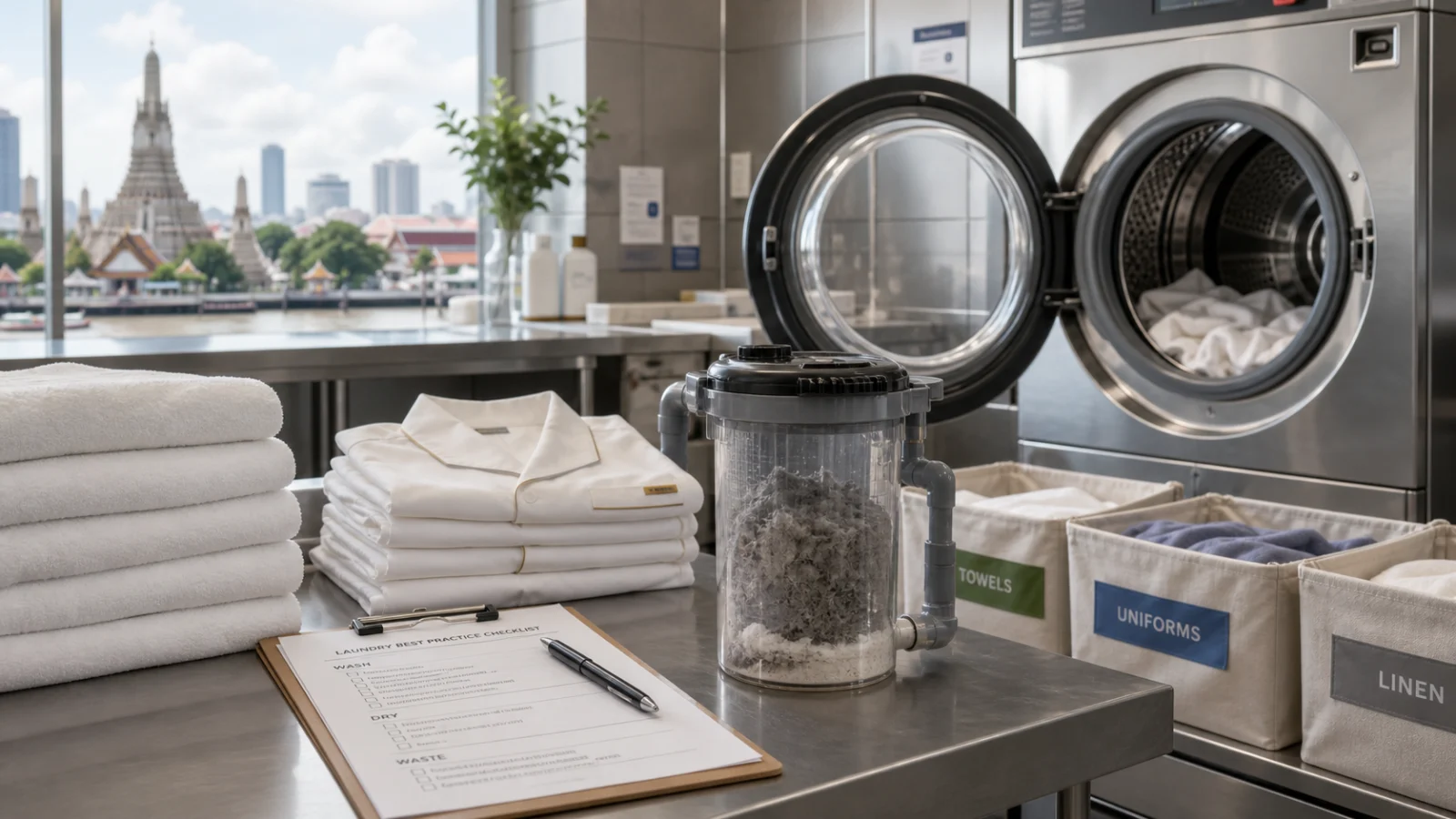
Drying is part of the system. Over-drying can age fibers and increase lint. Clean lint screens, maintain dryer airflow, avoid unnecessary high heat, and remove items when dry rather than continuing cycles because staff are busy. Lint should be handled as waste, not blown around the laundry room or rinsed into sinks. A clean maintenance routine helps both microfiber reduction and fire safety, so it is an operational win rather than an environmental add-on.
Do microfiber filters solve the problem?
Filters can be useful, but they should be treated as one layer. Built-in washing-machine filters, external capture devices, laundry bags and facility-scale wastewater controls can capture some fibers under some conditions. Their real-world value depends on installation, flow rate, maintenance, cleaning frequency, staff training, disposal of captured lint and whether they interfere with laundry performance. A filter that staff forget to empty or rinse into a sink becomes a weak control.
For small hotels, spas and salons, the first step is not always to buy equipment. First, know the textile inventory and the laundry provider. If laundry is outsourced, ask whether the provider already uses lint capture, wastewater treatment or microfiber controls, and how captured material is disposed of. If laundry is in-house, evaluate filters against machine warranties, capacity, plumbing, maintenance time and waste handling. The decision should be documented as a pilot or procurement note rather than a decorative claim.
The strongest public statement is modest: the business is reviewing microfiber capture, training staff, improving textile purchasing, maintaining lint controls or piloting a filter. Avoid saying the laundry is microfiber-free unless there is credible evidence across all textile items, wash routes and wastewater pathways. Microfiber pollution is diffuse, so exact elimination is rarely a responsible claim.
A practical checklist for managers
Create a one-page monthly microfiber checklist. Count high-wash synthetic or blended textile categories. Check whether washing instructions are posted where staff actually load machines. Confirm lint screens are cleaned and lint is placed in dry waste. Review whether any items are visibly pilling, shedding or tearing. Ask whether staff are washing lightly used items automatically. Record complaints about towel softness, odor, drying time or uniform comfort because service friction can cause hidden waste.
Add a purchasing review every quarter. Compare textile replacement quantities, damaged-item causes, supplier packaging, laundry cost, water and energy indicators where available, and waste disposal notes. A microfiber plan becomes stronger when it is connected to costs and operations. Managers usually cannot run a laboratory, but they can see whether cheap textiles are failing fast, whether laundry volume is rising without guest volume, and whether some items are being washed because storage and labeling are unclear.
If the operation has several departments, assign owners. Housekeeping owns towel and linen routines. Spa or salon supervisors own treatment textiles and guest-facing explanations. Purchasing owns supplier questions. Laundry staff or contractors own machine settings, lint capture and maintenance. Marketing owns claim discipline. Without owners, microfibers become everyone's concern and nobody's routine.
Greenwashing cautions for textile claims
Textile claims are easy to overstate because they sound positive in isolation. Recycled polyester may reduce demand for virgin material, but it is still synthetic and can still shed fibers. Natural fiber may avoid plastic microfiber release, but it can still involve water, land, chemicals, transport and short lifespan problems. A microfiber cleaning cloth may reduce chemical use, but it also needs a washing and end-of-life plan. A towel reuse card may reduce laundry loads, but only if housekeeping rules and guest communication actually change behavior.
For public claims, use narrow wording. Say uniforms contain documented recycled polyester, not that uniforms are plastic-free. Say the spa reduced towel rewash rates by improving guest opt-in systems, not that it solved textile pollution. Say a microfiber filter pilot captures lint that is disposed of as solid waste, not that wastewater is clean. Say the business is shifting high-failure items to longer-lasting textiles, not that all linens are sustainable.
The same caution applies to guest education. A spa guest should not be handed a lecture while trying to relax. A hotel guest should not be blamed for using a towel. The better communication is quiet and specific: towels are replaced on request or after use, staff follow hygiene rules, and the business is improving textile purchasing and laundry management to reduce waste. Public-information copy works best when it helps readers ask better questions rather than selling moral superiority.
Bangkok service-industry application
Bangkok's hospitality and wellness sector has a practical reason to care about laundry microfibers: textiles shape the guest experience. A treatment room may use sheets, face towels, robes, compress cloths and uniforms in a single appointment. A small hotel may process towels, bedding and staff clothing daily. A grooming studio may wash capes, towels and cleaning cloths after many clients. Each business can reduce leakage risk by treating textiles as inventory with environmental consequences, not as invisible back-of-house supplies.
Heat and humidity also affect decisions. Lightweight uniforms may need frequent washing. Towels must dry properly to avoid odor. Treatment oils require effective cleaning. These realities make simplistic low-laundry advice inappropriate. The practical route is better textile choice, good ventilation, clear storage, right-sized laundry schedules and supplier coordination. A Bangkok business should not weaken hygiene to reduce microfibers; it should reduce unnecessary washing and unnecessary textile failure.
Local small businesses can begin with a 30-day review. Week one: inventory textiles and identify synthetic or blended categories. Week two: observe wash frequency and automatic rewash triggers. Week three: ask suppliers or laundry providers for material and handling data. Week four: choose one intervention, such as better sorting, replacing a fast-failing uniform, posting load rules, piloting lint capture, or changing towel replacement communication. A modest completed loop is more useful than a broad campaign that disappears after one month.
How consumers and guests can help
Consumers do not control a hotel's textile procurement, but they can avoid turning low-waste systems into extra service friction. Reuse towels when the room or treatment context makes that hygienic and comfortable. Do not throw clean towels on the floor by habit. Use laundry request cards accurately. Avoid demanding disposable replacements when a clean reusable system is clearly provided. Ask polite questions if a business makes a broad green claim that sounds unsupported.
Guests should also keep perspective. A towel reuse card does not prove a hotel has a responsible textile policy. A recycled uniform does not prove microfiber control. A refill station does not answer laundry questions. Look for specifics: durable linens, clear housekeeping routines, refill and reuse systems, careful claims, visible cleanliness, and staff who can answer without improvising. The most credible businesses usually describe practical routines, not perfect environmental identities.
For households, the commercial lesson travels back home. Buy fewer low-quality synthetic textiles, wash full loads, avoid unnecessary hot or harsh cycles, clean lint screens, repair items when possible, and treat captured lint as waste. A small home routine and a professional laundry routine share the same logic: keep useful textiles in service longer and prevent fibers from leaving the system unnecessarily.
Bottom line
Hotel and spa laundry microfibers are not a reason to panic about every towel. They are a reason to manage textiles with the same seriousness that businesses already give to hygiene, comfort and cost. The best controls are practical: purchase durable textiles, wash only as needed, reduce abrasion, maintain machines, capture lint responsibly, review filters where feasible, and make public claims that match evidence.
For a manager, the next action is a textile inventory and one leakage-reduction pilot. For a laundry provider, the next action is better documentation of wash settings, lint handling and capture options. For a guest, the next action is to use textile reuse systems accurately and reward businesses that communicate honestly. For policymakers and producers, the next action is clearer textile design, better test methods and responsibility across the product lifecycle.
Plastic pollution education is strongest when it finds the hidden pathway behind an ordinary routine. Laundry is ordinary. That is why it matters. Every towel, robe and uniform is a repeated decision, and repeated decisions are where practical plastic reduction becomes visible.
Detailed infographic
Commercial laundry microfiber control loop
A practical operating map for reducing microfiber leakage from towels, linens, uniforms and cleaning textiles.
- Map Identify high-wash towels, robes, uniforms, mats and cleaning cloths.
- Choose Buy durable textiles with documented composition and realistic care guidance.
- Wash Use appropriate loads, settings, detergent and sorting to reduce abrasion.
- Capture Maintain lint screens and evaluate filters or provider controls where feasible.
- Report Track replacements, laundry volume, lint handling, pilots and claim evidence.
Action checklist
- Separate high-friction items from delicate towels and linens.
- Clean lint screens and keep lint out of sinks and drains.
- Ask laundry providers about wastewater and microfiber controls.
- Replace fast-failing textiles with longer-lasting options.
- Use precise public claims with evidence and limits.
Frequently asked questions
Do hotel towels release plastic microfibers?
Only textiles that contain synthetic polymers or blends can release plastic microfibers. A towel, robe, uniform or cleaning cloth should be checked by material composition before making a claim.
Should spas stop using microfiber cleaning cloths?
Not automatically. Microfiber cloths can perform well and may reduce some chemical use, but they need careful washing, long service life, lint handling and end-of-life planning.
Is a microfiber filter enough for a hotel laundry?
No. Filters can be part of the answer, but purchasing, textile durability, wash settings, load management, lint disposal and outsourced laundry practices also matter.
What should a small spa or hotel do first?
Start with a textile inventory, identify the items washed most often, ask suppliers or laundry providers for material and handling information, then pilot one better care or purchasing change.
Can a business say its laundry is sustainable?
Only with specific evidence. It is better to state measurable actions, such as durable textile purchasing, towel reuse rules, lint handling, filter pilots or reduced replacement rates, than to use broad sustainable claims.
Sources and further reading
- OECD policies to reduce microplastics from textiles and tyres
- OECD microplastics mitigation technologies and best practices
- European Commission Sustainable and Circular Textiles Strategy
- EPA guide for managing and reducing wastes in commercial buildings
- EPA waste management hierarchy
- NOAA microplastics definition