Direct answer
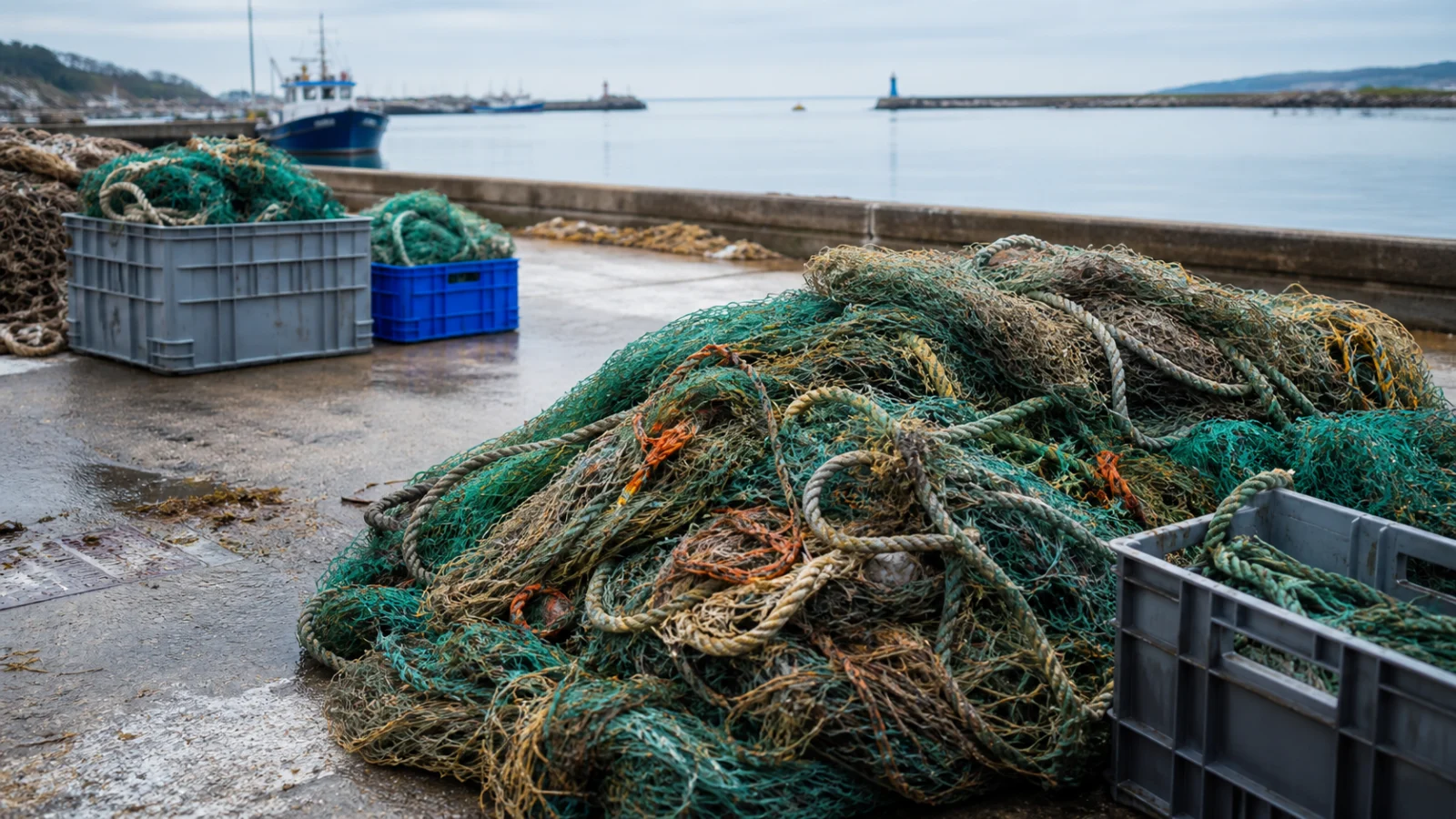
Ghost gear is abandoned, lost or otherwise discarded fishing gear such as nets, lines, traps, pots, ropes and fish aggregating devices. It is a plastic pollution problem because modern fishing gear is often synthetic, durable and designed to catch. When it is lost, it can keep trapping marine life, damage habitat, create navigation hazards, fragment into microplastics and impose costs on fishers and coastal communities. The best response is prevention first: mark gear, report losses quickly, retrieve gear safely, provide port disposal, design better end-of-life systems and use cleanup data to stop repeat losses.
Key points
- Ghost gear is not ordinary beach litter; it is equipment that can keep doing harm after it is lost.
- Prevention is more effective than trying to recover every net, rope or trap after it has moved, sunk or fragmented.
- Gear marking, fisher-led reporting, safe retrieval and port reception systems make lost gear easier to manage.
- Recycling recovered gear can be useful, but only after contamination, mixed materials and transport are handled honestly.
- Public education should connect ghost gear to plastic pollution without blaming all fishers for a systems problem.
Related Plastika Problema reading
- How plastic reaches the ocean - background on the land-to-water leakage route that complements sea-based gear pollution
- Plastic pellet pollution and stormwater - a useful comparison for why prevention beats cleanup once small plastics disperse
- Beach cleanups and source reduction - context for using cleanup data without treating cleanup as the whole solution
- Plastic reduction actions - practical prevention habits that keep plastic leakage visible and measurable
- Global plastics treaty policy guide - policy background for why plastic pollution controls need clear duties and evidence
Why ghost gear belongs in the plastic pollution conversation
Plastic pollution is often pictured as bottles, bags, wrappers and takeout containers, but some of the most damaging ocean plastic is designed for the sea in the first place. Fishing nets, lines, traps, pots, ropes and related gear are essential working tools for many fisheries. When they are abandoned, lost or discarded, they become ghost gear. The problem is not only that the material is plastic. The problem is that the object was built to be strong, flexible, water-resistant and effective at catching or holding marine life.
That is why ghost gear needs its own article instead of being folded into a generic ocean litter checklist. A lost drink bottle is pollution. A lost net can be pollution, a capture device, a habitat hazard and a navigation problem at the same time. NOAA describes derelict fishing gear as gear in the marine environment that can continue to trap animals, entangle marine life, smother habitat and create hazards for vessels. That practical definition helps readers understand why the issue is more operational than symbolic.
A fair public-information article should also avoid lazy blame. Many gear losses are not deliberate dumping. Gear can be lost during storms, conflict with vessels, snagging, poor marking, gear theft, weak disposal options, illegal fishing, high retrieval costs or lack of reporting systems. Fishers can also be central to the solution because they know where gear is used, when it is likely to move and which retrieval methods are safe. Ghost gear prevention works best when it treats fishing communities as technical partners, not as a stereotype.
What counts as ghost gear
Ghost gear is a plain-language name for abandoned, lost or otherwise discarded fishing gear, often shortened in policy and technical documents to ALDFG. The category can include gillnets, trawl nets, longlines, monofilament lines, crab pots, lobster traps, fish traps, ropes, floats, buoys, fish aggregating devices and fragments of larger gear. Aquaculture equipment can create similar end-of-life and loss risks, though some guidance treats aquaculture gear as a related but distinct management challenge.
Modern fishing gear is commonly made from synthetic polymers because those materials are strong, light, durable and resistant to saltwater. Those qualities are useful during fishing and difficult after loss. A net that remains intact can keep catching. A rope that abrades can shed smaller fibers. A plastic float can break into pieces. A trap can continue attracting and holding species until it is disabled, buried, retrieved or degraded. The material and the function reinforce each other.
The phrase ghost fishing describes the most visible harm: lost gear keeps catching target and non-target species without anyone landing, counting or managing the catch. But the article should be broader than ghost fishing alone. Gear can scrape seabeds, cover coral or seagrass, trap sediment, introduce synthetic fragments, wash onto beaches, foul propellers and create safety risks for divers and vessels. A useful definition therefore links object, material, movement and consequence.
How fishing gear becomes lost
Gear loss is a chain of events, not a single mystery. Bad weather can move nets and pots. Strong currents can drag gear from a marked location. Gear can snag on rocks, reefs, wrecks or other equipment. Vessels can accidentally tow through another fishery's lines. Buoys can break away. Marking can fail. Gear can be abandoned when retrieval is unsafe or uneconomic. In illegal or unreported fishing, gear may be hidden or cut loose to avoid enforcement. In small ports, old gear may accumulate because there is no convenient or affordable disposal route.
This matters because solutions have to match causes. If storms are the main driver, better forecasts, seasonal rules, stronger marking and post-storm retrieval planning may help. If vessel conflict is the driver, spatial management and better communication may matter. If end-of-life gear is dumped because port disposal is expensive or absent, a port reception system may do more than a poster. If lost gear is not reported because fishers fear penalties, a no-fault reporting route may be necessary.
A practical prevention program starts by asking where gear is lost, which gear type is involved, why retrieval failed and who has the safest ability to respond. The answers will differ between a crab-pot fishery, a gillnet fishery, a tuna fishery using drifting devices, a small-scale coastal fleet and a recreational fishing area. Ghost gear policy becomes credible when it is specific enough to fit the fishery.
Why synthetic nets and ropes persist
The plastic issue is not just a label. Synthetic gear can stay functional long after it leaves the control of the owner. Unlike many natural fibers, modern netting and rope materials are designed to resist water, strain and abrasion. That durability is valuable while a fishery is operating. In the wrong place, it becomes persistence. The material can remain as a large object for long enough to keep interacting with animals, reefs, boats and shorelines before slowly breaking down into smaller fragments.
Microplastic risk enters when gear wears, frays, breaks and weathers. A single rope can release fibers along its life. A net fragment can rub against rocks or metal. Floats and lines can degrade under sunlight and mechanical stress. Those small particles are harder to recover than the original gear. This is the same prevention logic used for plastic pellets, tire wear and paint flakes: once plastic has dispersed into many small pieces, cleanup becomes slower, more expensive and less complete.
This is why a ghost gear article should not overpromise recycling as the answer. Recycling a clean, sorted, known polymer stream can be useful. Recovered fishing gear is often wet, salty, biofouled, mixed with lead, metal, rubber, floats, knots and different polymer types. It may be expensive to transport and process. End-of-life design and port-side sorting are therefore part of the recycling story. The cleaner the system is before loss, the more credible material recovery becomes after collection.
The harm is ecological, economic and operational
The ecological harm is the most familiar: entanglement, ghost fishing, habitat smothering and injury. Lost gear can affect protected species, commercial species and non-target species. It can damage benthic habitats and coral areas when dragged or lodged. It can keep catching until it loses capture efficiency, is disabled or is removed. The full impact depends on gear type, location, depth, currents, species present and how long the gear remains active.
The economic harm is equally important for practical policy. Lost gear costs money to replace. It can reduce future catch when it keeps killing marketable species without harvest. It can foul active gear, damage vessels, create navigation hazards and reduce the quality of beaches and tourism sites. A coastal community may pay for cleanup even when the gear came from far away. A port may face storage and disposal costs for gear it did not lose.
The operational harm is that unmanaged gear loss weakens trust. Fishers may feel blamed for a problem they cannot solve alone. Regulators may lack usable data. Cleanup groups may recover gear without knowing its source. Recyclers may receive material that is too mixed to process. Public audiences may see dramatic images but not the maintenance work that prevents repeat loss. Better systems turn ghost gear from a vague ocean problem into a managed chain: use, mark, report, retrieve, receive, sort and learn.
Prevention starts before gear enters the water
The strongest ghost gear strategy begins before fishing starts. Gear should be selected, marked, recorded and maintained in ways that make loss less likely and recovery more realistic. FAO's gear-marking guidance treats marking as part of a wider system for management, enforcement, lost gear reporting, recovery and environmentally sound disposal. That system view matters because a label alone cannot retrieve a net. The label has to connect to records, rules, incentives and safe response.
Basic prevention questions are direct. Is each gear unit identifiable? Is ownership traceable without exposing fishers to unfair risk? Is the buoy or marker durable enough for local conditions? Are gear positions recorded? Are weak ropes, clips and floats replaced before a storm season? Are crews trained to report lost gear quickly? Is there a clear port contact for retrieval information? Are disposal options available for damaged gear so dumping is not the easiest route?
Design also matters. Gear can sometimes be modified so it stops fishing after loss, is easier to locate, or is easier to separate at end of life. Escape panels, degradable links in some traps, better marking, tracking devices, stronger retrieval points and fishery-specific maintenance rules can all be part of the toolkit. The best option depends on the fishery and should be tested for safety, catch performance, cost and real-world maintenance.
Reporting lost gear should be normal
Fast reporting is one of the most practical steps because gear is easiest to retrieve when the location is fresh. A fisher who reports a lost net, pot or line can provide coordinates, gear type, depth, weather conditions and any safety concerns. That information is far more useful than a cleanup team finding an anonymous tangle months later. The reporting system should be simple enough to use during real work, not buried in paperwork that punishes honesty.
FAO and IMO-linked GloLitter materials emphasize reporting and fisher-led retrieval programs because the people working on the water often have the best knowledge of where gear is lost and how it can be recovered safely. Successful programs can include no-fault reporting, rapid response, seasonal retrieval, trained contractors, clear agency roles and data feedback. The goal is not to create a database for its own sake. The goal is to shorten the time between loss and recovery.
Public education can help by changing the story around reporting. Losing gear should not automatically be treated as proof of careless behavior. Storms happen. Lines break. Gear conflicts occur. What matters is whether the system encourages quick disclosure, safe retrieval and learning. If fishers are afraid that reporting will only bring penalties, the gear may stay hidden until it becomes harder to remove.
Retrieval must be safe and evidence-led
Retrieval is valuable, but it is not a casual beach-pickup task when gear is heavy, submerged, entangled or near sensitive habitat. Divers, fishers, agencies and cleanup groups need safety planning, permits where required, vessel support, weather windows, lifting equipment and disposal routes. Pulling a net from a reef without the right method can cause additional damage. Dragging unknown gear can create hazards. A well-run retrieval program protects people and habitat as well as removing plastic.
The best retrieval decisions use evidence. Where is the gear? What type is it? Is it actively fishing? Is it near protected habitat? Can it be removed without greater damage? Who owns or may have lost it? What disposal or recycling route will receive it afterward? The answers can prioritize urgent gear while avoiding heroic but harmful removal attempts. In some cases, disabling fishing function may be a temporary step before full removal.
Cleanup data should feed prevention. If the same beach receives the same type of rope after storms, the community has a source pattern. If crab pots accumulate in predictable channels, the fishery may need marking, seasonal retrieval or vessel-conflict fixes. If nets appear without marks, enforcement and gear identification may need attention. A pile of recovered gear is not just waste; it is evidence about where the system failed.
Port disposal and end-of-life systems decide what happens next
A fisher with damaged gear needs somewhere to put it. Without convenient port reception, old nets and ropes can become a storage problem that later becomes a dumping problem. Good port systems provide clear drop-off points, cost rules, sorting instructions, contamination guidance and downstream handling. If recycling is available, the port can separate material by type and condition. If recycling is not available, safe disposal still prevents the gear from entering water.
End-of-life systems should be designed around real material, not ideal material. Gear may be wet, salty, tangled, mixed with organic matter or combined with metal components. Staff need rules for cutting, cleaning, bundling, storing and recording it. Recyclers need predictable quality. Authorities need data on volumes and sources. Fishers need a process that does not waste a working day. If any part is unrealistic, the system will leak.
This is where extended producer responsibility ideas can become relevant, although fishing gear needs careful design because ownership, repair, reuse and regional fisheries are complex. Producers, importers, gear sellers, ports and fisheries agencies can share responsibility for take-back, design improvements and material records. The policy should make proper handling easier than abandonment, not simply add a slogan to gear that has nowhere to go.
Greenwashing cautions around recycled ghost gear
Recovered fishing gear has become a popular material story for consumer products. That can be positive when it funds collection, creates demand for recovered polymers and communicates the problem clearly. It can also become greenwashing when the claim is vague. A product should not imply that buying it solves ghost gear unless the collection, sorting, processing and chain of custody are documented. Ocean plastic language is especially risky when it turns a complex prevention problem into a simple shopping emotion.
A credible claim should answer several questions. Was the material actually recovered fishing gear, end-of-life fishing gear collected before loss, or another marine plastic stream? Where was it collected? Was it cleaned and recycled mechanically or chemically? What percentage of the final product is recycled content? What happens to the product at the end of its life? Is the program also preventing future gear loss, or only using recovered material as branding?
The strongest public advice is balanced. Support real recovery systems where evidence exists, but do not let recycled ghost gear products distract from prevention. A net that is never lost is better than a net that becomes a marketing claim after months in the sea. Recovery and recycling are useful downstream tools. Marking, maintenance, reporting, retrieval and port disposal are upstream controls.
What coastal communities can do
Coastal communities can start with mapping. Record where nets, ropes, lines, traps and floats appear, what season they appear, whether storms precede the finding, and whether marks or tags are present. Separate fishing gear from generic plastic litter in cleanup records. Photograph items for documentation, but avoid sharing precise sensitive locations if doing so would create safety, enforcement or habitat risks. The point is to build a prevention dataset, not only a cleanup gallery.
Next, connect the right partners. Fishers, harbor masters, waste contractors, divers, conservation groups, local authorities, tourism operators and schools each see a different part of the problem. A harbor master may know disposal barriers. Fishers may know gear-conflict hotspots. Divers may know submerged accumulations. Waste contractors may know which material cannot be recycled. Schools and public educators can translate the issue without oversimplifying it.
A practical local checklist might include a port gear drop-off day, clear reporting contact, seasonal post-storm survey, marked cleanup categories, safe-storage area, recycler assessment and a monthly meeting with fishing representatives. None of this is glamorous. That is the point. Ghost gear prevention is maintenance, logistics and trust before it is a campaign image.
What readers away from the coast can do
People far from a fishing port can still usefully understand ghost gear. First, they can avoid treating ocean plastic as only a consumer-packaging story. Land-based plastic leakage matters, but sea-based plastic sources have different causes and solutions. Second, they can ask for evidence when brands use ocean plastic or fishing-net claims. Third, they can support policies and organizations that build reporting, retrieval and end-of-life systems instead of only promoting one-time cleanup events.
Consumers of seafood can also ask better questions without turning dinner into an interrogation. Retailers, restaurants and certification systems can be encouraged to explain gear-loss prevention, fishery management and traceability. Not every small fisher can produce a glossy sustainability report, and public education should respect that. The useful pressure is for transparent systems: gear marking, loss reporting, safe retrieval and port disposal that are normal parts of responsible fishing.
Finally, readers can connect ghost gear to the same prevention logic used elsewhere on this site. Plastic pollution gets harder to solve after it disperses. Whether the source is a city street, a pellet spill, a synthetic textile or a fishing net, the best time to intervene is before the material fragments and moves. That shared logic makes ghost gear part of the broader plastic pollution problem without pretending all sources are identical.
A practical checklist for ghost gear prevention
For fishing operators, start with gear inventory and marking. Record what gear is used, where it is deployed, how it is identified and when it is inspected. Replace weak points before high-risk seasons. Store spare tags, lines and floats so maintenance is easy. Train crews to record coordinates when gear is lost and to report losses quickly through the accepted local channel. If no channel exists, the fishery association or port authority should help create one.
For ports and authorities, provide a place for old gear. Make disposal instructions visible. Separate reusable, recyclable and disposal material. Track volumes by gear type. Share retrieval data with fishing representatives. Avoid making honest reporting feel like a trap. Build response plans for storms and known hotspots. Use recovered gear data to improve marking, spatial rules or retrieval funding.
For cleanup groups, separate ghost gear from general litter data. Do not attempt dangerous retrieval without training and permits. Coordinate with local fishers before removing gear that may still be active or legally placed. Document condition, location, marks and likely gear type. Ask what prevention step would stop the same item appearing again. The cleanup is not finished when the net leaves the beach; it is finished when the system learns from it.
Bottom line
Ghost gear is one of the clearest examples of why plastic pollution needs source-specific solutions. It is plastic, but it is also working equipment. It can keep catching, smother habitat, move through storms, endanger navigation and fragment into smaller particles. A generic message about using fewer straws will not fix a lost gillnet or a field of abandoned traps. The solution has to match the object.
The practical hierarchy is prevention, reporting, retrieval, reception, sorting and learning. Mark gear before it is lost. Maintain it before it fails. Report it quickly when loss happens. Retrieve it safely when evidence supports removal. Provide port systems for damaged gear. Recycle only where the material stream is real. Use every recovered item as data for the next prevention decision.
For public readers, the most useful takeaway is simple: ghost gear is not invisible just because it is offshore. It is a plastic pollution pathway that can be managed when fishers, ports, agencies, recyclers and communities have clear roles. Cleanup matters, but prevention is the stronger environmental habit. A net kept in the working system, repaired, tracked and retired properly is better than a net recovered after it has already become ocean plastic.
Detailed infographic
Ghost gear prevention loop
A practical systems map showing how fishing gear moves from useful equipment to marine plastic pollution, and where prevention works best.
- Prepare Inventory, mark and maintain gear before it enters the water.
- Use Record deployment areas, weather risks and gear conflicts during fishing.
- Report Share loss location, gear type and safety details quickly.
- Retrieve Remove or disable gear only with safe, evidence-led methods.
- Learn Sort, dispose or recycle material and update prevention rules.
Action checklist
- Mark gear and keep deployment records.
- Make no-fault loss reporting easy.
- Provide port drop-off for damaged nets and ropes.
- Separate cleanup data by gear type.
- Question recycled ghost gear claims without documentation.
Frequently asked questions
What is ghost gear?
Ghost gear is abandoned, lost or otherwise discarded fishing gear, including nets, lines, traps, pots, ropes and related equipment that remains in the marine environment.
Why is ghost gear a plastic pollution problem?
Many modern nets, ropes, floats and lines are synthetic and durable. After loss, they can continue to catch marine life, damage habitats, create navigation hazards and fragment into smaller plastic pieces.
Can ghost gear be recycled?
Sometimes, but only when the recovered material is clean enough, sorted by polymer and connected to a real processor. Wet, mixed, biofouled or metal-contaminated gear may need other handling.
What is the best way to prevent ghost gear?
The strongest prevention mix is gear marking, maintenance, simple loss reporting, fisher-led retrieval where safe, port disposal for end-of-life gear and data feedback from cleanups.
Should cleanup groups remove every net they find?
No. Heavy or submerged gear can be dangerous and may damage habitat if removed incorrectly. Cleanup groups should coordinate with local authorities, fishers and trained retrieval teams.
Sources and further reading
- NOAA Ocean Service on ghost fishing
- FAO Voluntary Guidelines on the Marking of Fishing Gear
- FAO reporting and retrieval of lost fishing gear
- IMO on solutions for abandoned, lost or otherwise discarded fishing gear
- European Commission single-use plastics overview
- Global Ghost Gear Initiative resources and best practice frameworks