Direct answer
Artificial turf infill microplastics are small rubber or plastic granules used to support synthetic sports surfaces. They can leave a pitch on shoes, clothing, equipment, maintenance machines, snow, wind and stormwater, then collect around drains, paths, changing rooms and nearby soil. The practical answer is not to close every field overnight. It is to stop granules from escaping: install pitch-edge barriers and drain traps, brush material back onto the field, use shoe-cleaning stations, manage snow and washdown water carefully, train grounds teams, choose future surfaces with lower leakage risk, and keep public claims specific and evidence-based.
Key points
- Rubber and plastic infill granules are microplastics when they are small synthetic polymer particles that can escape into the environment.
- ECHA identifies granular infill for artificial sports surfaces as a major intentional microplastic release source in Europe, with an EU sales ban applying to granular infill from 17 October 2031.
- The most useful controls are physical and operational: barriers, brushing, drain capture, shoe cleaning, snow handling, maintenance logs and procurement rules.
- Stormwater matters because loose granules can move from field edges into drains and waterways after rain or cleaning.
- Schools, clubs and venues should avoid vague green claims and instead report measurable actions such as captured infill, reduced top-up purchases or verified alternative surface choices.
Related Plastika Problema reading
- Microplastics in drinking water and food - background on why microplastics are a pollution category rather than one single material
- Tire wear microplastics and stormwater - context for rubber particles and runoff pathways
- How plastic reaches the ocean - a related guide to drains, rain and urban leakage routes
- Plastic packaging greenwashing claims - useful for checking broad environmental claims before repeating them publicly
- Action checklist - practical prevention habits that support larger plastic reduction systems
- Plastic types guide - background on how plastic materials differ before and after use
Why artificial turf belongs in the microplastics conversation
Artificial turf is usually discussed as a sports, maintenance or land-use decision. It belongs in the plastic pollution conversation because many synthetic fields use loose infill granules to provide shock absorption, traction, drainage and surface stability. Those granules are often made from recycled tyre rubber, although other polymer materials and alternative infills also exist. When the particles are small, synthetic and persistent, they fit the practical microplastics concern: once they leave the field, they are difficult to collect completely.
This does not mean every synthetic field should be treated as an emergency. It does mean a field should not be treated as a sealed system. Players carry granules in shoes and socks. Maintenance brushing can push material toward edges. Heavy rain can move particles into drains. Snow clearance can move infill into piles where it later melts and spreads. Leaf blowers, washdown routines, open gates, torn edging and poor storage can all turn a controlled sports surface into a wider leakage point.
The public-information posture should be balanced. Artificial turf can provide year-round playing time, lower mud problems and predictable maintenance for some schools and clubs. Natural grass can have its own water, pesticide, compaction and access tradeoffs. The useful question is narrower and more practical: if a venue already has an infilled synthetic surface, how does it keep the infill on the pitch, and if it is buying a new surface, how does it compare lower-leakage options honestly?
The answer-first risk map
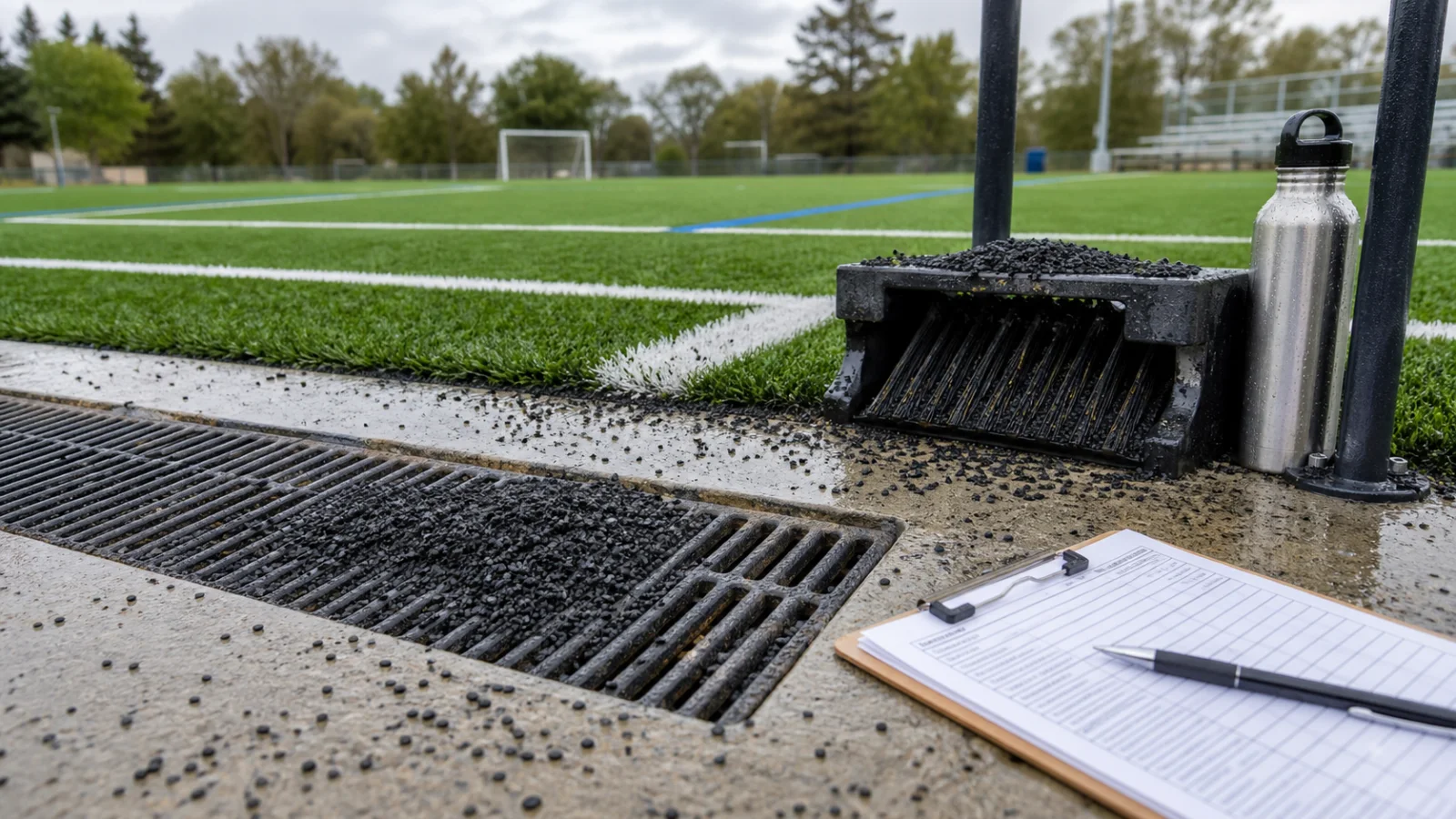
Start by mapping where granules leave the playing area. Walk the site after a wet session, after maintenance, after a tournament and after a dry windy day. Look at gate thresholds, boot-cleaning points, changing-room entrances, storage areas, maintenance paths, spectator edges, nearby drains, gutters, wheel tracks and the first few meters outside the fence. These places often reveal more than a desk review because escaped infill is visible as small dark particles gathered where people and water move.
Next, separate the pathways. Player carry-off is the material trapped in shoes, socks, hems, bags and equipment. Maintenance carry-off is material moved by brushes, machines, refill bags, blowers or poor edge management. Weather carry-off is material moved by wind, rainwater, runoff or snow. Construction and repair carry-off is material lost during installation, seam work, top-ups or pitch replacement. Each pathway needs a different control, so one generic sign at the gate is not enough.
Finally, decide which points need immediate action. A drain with visible granules needs capture and cleaning. An open gate with a pile of infill needs a threshold system and brushing-back routine. A maintenance shed with torn infill bags needs storage rules. A changing room with granules across the floor needs shoe-cleaning and housekeeping changes. A site near a stream, canal or storm drain deserves extra priority because leakage can move quickly away from the field.
What official sources say about infill
ECHA's public page on granules and mulches explains why the issue has moved from specialist debate to policy. It describes the rubber and plastic granules used on pitches as microplastics and identifies granular infill as the largest single source of intentionally added microplastic pollution in Europe, with estimated releases of up to 16,000 tonnes per year. The same page explains that the European Commission adopted the wider intentionally added microplastics restriction in September 2023 and that the sales ban for granular infill used on artificial sport surfaces starts applying from 17 October 2031.
The date matters because it prevents two kinds of bad advice. First, it is wrong to tell communities that EU rules already require every existing pitch to close. ECHA has been clear that the restriction is about placing granular infill on the market after the transition period, not an immediate shutdown of pitches. Second, it is weak to ignore the transition and continue business as usual. The long lead time is a planning window for procurement, field replacement, leakage controls and better maintenance.
OECD material on microplastics pollution in water also discusses rubber granulate from artificial sport turf as a leakage source and lists mitigation options such as brushing material back, drainage slit traps, separate collection or treatment of surface water, snow handling routines and operational controls. EPA stormwater pages are not written only for sports fields, but they are useful because they frame microplastics as pollutants that can move through stormwater systems. Taken together, the policy lesson is practical: treat the pitch edge and drainage network as part of the plastic control system.
Where granules escape first
The pitch edge is usually the first control zone. Any gap in a perimeter board, curb, fence base or gate threshold can become a pathway. A well-designed edge holds infill during play and maintenance while still allowing safe access, emergency movement and drainage. If a site has frequent granule piles outside gates, the problem is not only player behavior. The physical design is allowing material to leave at the moment when athletes and staff naturally exit.
Drains are the second control zone. Loose granules near a drain grate are a visible warning. Once particles enter stormwater infrastructure, collection becomes harder and responsibility can become unclear. Drain baskets, sediment traps, filter inserts or other capture systems may help when they are designed for the site and maintained on schedule. A trap that is never cleaned becomes a false control. A drain that bypasses treatment can move material quickly into wider waterways.
Changing rooms and paths are the third control zone. Players may not notice small particles on shoes, socks and bags, especially after wet play. Shoe brushes, boot scrapers, clear exit routes, storage mats and simple team instructions can reduce carry-off. The goal is not to shame players. It is to make the right action normal: brush shoes before leaving, empty granules back onto the pitch where appropriate, and avoid tracking material into cars, homes and drains.
Maintenance practices that prevent leakage
Maintenance is often the difference between a controlled field and a leaking one. Regular brushing can redistribute infill and return displaced material from edges back into the playing area. Staff should avoid blowing granules into landscaping, drains or paths. Top-up infill should be stored in intact bags or covered containers away from drains. Any spill during delivery or maintenance should be swept and returned immediately rather than left for rain.
Snow and heavy rain require specific rules. Where snow is cleared from a synthetic pitch, the storage area should allow infill to be recovered after melting. Piling snow outside the controlled perimeter can spread granules into soil and drains. In warm climates without snow, heavy rain and washdown routines are more relevant. Staff should inspect drains and low points after storms and record whether granules are accumulating.
A maintenance log does not need to be complex. Record date, weather, observed leakage points, brushing completed, traps cleaned, top-up material added, spills recovered and repairs needed. The most important number is not a perfect scientific emission estimate. It is the direction of travel: are piles around gates smaller, are drain traps catching material, are top-up purchases falling, and are staff finding fewer granules outside the field after events?
Procurement questions for new or replacement surfaces
When a school, sports club or municipality is planning a new surface, the lowest-cost bid should not be the only environmental question. Ask suppliers what infill is used, whether loose granular infill is needed, what alternatives exist, how much infill is expected to be added each year, what containment features are included, how drainage captures particles, what maintenance is required, and how the surface will be removed at end of life. A procurement document should require answers before the contract is signed.
Alternative infills and non-infill systems need the same honest scrutiny as rubber granulate. Cork, sand, olive pits, coconut fiber, coated minerals, thermoplastic elastomers and other options can have different performance, cost, heat, water, durability, transport and maintenance profiles. A natural-looking infill is not automatically impact-free. A polymer alternative may still raise microplastic questions. The right approach is evidence-led comparison, not swapping one green-sounding label for another.
End-of-life planning is part of procurement. Synthetic turf replacement can generate rolls of plastic carpet, backing, infill and mixed materials. The contract should state how the old material will be separated, recovered, reused, recycled or disposed of, and who documents the route. A field designed for lower leakage during use can still create a waste problem at replacement if end-of-life is ignored.
A practical checklist for schools and sports clubs
Use a monthly checklist that fits ordinary operations. Inspect gates, drains, edge barriers, maintenance paths, changing-room entrances and low points after rain. Sweep loose granules back onto the field when safe and appropriate. Clean shoe brushes and drain traps before they overflow. Store top-up infill under cover and away from stormwater. Brief coaches and teams at season start. Put a simple sign at exits asking players to brush footwear before leaving the pitch.
Assign owners. A school facilities manager may own drain checks. A grounds contractor may own brushing and top-ups. Coaches may own player routines. A venue manager may own event-day inspections. Without owners, the checklist becomes a poster. With owners, it becomes normal site management.
Review the checklist after tournaments and community events because high-use days create different leakage patterns. More players means more carry-off, more bags on paths, more spectators near edges and more cleaning pressure afterward. If the field serves public rentals, include leakage controls in user agreements. A short clause about brushing footwear and keeping granules on site can be more useful than a long sustainability statement nobody reads.
Stormwater controls and site layout
Stormwater controls should be designed with the whole site in mind. The pitch surface, perimeter, paths, gutters, drains, landscaping and nearby roads work together during rain. A field with good pitch drainage can still leak granules if the exits drain directly to an uncovered grate. A site with traps can still fail if maintenance staff wash particles around the trap or if overflow bypasses the capture point during heavy storms.
Practical controls include raised edges where safe, sealed gate thresholds, brush mats, catch basins, drain baskets, sediment traps, protected storage, sweeping routines and clear maintenance maps. The best combination depends on field age, climate, slope, drainage design and user volume. A small school field may need simple edge and shoe controls. A large municipal sports complex may need engineered drainage capture and written contractor procedures.
Stormwater language is useful because it connects the pitch to wider public infrastructure. Granules that leave the field do not simply vanish. They can move into drains, retention areas, canals, rivers or soil. Once they are mixed with sediment and other urban pollutants, recovery becomes more difficult. This is why prevention at the field edge is usually cheaper and clearer than cleanup downstream.
Health, chemicals and public communication
Public communication should separate environmental leakage from player health claims. ECHA's page notes that rubber granules may contain substances such as PAHs, metals and phthalates and also gives basic hygiene measures while stating that there is no scientific basis, at that point, to advise people against playing on synthetic pitches containing recycled rubber granules. A responsible article should not turn that into either panic or dismissal.
For venue operators, the safest public message is practical. Encourage handwashing after play and before eating. Ask players to clean cuts quickly. Keep footwear and equipment from tracking granules indoors. Do not let children swallow granules. Maintain the field and capture escaped material. If parents, athletes or staff ask about chemical concerns, refer them to current official health and environmental guidance rather than making improvised medical claims.
The same discipline applies to sustainability claims. Do not say a field is microplastic-free if it uses loose synthetic infill. Do not say recycled tyre infill is automatically circular if granules are escaping to drains. Do not say an alternative infill is natural or safe without evidence and end-of-life planning. Say what the site actually does: containment installed, traps cleaned monthly, top-up material reduced, alternative surface being evaluated, or replacement scheduled before the EU transition date where relevant.
Greenwashing cautions for artificial turf decisions
Artificial turf decisions are vulnerable to broad claims from both sides. A supplier may emphasize recycled tyre recovery, all-weather access or lower watering needs while underplaying infill leakage. A critic may describe every synthetic surface as the same problem while ignoring differences in design, maintenance, alternatives and local sports access. A public-information article should avoid both shortcuts.
A credible claim names the surface type, infill type, containment measures, drainage controls, expected maintenance, replacement plan and evidence source. If a venue says it reduced microplastic leakage, it should be able to describe the baseline and the action: for example, drain traps installed, granule piles at gates removed, top-up purchases reduced, or snow storage changed. If a supplier says an alternative is biodegradable, recyclable or lower impact, ask for the standard, test conditions, expected lifespan and disposal route.
The same logic used for packaging labels applies here. Recycled content is not the same as recyclability. Reuse of tyre material is not the same as preventing leakage. A transition period is not the same as permission to ignore the issue. The most trustworthy position is specific, measurable and modest.
What households and players can do
Players and families have a small but useful role. Brush shoes at the field before leaving. Shake granules from socks, bags and equipment back into a controlled area rather than onto pavements or drains. Keep sports shoes outside living areas where practical. Wash hands after play and before eating. Do not treat loose granules as toys for children. Report visible piles near drains or gates to the venue rather than assuming someone has noticed.
Parents and community members can ask better questions at school-board, club or municipal meetings. What type of infill is used? Are there edge barriers? Are drains protected? How often are traps cleaned? How much top-up infill is added annually? Is replacement planned before regulatory changes affect future purchasing? Are alternative surfaces being reviewed? Are maintenance contractors required to recover loose granules?
These questions are practical because they point to controls. They do not require every parent to become a polymer specialist. They ask the operator to show how material stays on site. That is the core of artificial turf infill microplastic management.
Bottom line
Artificial turf infill microplastics are a manageable pollution issue when the field is treated as a system rather than a carpet. The material has to be contained during play, maintenance, rain, cleaning, events and replacement. The most useful actions are visible: stronger edges, cleaner gates, drain capture, shoe brushes, careful brushing, snow or runoff rules, storage discipline and honest records.
For an existing field, the next step is a leakage walk after rain and after heavy use. Mark every place where granules collect outside the pitch and fix the highest-risk drain or gate first. For a new field, the next step is a procurement checklist that compares infill choices, containment, drainage and end-of-life before the contract is signed. For public claims, the next step is restraint: describe the controls and data, not a vague promise.
Plastic pollution education works best when it turns a hidden pathway into a practical maintenance task. A rubber granule at a drain is small, but the route it represents is large. Stop it at the field edge, and the solution stays local, visible and affordable.
Detailed infographic
Artificial turf infill leakage control
A practical field-management loop for keeping rubber or plastic infill granules on site and away from drains.
- Inspect Walk gates, drains, paths, changing-room entrances and low points after heavy use.
- Contain Use edge barriers, thresholds, brush stations and protected storage.
- Capture Fit and maintain drain baskets, sediment traps or site-appropriate filters.
- Recover Brush loose granules back onto the pitch and clean traps before overflow.
- Document Track top-ups, spills, trap cleaning, repairs and replacement planning.
Action checklist
- Brush footwear before leaving the pitch.
- Keep top-up infill covered and away from drains.
- Clean drain traps and record what they capture.
- Review snow, rain and washdown procedures.
- Require leakage controls in new-surface procurement.
Frequently asked questions
Are artificial turf infill granules microplastics?
Yes, when the infill consists of small synthetic polymer particles such as rubber or plastic granules. The environmental concern is that loose particles can leave the pitch and become difficult to recover.
Does the EU ban mean existing artificial turf fields must close?
No. The EU microplastics restriction includes a transition period for granular infill used on artificial sport surfaces, with the sales ban applying from 17 October 2031. Existing pitch decisions still depend on local rules, contracts and maintenance plans.
What is the fastest way to reduce infill leakage?
Inspect the field after rain and heavy use, then fix visible leakage points first: gate piles, loose edges, unprotected drains, poor shoe-cleaning areas and uncovered infill storage.
Are natural infill alternatives automatically better?
No. Alternatives need evidence on performance, leakage, maintenance, transport, durability, cost and end-of-life. A natural-sounding material can still create problems if it is poorly managed or replaced frequently.
What should a school or sports club report publicly?
Report specific actions such as drain traps installed, shoe-brush stations added, traps cleaned monthly, top-up infill reduced, replacement options reviewed or a procurement rule adopted. Avoid broad claims such as eco-friendly pitch without evidence.
Sources and further reading
- ECHA granules and mulches on sports pitches and playgrounds
- European Commission Regulation (EU) 2023/2055 on intentionally added microplastics
- OECD policies to reduce microplastics from textiles and tyres
- OECD microplastics mitigation technologies and best practices
- EPA stormwater pollutants of emerging concern
- NOAA microplastics definition