Direct answer
Microplastics in cosmetics are intentionally added synthetic polymer particles or plastic ingredients that can be washed off skin, rinsed from tools, shed during use or eventually enter waste and wastewater routes. The clearest historic example is the plastic microbead in face scrubs, cleansers and toothpastes. Many jurisdictions have restricted or banned those beads in rinse-off products, but the wider issue is broader than one blue bead: plastic glitter, film-formers, powders and other synthetic polymer particles can create different regulatory deadlines, disposal questions and claim risks. The practical answer is to read ingredients, avoid rinse-off products with plastic particles, treat biodegradable and plastic-free claims carefully, and ask brands for specific evidence rather than broad clean-beauty language.
Key points
- Microbeads are the easiest cosmetic microplastic to understand, but they are not the only ingredient or claim issue.
- Rinse-off products matter because ingredients used for seconds can move directly toward drains and wastewater systems.
- EU rules on intentionally added microplastics began applying on 17 October 2023, with different transition periods for rinse-off, leave-on, makeup, lip and nail cosmetics.
- The United States Microbead-Free Waters Act focuses on rinse-off cosmetics with intentionally added plastic microbeads, while Canada regulates microbeads in toiletries.
- Plastic-free, biodegradable, natural and clean beauty claims are not complete unless they explain the material, evidence, product scope and disposal route.
Related Plastika Problema reading
- Microplastics in drinking water and food - background on why tiny particles require source control before exposure questions become personal
- Plastic packaging greenwashing claims - a related framework for checking broad environmental wording before trusting it
- Biodegradable vs compostable vs recycled plastic - context for separating material claims from real environmental routes
- Facial treatment plastic waste - a service-industry view of beauty waste beyond ingredient particles
- Action checklist - simple household routines that reduce plastic leakage before cleanup is needed
- Plastic types guide - background on common plastic material families that may appear in ingredient discussions
Why cosmetics belong in the microplastics conversation
Cosmetics and personal care products can feel too small to matter. A face scrub, toothpaste, glitter gel, exfoliating cleanser, mascara, nail product or body wash is tiny compared with a shipping pallet, fishing net or broken plastic crate. That is exactly why the category deserves attention. Products used by millions of people in small amounts can create repeated releases, especially when the product is designed to be rinsed away. A plastic particle used for a few seconds as an exfoliant has almost no useful life before it moves toward a drain.
The best-known example is the plastic microbead. These small solid plastic particles were added to some rinse-off products to exfoliate, polish, cleanse or change texture. They were cheap, uniform, colorful and stable. They also washed into wastewater systems after use. That design made them a clear source-reduction target: if a plastic particle is intentionally added to a product that is meant to be rinsed down a sink, the prevention point is the formula, not a beach cleanup years later.
The topic has grown beyond old face scrubs. European rules now use the broader concept of synthetic polymer microparticles, and official guidance discusses plastic glitter, cosmetics and transition periods. That does not mean every cosmetic ingredient is the same as a visible microbead. It means readers need a careful framework: what is the ingredient, what size and form is it, is it solid or soluble, is it rinsed off or left on, does the rule apply now or later, and what evidence supports the product claim?
Direct answer: what should shoppers do first?
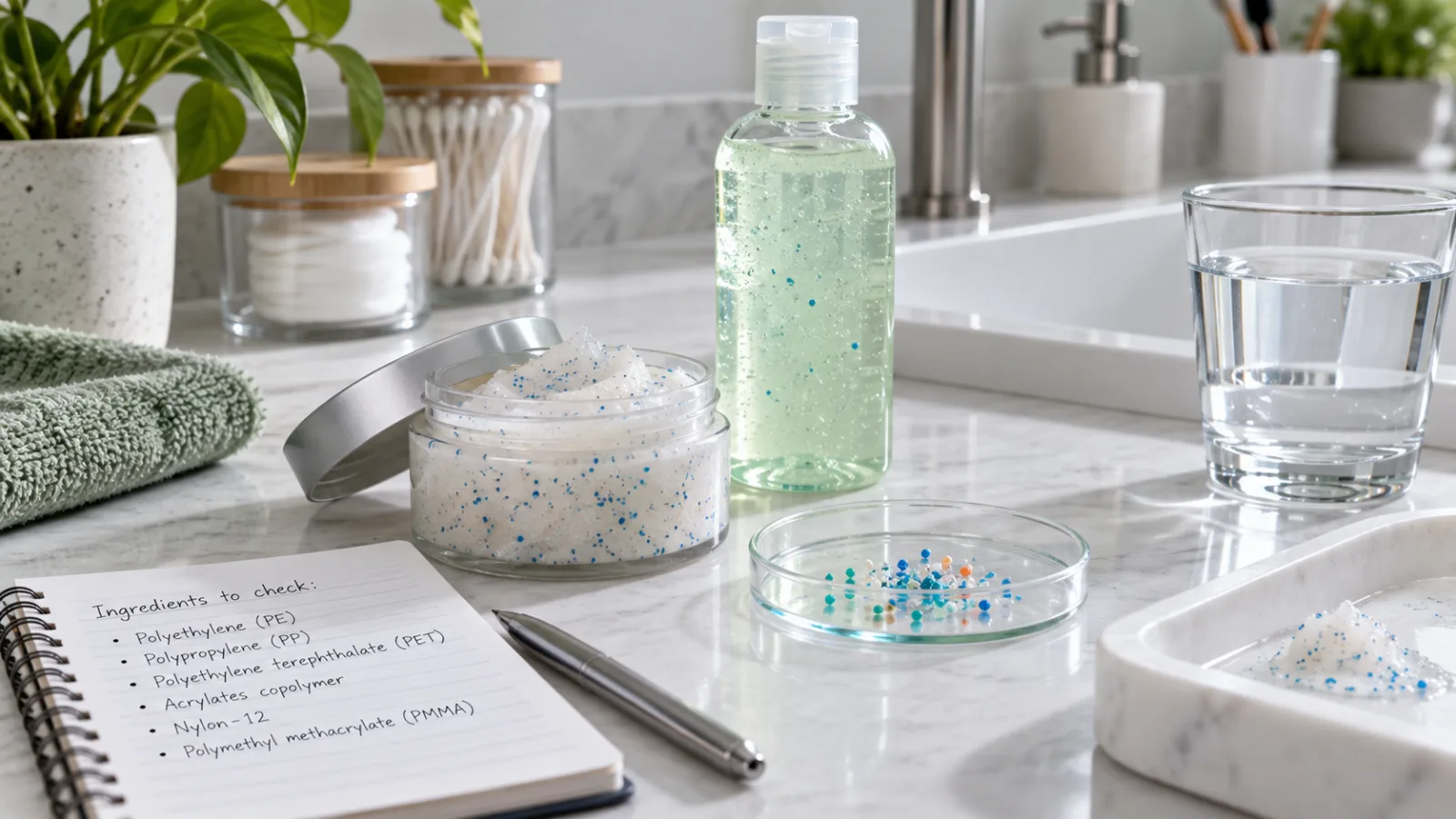
Start with rinse-off products because the pathway is shortest. Check facial scrubs, exfoliating cleansers, body washes, toothpaste, shower gels and glitter products that are washed away after use. Avoid products that list obvious plastic particles or common synthetic polymer particles used as abrasives or visual effects. Ingredients to question can include polyethylene, polypropylene, polyethylene terephthalate, polymethyl methacrylate, nylon-12, nylon-6, polyurethane, acrylates copolymer and similar polymer wording, although ingredient function and regulation depend on context.
Second, separate the claim from the route. Plastic-free is a material claim. Biodegradable is a degradation claim. Natural is a sourcing or marketing claim. Rinse-off is a use-route question. Cruelty-free, vegan, clean or non-toxic may say nothing at all about microplastic release. A product can make one claim truthfully and still leave another environmental question unanswered. The safest habit is to ask what exact ingredient was removed, what replaced it, whether the alternative is soluble or biodegradable under relevant conditions, and whether the claim applies to the whole product or only one ingredient.
Third, do not panic-buy replacements. The lowest-plastic routine is often a simpler routine. Use up compliant products responsibly, avoid buying novelty glitter or abrasive scrubs you do not need, choose washable tools where hygiene allows, and prefer clear ingredient disclosure over vague green design. For many households, the biggest improvement is not finding a perfect product. It is stopping the automatic purchase of rinse-off products that depend on small plastic particles for texture, sparkle or marketing theater.
What microbeads are and why they were targeted
Microbeads are manufactured plastic particles, often small, solid and intentionally added to personal care or cosmetic products. In older product formulas, they were commonly used for exfoliation, cleansing, polishing, visual appeal or texture. A user could feel the grains, rinse the product away and never see the particles again. The product experience was simple. The environmental route was not.
UNEP's report on plastic in cosmetics described plastic particles in personal care and cosmetic product formulations as a possible source of micro-sized plastic litter. The concern was direct and easy to understand: ingredients used by consumers in households worldwide can contribute to the abundance of plastic particles smaller than 5 millimeters when they are emitted to the environment. That framing helped move the topic from specialist wastewater science into ordinary bathroom choices.
Microbeads became a policy target partly because substitution was realistic. Many exfoliating functions can be delivered without solid plastic beads, or the product can be redesigned so exfoliation is less central. Unlike tire wear, paint abrasion or textile shedding, the bead was intentionally added for a non-essential effect in many products. That made the prevention case strong: remove the bead before it reaches the drain.
How rinse-off products create a fast pathway
The phrase rinse-off matters because it describes the route. A face cleanser, body scrub, toothpaste or shower gel is designed to mix with water and leave the body quickly. If the product contains persistent solid plastic particles, the drain is the expected destination. Wastewater treatment can capture many solids, but policy documents and public guidance have repeatedly treated microbeads as a concern because small particles can pass through, concentrate in sludge, or create management questions that are harder than formula prevention.
This does not mean every particle from every product instantly reaches the ocean. Wastewater systems differ by city, treatment level, overflow risk, sludge use and maintenance. But the prevention logic remains strong. If the particle has no essential reason to be plastic and is intentionally added to a rinse-off product, source reduction is cleaner than hoping every downstream system captures it forever.
The same logic applies in beauty, grooming and hospitality settings. A treatment room, hotel bathroom, salon sink or spa shower can multiply the use of rinse-off products. Staff may not control every guest product, but they can control house scrubs, sample sachets, glitter add-ons, disposable cleansing products and purchasing standards. A small business does not need a laboratory to improve this pathway. It needs a product list, ingredient screen and a no-plastic-particle default for rinse-off items.
What the current EU restriction says in practical terms
Commission Regulation (EU) 2023/2055, commonly described as the EU restriction on intentionally added microplastics, began applying on 17 October 2023. The European Commission page explains that the restriction concerns synthetic polymer microparticles on their own or intentionally added to mixtures. It also explains that certain products have transition periods and that articles are not in scope in the same way as mixtures. That distinction matters because public summaries often turn a detailed regulation into a simplistic claim that all glitter or all cosmetics were banned on one day.
For cosmetic readers, the transition dates are the practical headline. The Commission guidance states that plastic glitter or other microplastics used in cosmetics can continue being sold until the end of the relevant transition period: 16 October 2027 included for rinse-off cosmetics, 16 October 2029 included for leave-on cosmetics, and 16 October 2035 included for makeup, lip and nail cosmetics. It also notes that makeup, lip and nail products need microplastics labelling from 17 October 2031 until 16 October 2035 to continue being sold.
The public-information lesson is clear: a legal transition period is not the same as an environmental endorsement. It is a compliance timeline. A brand may be legally transitioning away from a material while consumers still reasonably prefer products without intentionally added persistent plastic particles. The honest article should avoid saying every product is illegal now. It should say the direction of regulation is away from unnecessary intentional microplastic releases and toward clearer product responsibility.
United States and Canada examples
The United States Microbead-Free Waters Act is narrower than the EU's broader intentionally added microplastics restriction. The public law text targets rinse-off cosmetics containing intentionally added plastic microbeads and defines a plastic microbead as any solid plastic particle less than five millimeters in size intended to exfoliate or cleanse the human body or any part of it. This is useful for readers because it shows how a rule can solve one obvious product design without answering every possible synthetic polymer ingredient question in the beauty aisle.
Canada's Microbeads in Toiletries Regulations provide another clear example. The Justice Laws text defines toiletries as personal hair, skin, teeth or mouth care products for cleansing or hygiene, including exfoliants. It prohibits manufacturing, importing and selling toiletries that contain microbeads, with specific dates and extensions for natural health products and non-prescription drugs. The Canada Gazette impact statement explains the environmental rationale: plastic microbeads are washed down the drain and are too small to be entirely captured by wastewater treatment plants.
Together, these examples teach a practical reading habit. Do not assume all countries regulate the same products, dates or definitions. Some laws target microbeads in rinse-off cosmetics. Others address broader synthetic polymer microparticles, transition periods, labelling or specific product groups. For a consumer, the simplest durable rule is stronger than the minimum law: avoid intentionally added plastic particles in products that are washed away, and demand clear evidence for any environmental claim.
Ingredient checking without pretending to be a chemist
Ingredient lists can be intimidating, but shoppers do not need to become cosmetic chemists to ask better questions. Start by looking for words that clearly identify polymers or plastics: polyethylene, polypropylene, polyethylene terephthalate, polymethyl methacrylate, nylon, polyurethane, acrylates copolymer, polyacrylate and similar terms. Some ingredients may be used in forms or functions that are outside a particular restriction, so the list is a screen, not a final legal judgment.
Then look at the product type. A polymer powder in a rinse-off exfoliant raises a different practical question from a film-former in a long-wear mascara, and both differ from packaging plastic. The question is not simply whether a long chemical name appears. The question is whether the ingredient is a persistent synthetic polymer particle, whether it is intentionally added, whether it can be released during normal use, and whether a safer or lower-leakage design exists.
When uncertain, ask the brand a specific question. Do not ask, 'Is this clean?' Ask, 'Does this rinse-off product contain intentionally added solid plastic particles or synthetic polymer microparticles?' Ask whether any glitter is plastic, biodegradable, soluble, mineral or otherwise outside the microplastic scope. Ask whether the product has documentation for biodegradable or plastic-free claims. Specific questions are harder to answer with vague marketing.
Greenwashing cautions in beauty marketing
Beauty marketing is full of broad words: clean, conscious, ocean-safe, reef-friendly, biodegradable, plant-based, natural, sustainable, zero waste and plastic-free. Some brands use these words carefully. Others use them as mood. Microplastics make the weakness visible because the environmental question is specific. Does the product contain persistent plastic particles? Are they rinsed away? What rule, test or standard supports the claim? What part of the product is being described?
A plastic-free product claim should explain whether it refers to ingredients, packaging or both. A biodegradable claim should explain the material and conditions, not only imply that nature will take care of it. A natural exfoliant can still be abrasive, overpackaged or poorly sourced. A recycled plastic jar may be an improvement in packaging while saying nothing about rinse-off ingredients. A clean beauty statement may address a brand's restricted-substance list while leaving microplastic policy vague.
The FTC Green Guides are not a cosmetic microplastics law, but they are useful because they warn against broad environmental claims that consumers can interpret too widely. The same discipline applies here. A credible claim is qualified, specific and evidence-backed. A weak claim asks the shopper to trust a leaf icon, ocean image or soft color palette.
What salons, spas and small retailers should do
Service businesses should make the issue operational. Build a product inventory for every cleanser, scrub, peel, mask, glitter product, rinse-off treatment, shower amenity and retail item. Mark each as rinse-off, leave-on, makeup, nail, hair, cleaning or packaging-related. Then screen ingredient lists and supplier documents for intentionally added plastic particles, microbeads and plastic glitter. The highest priority is any rinse-off product with visible particles or exfoliating function.
Purchasing rules should be written in plain language. For example: no intentionally added plastic microbeads in rinse-off products; no loose plastic glitter for treatments or events; no vague biodegradable or plastic-free claims without supplier documentation; no sample sachet programs that create more plastic waste than product value; and no promotional language that says ocean-safe unless the evidence is narrow and current. Staff need rules they can use during ordering, not a long policy nobody reads.
Retailers can also reduce confusion at the shelf. If a product is sold as an exfoliant, display the exfoliating material clearly. If a glitter product is plastic-free, explain what the glitter is made from and what evidence supports the claim. If a product is being phased out because of regulatory transition dates, say that directly rather than pretending nothing changed. The trust benefit is real: careful environmental wording is more credible than a perfect-looking green shelf.
A practical home checklist
Use a simple bathroom audit. Pull out rinse-off exfoliants, facial cleansers, body scrubs, toothpastes, glitter gels and novelty bath products. Check the ingredient lists for plastic particle terms and for vague sparkle or scrub claims. If a product is old, unlabelled or unclear, do not replace it with the same style until you verify the formula. Avoid flushing or draining concentrated leftover product where local disposal guidance says otherwise.
Then improve the routine. Choose products that do not need plastic particles for texture. Use a washable cloth, brush or reusable tool where hygiene and skin tolerance allow. Avoid novelty glitter for short events, especially when it is loose or washed off. Buy fewer products with simpler functions. Keep packaging and ingredient questions separate so you do not accept a recyclable jar as proof of a low-microplastic formula.
Finally, make the decision repeatable. Keep a short list of ingredient words to question. Save the supplier answers for products you trust. Teach the household rule: visible plastic particles and rinse-off products do not belong together. The rule is imperfect, but it prevents the most obvious pathway without turning every shower into a research project.
What policy can and cannot do
Policy can remove obvious high-leakage ingredients from the market, create transition deadlines, define terms, require labels, stop reintroduction and push suppliers to reformulate. The microbead story shows that regulation can work when a non-essential plastic particle has a clear release route and practical alternatives. It also shows why definitions matter. If a law only covers one type of bead in one product category, companies may still need broader internal standards to address other synthetic polymer particles.
Policy cannot make every shopper understand every ingredient overnight. It cannot instantly harmonize global rules. It cannot guarantee that a product bought online from another jurisdiction meets the same expectations. It also cannot solve packaging waste, wastewater overflows or overconsumption by itself. That is why a good public-information article connects law with habits, product design and claims discipline.
The strongest public stance is not panic and not complacency. Microbeads were a preventable design problem, and many rules now reflect that. Broader intentionally added microplastics are being phased, labelled or debated under more complex timelines. Consumers and businesses do not need to wait for every deadline to adopt a practical standard: do not buy unnecessary cosmetic products that intentionally add persistent plastic particles and send them toward water.
Bottom line
Microplastics in cosmetics are a good example of source reduction. Once tiny particles leave a bathroom, salon sink or treatment room, the issue becomes a wastewater and environmental management problem. Before purchase, it is a product design choice. The strongest prevention point is therefore the formula and the buying standard, especially for rinse-off products.
Microbead bans solved one visible part of the problem, but the wider lesson is more durable. Read the route, not only the label. Rinse-off products deserve stricter rules than products that are not designed to enter drains. Plastic-free, biodegradable, natural and clean claims need evidence. Legal transition periods explain compliance timing, not environmental virtue.
For the next purchase, use one practical test: if the product gets washed away and relies on small plastic particles for scrub, sparkle, slip or appearance, choose another option or ask the brand for exact evidence. A simpler bathroom shelf can be a stronger plastic pollution action than a complicated list of green-sounding products.
Detailed infographic
Cosmetic microplastics decision map
A practical flow for checking whether a cosmetic or personal care product creates an avoidable microplastic release route.
- Identify Separate rinse-off, leave-on, makeup, nail, hair and glitter products.
- Screen Look for microbeads, plastic glitter and synthetic polymer particle terms.
- Question Ask whether the ingredient is solid, persistent, soluble, biodegradable or released.
- Replace Choose simpler formulas or reusable tools where hygiene allows.
- Document Keep supplier evidence before repeating environmental claims.
Action checklist
- Prioritize scrubs, cleansers, toothpaste, shower gels and glitter products.
- Do not treat recyclable packaging as proof of a plastic-free formula.
- Ask brands specific ingredient questions instead of accepting clean beauty language.
- Avoid loose plastic glitter for short events and rinse-off treatments.
- For businesses, keep a product inventory and supplier evidence file.
Frequently asked questions
Are microbeads still used in cosmetics?
Many jurisdictions restrict or ban plastic microbeads in rinse-off products, so they are much less common in regulated markets than they used to be. However, rules differ by country and product type, and broader synthetic polymer particles or plastic glitter can still raise questions under transition periods or different definitions.
What ingredients should I look for?
Question ingredients such as polyethylene, polypropylene, polyethylene terephthalate, polymethyl methacrylate, nylon, polyurethane and acrylates or polyacrylate wording, especially in rinse-off exfoliating or glitter products. The ingredient list is a screen, not a final legal judgment.
Is biodegradable glitter always safe?
No. A biodegradable claim depends on the material, test conditions, time frame and where the product goes after use. Ask whether the glitter is plastic, soluble, natural, inorganic or proven biodegradable under relevant environmental conditions.
Do microbead bans cover all microplastics in beauty products?
No. Some laws focus on plastic microbeads in rinse-off cosmetics, while broader rules such as the EU intentionally added microplastics restriction use wider definitions and transition periods. Always check scope and dates.
What should salons and spas do first?
Create a product inventory, prioritize rinse-off scrubs and glitter products, ask suppliers about intentionally added plastic particles, keep claim evidence, and stop buying products that depend on persistent plastic particles for short-lived effects.