Direct answer
Foam packaging recycling depends on the material, its condition and the receiving program. Keep clean EPS blocks or coolers for a specific suitable reuse, or confirm a specialist collection route before taking them there. Do not assume a recycling symbol means the ordinary recycling bin accepts them. Keep pieces contained, follow the collector's preparation rules, and use the locally instructed managed disposal route when recovery is unavailable. For repeat deliveries, ask the supplier to reduce unnecessary foam or provide a workable return system.
Key points
- Check the foam type and product format, not just a resin number.
- Ordinary recycling and specialist foam collection can have different rules.
- Store intact pieces securely and keep scraps away from drains.
- Reuse needs a suitable next shipment, an owner and a storage limit.
- Measure reduction, collection and confirmed processing separately.
Related Plastika Problema reading
- Understand plastic recycling symbols - Use material codes as a starting point for a local acceptance check.
- Reduce e-commerce packaging waste - Review box size and product protection before changing cushioning.
- Make reusable packaging work - Plan the return journey and actual repeated use.
- Run a practical plastic waste audit - Connect receiving records to the next purchasing decision.
Start with the delivery in front of you
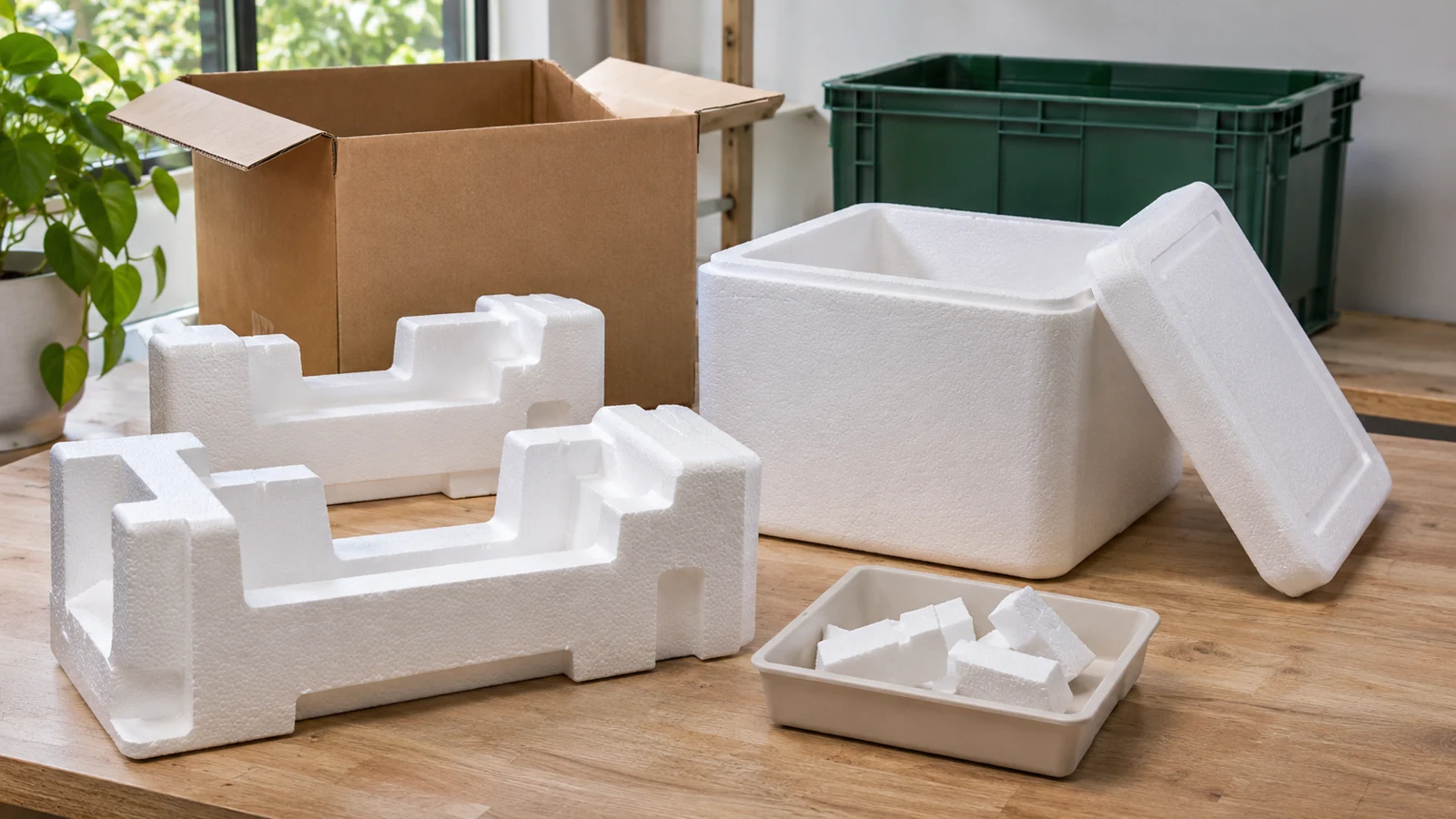
A new appliance arrives safely, but its molded corner blocks fill half the waste cupboard. An online order brings a foam box that looks useful, although nobody knows who will use it. These are ordinary situations in which a recycling logo provides very little practical help. The useful question is what can happen to this particular package, in its present condition, through a service you can actually access. Begin before it is mixed with food waste, tape or unrelated packing materials.
Separate the outer carton, protective foam, loose fill and any other components without deliberately crumbling them. Check whether the supplier needs the original packaging for a planned return or repair shipment. If not, look for the material description and current local instructions. This guide focuses on protective delivery blocks and coolers; insulation removed from buildings or appliances, contaminated laboratory materials and other specialist wastes need their own routes. Sorting an empty delivery box is not an invitation to dismantle equipment or handle unknown residues.
Foam is a structure, not one recycling category
Expanded polystyrene is usually abbreviated EPS. Packaging foam can also be expanded polyethylene or polypropylene, among other materials. King County's foam-block directory explicitly distinguishes these categories. A soft protective sheet and a rigid molded block should therefore not be combined merely because both feel lightweight. Supplier specifications, an existing product marking or confirmation from the receiving operator are more useful than guessing from color. Do not burn, dissolve or otherwise experiment on a sample to identify it.
A resin code is another clue, not an acceptance ticket. The U.S. Environmental Protection Agency explains that the familiar numbered symbol identifies plastic type without guaranteeing local collection. Keep the product format in the conversation: a clean shipping block, an insulated box, loose packing peanuts and a food tray may receive different answers even when their polymer is related. If the material is unmarked, send the collector a photograph and the supplier's description. Until the answer is clear, hold it separately instead of adding it to a verified batch.
Why the ordinary bin and a drop-off program differ
EPA says very few U.S. localities accept polystyrene foam in curbside recycling. Portland gives a concrete municipal example: its ordinary recycling bin excludes polystyrene foam, and its guidance explains that broken pieces scatter and become residue. This is evidence about those systems, not a universal rule for every country. Your own provider's accepted-material list is the decision point. A general statement that plastic can be recycled cannot override the instructions for the service collecting your bin.
Specialist collection may operate with a narrower, separately stored material stream. King County lists options for polystyrene blocks and coolers while excluding packing peanuts from those listed routes. That distinction is entirely compatible with an ordinary-bin rejection. Before using any directory entry, confirm that the operation still accepts your material, your quantity and your customer category. A household scheme may not take commercial loads. Keep a dated note of the answer, especially for repeated business collections, so the team does not rely indefinitely on a screenshot from an old program.
Prevent small pieces from becoming a second problem
Treat containment as part of unpacking. Choose a sheltered work area, keep a suitable container beside the carton and collect loose pieces before opening the next delivery. Do not leave lightweight scraps beside an open loading door or an outdoor drain while deciding where the main blocks should go. Use a container or transport bag that the receiving service allows, close it securely, and check the floor after the delivery area is cleared. This routine is a proposed practical measure, not a claim that every escaped fragment reaches the ocean.
NOAA describes microplastics as plastic pieces smaller than five millimeters and explains that larger debris can fragment into smaller pieces. That supports prevention while pieces remain manageable; it does not tell a business how many particles its receiving area releases. Avoid deliberately crushing foam just to make the cupboard look tidier. Collect accessible fragments without washing them into drainage. If foam is already mixed with an unknown spill or hazardous residue, stop treating it as clean packaging and ask the appropriate waste service for instructions.
Keep packaging only when reuse has a real purpose
An intact insert designed for a particular product can be worth keeping for an expected return or another suitable shipment. Identify that use before allocating permanent storage. Label the package with the product or size it fits, assign a person who can release it, and set a review date. A shop sending repaired products back to customers may have a regular need; a household with no planned shipment may not. Keeping everything indefinitely moves the disposal decision into a cupboard without necessarily avoiding any new material.
Check condition and suitability each time. Do not assume a cracked block still protects a heavy item, or that a box previously used for one purpose is appropriate for food or temperature-sensitive goods. Follow the shipper's packaging requirements and the product's handling instructions. Where a local reuse recipient is interested, agree on the exact material and quantity before delivering it. The useful result is a documented package used again in an appropriate application. A donation offer, collection promise or pile awaiting collection is only an intermediate step.
Ask these questions before a recycling trip
Prepare one short message with a photograph, the material marking if available, the type of package, its condition and your estimated quantity. Ask whether the program accepts this exact item today; whether it serves your address or business; and whether an appointment, fee or minimum amount applies. Then confirm preparation: must labels or tape be removed, are colored pieces allowed, and should material arrive loose or contained? Keep the reply with the collection record. These questions are a proposed checklist rather than a universal set of recycling requirements.
Ask what the service can document after handover. It may be able to confirm receipt and weight while providing only general information about downstream processing. Record those limits honestly. If the scheme rejects the material, ask for the appropriate local disposal option rather than leaving it beside the collection point. Avoid a dedicated long journey without considering alternatives. Kirkland specifically advises residents with small quantities to combine trips or follow its disposal guidance, because transport can outweigh the benefit of a small recovery load. It provides no universal distance threshold.
Prepare to the operator's instructions, not a generic poster
The University of Washington's campus program offers a useful operational example. It separates rigid polystyrene from specified flexible polyethylene foams, requires clean empty material with unwanted components removed, and excludes several other foam and waste categories. Crucially, it does not accept foam brought from off campus. The lesson is the specificity of the receiving agreement, not that readers should travel there. A photograph of an accepted block is more helpful on a workplace sign than a broad instruction to recycle all foam.
Once your operator has confirmed the rules, place the sorting instructions where deliveries are opened. If tape removal is required, do it carefully and capture any fragments. Keep ice packs, liners and straps in their own appropriate routes. Do not wash rejected or contaminated foam in the hope that appearance alone makes it acceptable. Bagging can be required by a special program while being wrong for ordinary mixed recycling; the two instructions must remain separate. Give cleaning or receiving staff enough time and storage space to follow the actual process.
A shared receiving area needs a named handoff
In an apartment building, shop or office, the person who opens a box is often different from the person who moves waste. Walk through that handoff with both people. Decide who identifies reusable inserts, who removes disallowed components and who arranges collection. Place the approved material container where staff can reach it without crossing a busy loading route. Keep storage within the site's access and safety rules, with clear doors and walkways. When the container is full, there should be a known action rather than an expanding overflow pile.
Start with one manageable delivery stream, such as a recurring equipment order. A sign can show the actual accepted foam, the components that belong elsewhere and a contact for uncertainty. Add a simple full-container trigger: notify the named person, close the container and use the agreed temporary holding location. Review rejected loads with the team before ordering another bin. Extra containers will not resolve a mismatch between purchased packaging and the collector's specification. Correct that mismatch at the supplier or collection agreement first.
Ask the supplier to solve the repeated packaging problem
For recurring purchases, send the supplier evidence from a normal delivery: the product, the foam components and the available local waste route. Ask whether the same protection can be achieved with less unnecessary material, a different insert design or packaging returned on an existing delivery journey. Explain the constraint precisely. A request for packaging that your contracted service actually accepts is more actionable than asking for something environmentally friendly. Do not demand a material change while ignoring the conditions needed to protect the product.
A return proposal needs operating details. Who owns the packaging? Which conditions make it eligible for reuse? Who stores it, cleans it if necessary, checks it and pays for transport? What happens to damaged units? Agree on a small trial and a named contact on each side. A reusable transit crate is only a proposal until it circulates reliably. If the supplier cannot offer a return loop, a simpler reduction in unnecessary inserts may still be worth evaluating. Record the change and its limitations instead of announcing a closed loop prematurely.
Test alternatives against the product and the journey
Possible options to discuss with a packaging supplier include better-fitting cartons, revised cushioning, suitable fiber-based inserts or durable transit containers. None is automatically preferable for every product. Compare the whole package and its actual delivery route, including replacement shipments when damage occurs. An insert that works for a small object may be unsuitable for a heavy or delicate one. A material accepted locally at your warehouse may also have no useful route at the customer's address. Those differences belong in the purchase decision.
Treat insulation as a separate performance requirement. Do not remove foam from food, medicine or other temperature-sensitive deliveries simply to reduce a waste count. The responsible supplier must establish that an alternative meets the applicable transport and handling requirements. This guide does not qualify cold-chain packaging. For an ordinary non-sensitive product trial, agree on inspection criteria before dispatch, record damage and packing effort, and ask the receiving team whether disposal instructions were clear. Environmental improvement requires evidence about the actual change; a new material name alone does not establish it.
Measure the foam stream without inventing a recovery rate
EPA's assessment guidance combines records, a walk-through and, where appropriate, a waste sort. Apply that approach to a representative period rather than a delivery-free week or a one-off clearance. Record the supplier, product, package type, material where known, quantity and intended destination. Include receiving staff, who can explain which deliveries create overflow and which inserts are already reused. Use photographs to support identification, while keeping invoices and collection records as the evidence for what was purchased and handed over.
For a small operation, a consistent container count can help plan storage, but it is not a plastic mass measurement. If weighing clean foam, record the scale reading and subtract the empty container's weight, as EPA's waste-sort method describes. Do not compare loosely filled bags with tightly packed ones as if they contained equal amounts. Separate material received, currently stored, reused, collected and rejected. A pickup receipt supports collection; it does not necessarily prove the full load became a new product. Ask for additional processing evidence before making that stronger claim.
Use a comparison that explains the purchasing decision
A practical review can compare foam per similar delivery or per unit of the same product, provided the scope stays consistent. Record changes in order size, product mix or the number of returns so a busy month does not look like a failed reduction effort merely because more goods arrived. Keep estimates distinct from measured weights. If you have only package counts, report package counts. Avoid converting them into kilograms using an assumed foam density or a figure taken from a different product.
Include work and service costs as separate observations: time spent separating components, storage needed, collection charges and any extra journey. EPA's records worksheet includes these kinds of operational costs, but your figures must come from your own records. A proposal that reduces new foam while creating an unmanageable return routine may need redesign. Conversely, a modest reduction that the team sustains can justify expanding a trial. Review the evidence with the buyer and receiving staff before writing the next order specification, because they control different parts of the same flow.
Cautions about recycling claims and home processing
Keep three claims separate: a material can be processed by a suitable facility, a particular service accepts your package, and your batch has actually been processed. A recycling symbol, directory listing or collection receipt answers different parts of that chain. The FTC's Green Guides summary, which is U.S. marketing guidance, emphasizes specific, substantiated environmental claims and clear comparison baselines. Its practical lesson here is to say exactly what changed. Recycled content in a new insert does not demonstrate that its next owner has a collection route.
Do not try to create a recycling process at home by melting foam, adding solvents or burning it. This guide recommends collection through an appropriate operator, not improvised processing. Keep any chemical, biological or other hazardous contamination outside the clean-packaging stream and follow specialist instructions. Likewise, do not describe crumbling foam as biodegrading or assume a compostable claim on a different component applies to the EPS block. If the required evidence is missing, use a narrower description and choose the waste route your local service actually instructs.
A practical first-month checklist
First, identify one recurring delivery and photograph the separate packaging components. Second, confirm material and local acceptance with the supplier and receiving service. Third, create a contained unpacking and storage routine with a named person responsible for handover. Fourth, retain only the pieces that have an agreed suitable reuse, with a review date. Fifth, record the first collection and any rejection. This sequence is an editorial planning checklist, not a certification scheme or a promise that a month will reveal every environmental impact.
Before the next order, propose one feasible improvement and agree how to judge it. That may be fewer unnecessary inserts, a reliable supplier return or better separation of already accepted blocks. Compare the next similar deliveries, check product condition and ask staff what made the process difficult. Keep useful changes and revise those that fail. The immediate goal is an inspectable routine: packaging still protects the product, loose pieces stay contained, and every material has an honest next step. Over time, purchasing decisions should prevent the awkward foam pile from repeatedly returning.
Detailed infographic
Five decisions for an incoming foam package
A practical sequence for protective delivery foam. Follow the actual product instructions and the receiving service's current rules.
- Check Read the marking or ask the supplier what the foam is.
- Reuse Keep serviceable packaging for an agreed suitable next use.
- Prepare Separate components according to the receiving program.
- Route Use confirmed collection or the locally instructed disposal option.
- Reduce Use delivery records to improve the next packaging order.
Action checklist
- Confirm eligibility, quantity limits and preparation before travel.
- Keep foam scraps away from doors, outdoor storage and drains.
- Give reusable stock a purpose, an owner and a review date.
- Record collection separately from verified processing.
- Test any packaging change against the product's protection needs.
Frequently asked questions
Can EPS foam go in my regular recycling bin?
Only if your actual local service explicitly accepts that format. EPA says few U.S. localities accept polystyrene foam curbside. A specialist drop-off or return route can have different rules; confirm the service before using it.
Are all white packing foams the same plastic?
No. Packaging can contain EPS, polyethylene, polypropylene or other foam materials. Check markings or supplier information and ask the receiving program about the exact product. Color alone does not establish acceptance.
Can packing peanuts go with EPS blocks?
Do not assume so. Some collection routes accept blocks and coolers but exclude peanuts. Other programs have separate categories. Ask about loose fill specifically and keep it contained.
Should I keep an insulated delivery box for reuse?
Keep it when there is a specific suitable use and the box remains fit for that use. Follow the product and shipper's requirements, particularly for temperature-sensitive goods. Set a storage limit and review date instead of keeping an indefinite pile.
Is a long drive to recycle a few pieces always worthwhile?
No universal answer or distance threshold applies. Kirkland warns that a special journey with a small load can undermine the environmental benefit. Check nearby options, combine an already planned trip where practical, or follow local managed-disposal guidance.
Does a collection receipt prove my foam was recycled?
It can document handover, quantity or receipt, depending on what it says. Actual processing is a separate claim. Ask what downstream evidence is available and keep public statements within the records you hold.
Sources and further reading
- US EPA guidance on common recyclables and polystyrene foam
- City of Portland: materials excluded from the ordinary recycling bin
- King County: foam block collection options and restrictions
- City of Kirkland: EPS recycling, disposal and transport considerations
- University of Washington: campus foam collection instructions and eligibility
- NOAA microplastics definition
- EPA waste management hierarchy
- EPA instructions on conducting waste assessments
- US EPA: how to conduct a waste records examination (PDF)
- US EPA: how to conduct a facility walk-through (PDF)
- US EPA: how to conduct a waste sort (PDF)
- FTC environmental claims summary